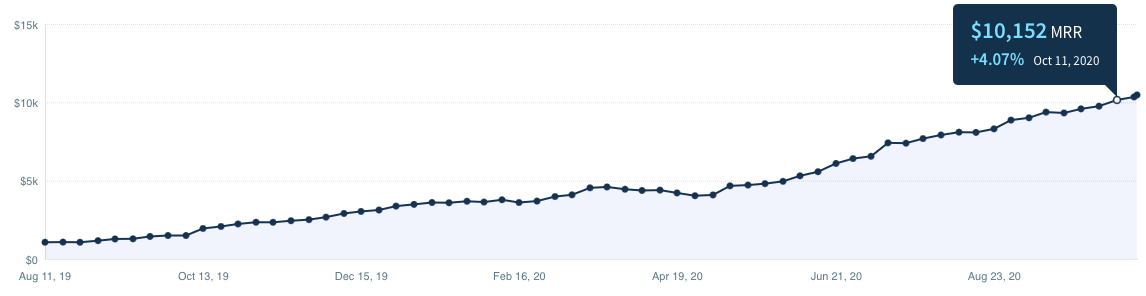
> MAY 2020 - Joining Tinyseed
> And this is precisely why we never decided to raise money. However, a few years ago, [...] An accelerator designed precisely to help people grow their business [...] The money and the support we got from the program helped us grow ScrapingBee into what it is now
Misleading people was never the intent.
We just wanted to share our story and give a little more "human" touch to our about-us page by sharing the journey.
Title was amended.
Have a good week-end HN!
So in essence, if you consider that bootstrapping is building a business without external funding, you're correct.
But to me, bootstrapping VS "VC road" is much more nuanced than this.
Going the VC road forces you to have crazy growth and raise more round because the VC model only works if they fund unicorn 1 time out of 100(0).
TinySeed works even if they fund 8/7 figures businesses, and this was our goal. We had no money when we began (we went through most of our savings during our first venture), no family to raise an angel round and this solution was perfect for us.
The amount of money we got was nothing near what we could have had raising traditional money, but it allowed us to stay independent and grow at our own pace.
"Our standard terms are for 10-12% equity."
The moment you give equity in exchange for money no matter whether its tinyseed or whatever, you are not bootstrapping. Your financial risk is lower because you don't have to pay this money back if your company fails. That is not called bootstrapping.
I bootstrapped with my own money AND some smaller loans which I am fully liable to pay off with a personal guarantee. If my business goes down, I am personally liable. That is bootstrapping.
Instead of contrasting Bootstrap VS Crazy-VC-Mode, it's more suitable to compare two different things. One is if you're bootstrapped or not, and if you're not, are you doing Tiny-VC-Mode or Crazy-VC-Mode? In this case you chose not to be bootstrapped, and are doing the Tiny-VC-Mode.
It's great that going Tiny-VC-Mode allowed you to grow at your speed and still remain independent, much better than the Crazy-VC-Mode usually allows. But if we start calling that "bootstrapped", then where does the line go for what is bootstrapping a business or not. The meaning would have to change from "Without any outside money" to "With a little bit of outside money, but still independent" which says something else.
Edit: Another way to see it: You still bootstrapped the early stages of the company, up until the point where you accepted outside investments. So according to you post, you joined TinySeed in May 2020, which your graph under "Slowly reaching $10k MRR" (https://d33wubrfki0l68.cloudfront.net/e1ea487c1823d29fb55da4...) show to be right around $5K MRR. So what you bootstrapped was up until "$60000 ARR", but after that you were no longer bootstrapped as TinySeed provided capital to you.
There's nothing bad/wrong about how you did it, but it's not bootstrapping. Saying it is makes it confusing for newbies which means they're more likely to be taken advantage of by VCs that realize they can market themselves as a "bootstrapper fund."
With TinySeed's round at "$120k for the first founder, $60k for the second, and $40k for the third" (https://tinyseed.com/program#program-faq) this is very much along those lines.
If one further gatekeeps the label with "but the founders need to invest this personally or it doesn't count..." that restricts the label to a very small segment of privileged individuals. And in a world where there's a (false) narrative of a "bootstrapped or VC backed" binary, that gatekeeping reinforces the notion that less privileged founders have no choice but to go the VC route or do nothing at all. I would hazard a guess that great ideas and great societal impacts have been lost as a result of this framing.
“How we got to $1mm ARR with only a tiny seed round”.
Reading an article and immediately recognizing inconsistencies is an instant turn-off for me, and I assume many other readers. I don’t see what you think you’re gaining by being misleading with the headline.
Once again another thread where no one seems to agree on what constitutes venture capital and what a startup is.
By definition - you took a minority investment. Bootstrapping, colloquially, means you have not funded your company with any equity or capital that could be converted to equity.
btw - you got attention by saying you were bootstrapped and since this is just marketing material then kudos to you for the good marketing.
Sure. But don't try and redefine what bootstrap means.
It means building your company without requiring any professional investors and without modifying your cap table.
You've done neither.
If you'd say "How we grew our business without traditional VCs" that'd be an excellent title. What you describe in your comment here sounds like an interesting alternative approach.
But the way it's introduced looks like an article about how a 25 year old bought their own house, and step 5 is "my parents took the mortgage and I pay them rent."
I went to the "TinySeed.com" website landing page and I do see that they prominently advertise "The First Accelerator Designed for SaaS Bootstrappers".
And then their FAQ page has these example financial terms:
>TinySeed invests $120k for the first founder, $60k for the second, and $40k for the third. Our standard terms are for 10-12% equity. -- from https://tinyseed.com/program#program-faq
Well, if founders accept those terms, they are no longer "bootstrapping" as people generally understand that word. Yes, you may have been bootstrapping right up to the point _before_ taking TinySeed $180k but after that outside capital infusion, "bootstrapping" literally no longer applies. It doesn't seem like any nuance is necessary. It's quite a binary status.
What growth metrics did Tiny look at? Did the investment come at a time when the business was needing to "survive, sustain, or grow"? [every business has all of those phases]
Yes. Yes, we do.
You didn't bootstrap, period.
Also, what a strange hill to die on ...
Maybe I missed this in your post, but did you utilize search advertising? That seems to be the most common and effective tool for short term growth
But to me, being a billionaire VS "a regular dude" is much more nuanced than this.
Being a billionaire is a state of mind.....yadda yadda
When, in the lifecycle of the company, can you sell a small stake of it and still call it bootstrapped? Basecamp sold a bit of equity in 2006 to Bezos[1], and is still considered the epitome of the bootstrapped company.
Additionally, if one has a couple hundred K after working at MANGA or wherever, or has wealthy parents/friends and uses that money to build their own start-up, is that still bootstrapping?
To me, their journey is much closer to bootstrapping, and is quite an impressive achievement. Congrats, guys!
[1]: https://m.signalvnoise.com/the-deal-jeff-bezos-got-on-baseca...
The biggest problem most people have with traditional VC and thus prefer to "bootstrap" is the pressure to grow too fast. TinySeed has none of that pressure. Boostrapping vs VC is a spectrum and Scrapping Bee is clearly on the bootstrapped side of that spectrum.
All the best!
There are thousands of small businesses out there that provide a quality service, and generate good revenue, and pay their founders and employees amazing sums of money.
Love it.
This is a blanket statement and it’s very wrong.
Know better than to look at revenue versus profit. Then again, Silicon Valley seems to have long since given up on that idea!
You recommended Rob Walling’s book, Start Small, Stay Small, but what else can I read?
And where do “indie hackers” like you hang out on the internet, so that i can learn more about how to do this myself?
Any other resources worth sharing?
- IndieHackers (haven't been here in a wild but I definitely recommend the funders interview)
- Microconf
Book:
- From Zero to Sold (Arvid Kahl)
- Hello Startup (Yevgeniy Brikman)
I hope it helps :)
https://www.indiehackers.com coined the term I believe
Exhibit 1: The ScrapingBee terms and conditions state "We assume that you use the Website Platform and Services legally and ethically and that you have obtained permission, if necessary, to use it on the targeted websites and/or other data sources." This is even backed up with an indemnity clause in which the user has to cover ScrapingBee for any third-party legal claim arising out of their use of the product.
Reference: https://www.scrapingbee.com/terms-and-conditions/
Exhibit 2: ScrapingBee explicitly advertises a feature allowing you to get Google search results via an API call. These results are presumably generated by scraping Google's search pages:
Reference: https://www.scrapingbee.com/features/google/
Exhibit 3: Google's own documentation explicitly states that automated querying is prohibited, so if you use this advertised ScrapingBee service, you are naturally violating Google's terms, and could be liable to cover ScrapingBee's legal costs if Google decide to come after them.
Reference: https://developers.google.com/search/docs/advanced/guideline...
$1MM in ARR is all well and good, but there's a limit to how large this business can grow without being pursued by the websites whose scraping they are enabling, and in the case of Google, explicitly promoting.
Scraping by itself shouldn't be illegal per se but not respecting policies and using glorifed bot nets won't help anyone. Scraping costs the hosting person/ company money and/ or resources. For example, the advertised use case of scrapping a job board to create an aggregator for job postings is maybe good from the point of someone searching for a job but a hefty punch to the hosted of the job board that has potentially hefty costs (running the board, moderating, ...) without any gain.
Scrapbee is not helping anyone but themselves and is only challenging the legality of commercial botnetes IMO.
Edit: changed 'public botnet' to 'commercial botnet' in the last sentence
Long live scrappingbee!
I totally agree, the $1 dollar you make online is really special.
I know that, as a computer engineer, it really made us shift our whole mindset about what we do.
We thought all we were able to do was to write code for someone else, we discovered that we could also sell a product and make a living out of it.
We use ScrapingBee's SEO progress as a benchmark of growth.
Also, to the HN crowd, we found out about TinySeed from ScrapingBee, and applied and got in for the next batch. We've grown from ~4k MRR to 16k MRR in 10 months.
So, to anyone who consider apply to YC, I'd recommend to take a look at TinySeed: https://tinyseed.com/
I couldn't find this on your website - does Scrapingbee respect robots.txt directives, or is there any other method for a website owner to limit or even just slow down your scraping?
I've got a good feeling about my latest effort (tryformation.com) where I am the CTO. For the first time, I have a combination of talent around me, a market that is showing actual interest in what we do (and paying us), and a level of control over our product, tech, and road map that means it is really my job to not mess this up. It's still super risky but there's a good chance I can make it work this time. I rebooted the product (rebuilt it from scratch), I've defined our product and vision and took ownership of the product roadmap. And it's working. We are closing deals and getting positive feedback from our early customers. This year is critical for us.
Early revenue is super hard without significant funding. Accepting pizza money from some accelerator helps a little but it's really not about the money usually but about getting some coaching, advice, and building a network around your company of people that can help you. If you are doing SAAS, you need sales people. And not just any people but good ones. A warm introduction can make all the difference you need.
Of course the trick is picking the right accelerator. YC, Techstars (for which I have mentored), and a few others stand out as being awesome. In our case, we actually joined the Bosch Startup Harbour program in Berlin, which helped us build relationships with German industries. Some of those are now becoming customers and a few others might follow. So, good value for us. We did not give away equity and we did not receive a lot in terms of cash. But it helped us a lot.
It's especially relevant today as we're really considering exploring the sales part of SAAS. Until now, everything has been more or less inbound.
Have a great week-end, good job and good luck with your projects!
What happened was a conjecture of 3 things: - better conversion with better success rate and dev experience (doc / SDK etc ...) - revenue extension from existing customers - SEO rising, slowly but surely on article which converted a lot
I'm a bootstrapping founder, have a question about your amazing blog. Love the scrolling table of contents on the left and title/cta that appear on the top as you scroll. Do you mind sharing what cms/theme you use for your blog?
Unless I missed it completely, a suggestion I have for your blog is to have a search feature.
That said, genuinely inspired by your story and grateful for your transparency on how you made it happen. All the best!
Whole blog is built on HUGO with a custom theme.
Here is the add-on used for the ToC:
Not saying I don't believe the numbers, would just love to understand the makeup of your client base.
This new look for your website is also great. What front end framework + back end stack are you using?
Back: Python + Postgres + Flask + redis
Front: JS vanilla + a bit of Svelte
Q: Does ScrapingBee differ to Browserless.io? Or do they do the same thing? I've been out of the scraping scene for years (BeautifulSoup was new when I was doing it).
Browserless allows have a fleet of Chrome in the cloud that you can use to run some browsing scenario.
ScrapingBee is an API allowing to get the HTML of webpages by optionally rendering them inside a real browser, but also managing proxies, data extraction and JS scenario.
Let's say we're cousins ;)
Yes, TinySeed mattered a lot.
Ravi de voir que même sur HN on sait apprécier les belles villes!
Si tu jamais tu as des questions, surtout n'hésite pas a me contacter, je suis souvent sur Twitter (Pierre de Wulf).
Et sinon bon courage et bonne chance pour ton projet!
PS: qu'est que toi ou tes collègues font dans leur travail de tout les jours que tu n'aimerais plus faire ou plus facilement? Maintenir un cahier / ficher de toutes les tâches que tu n'aimes pas ou que tu trouves redondante peut être un bon début pour la step 0.
Sinon il se dit aussi beaucoup que partout ou dans une entreprise il y a un excel a maintenir, ou des fichiers a s'envoyer régulièrement, il y a un SaaS qui attend d'être monté ;)
Echo Chambers echo.
As an aside, I'm curious if anyone has thought through the ethics of scraping through rotating proxies. Clearly the scraped website doesn't want mass scraping to occur, hence the need for proxies in the first place. What are the strong arguments in favor or against this?
I'm really curious to know what happened between $10k MRR and $1mn ARR. That growth happened in a span of 1 year which is just amazing.
Any pointers for others who are at a similar phase of their business looking to grow from 10k->83k MRR in a short span?