Millennials have been out there for nearly a decade yelling on social media about how ridiculous their student loans are. Kids on the precipice of college have started paying attention. Combine that with the restrictions for Covid, and you have a lot of kids who don't think that taking on tens of thousands (if not hundreds of thousands) of dollars in debt is worth it for some Zoom classes.
It's a single anecdote, but between online resources and alternative training programs, it seems harder to justify spending tens of thousands of dollars on college.

I learned more practical skills from free online classes and tutorials than I did from my entire university program, and I can think of maybe a handful of times I've thought about complexity analysis. But I've also entirely avoided whiteboard interviews, so perhaps myself and prospective employers have selected for my weakness in academic computer science concepts.
Out of interest, what are other fields besides IT?
The evidence suggests that bootcamp grads struggle at finding good jobs, and also bootcamps charge a lot up-front, whereas collages have more aid and other programs to defer payment.
It’s not a panacea, but it’s a decent option when compared to going to college for 4 years, going tens of thousands of dollars into debt, all to get an education with a lot of material that is fairly irrelevant to a career, while not having much better job prospects, particularly after getting the first job in the field.
While I agree with your core sentiment, my opinion is that this is a symptom of a cultural/societal problem and not one of the schools. Modern Universities are certainly ripe with problems (largely driven by adopting business structures), including generally poor quality courses and curriculum within them, but I think you've identified a larger societal problem we have.
Why is it that broad education which is generally, at the very least in my opinion, clearly valuable yet so lowly valued in society? It's my opinion that we have institutional structures that, given a lack of opportunities, value specialized and specific knowledge over general knowledge.
Meanwhile, if you have the capability to escape these institutional shackles, general knowledge becomes far more valuable. On the labor side, labor markets are all about jobs and specialized roles with efficient production from that role. On the capital side, you need more general knowledge to see, connect, and sieze opportunities. It seems to me that most lack enough genuine realizable opportunity where general knowledge becomes valuable (say, seeking entrepreneurship) and in such a set of constraints, it makes complete sense why people specialize and chase demand of specialization because it's their most optimal strategy for financial success.
I work in R&D in startup-esk environments and my general knowledge is fairly well valued, however even here leadership sometimes fail to see how some book or article I read years ago, course I took, project I worked on years ago, etc. was critical to making the connection that made this research thing possible.
They value the general subset of knowledge I have that made their thing possible (oh boy you know A, B, and C and those saved us!!!), never mind the hydrology work I've done, it's irrelevant (D, or so they think, even though I may draw on concepts from such domains opaquely) or perhaps hours of video gaming (E, which lead to a game theoretic intuition about approaching an underlying problem). That knowledge was only appreciated after the fact because it made someone a pile of money or positioned a large contract.
I remember hating taking geology in college because "I'd never use it," then I did a lot of applied science and R&D in the fossil fuels industry and suddenly a lot of "silly" things I did in geology gave me a foundation to jump from and to build upon. That silly geology course made me boatloads of money in retrospect. Throughout my career I always like to look back when I have a problem and say "ah ha, I sure am glad I studied or read about X years ago, that's one less thing I need to internalize now to do this thing." I'm always surprised how much old general knowledge I draw upon for new problems and how valuable they truly are.
When I was in high school and applying to colleges around 2011, the advice given to us was to not take cost too seriously. Many authority figures (like high school counselors) told my peers and I to, "follow your heart" or "go where you think you'll fit in best".
On top of that, student loans and interest rates where not explained to us very well. Very few of us understood that borrowing 160k-200k to go to an out-of-state/private school could very well mean you were signing up for a lifelong debt.
Looking back, its insane we could make such a life altering/hindering decision with so little oversight from the "adults".
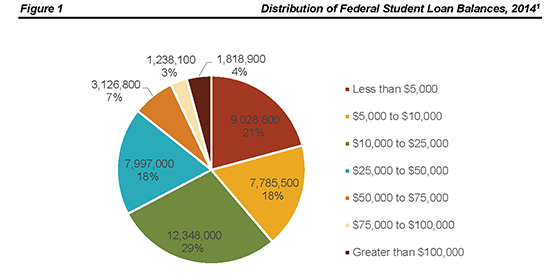
85% of graduates have less than $50,000 in student loans. Paid off over 20 years, that’s really not much. https://www.rclco.com/wp-content/uploads/advisory-student-de...
Additionally, those that have much higher loans are usually medical students who make $200,000/year at the entry level.
Meanwhile my wife only makes an appreciable dent in hers whenever she gets a gift from family members, and she's still paying $900 a month to not do much more than tread water. She did get it paid down a bit more thanks to the past two years of deferrals, but she still owes a lot more than I ever borrowed (two years of my school were paid for by a scholarship).
It's been a steady drag on our income since we've been together. At least mine is just about to go away, mine was $400/month as well... that $1300/month is almost as much as our mortgage payment.
I have multiple friends that have just given up on ever paying off their student loan debt in their lifetime and only pay enough to keep it where it is (or slowly increasing even). You wonder why people aren't buying homes and having children, there it is. I guess the solution to overpopulation is just saddle everyone with a bunch of debt, then.
> 85% of graduates have less than $50,000 in student loans. Paid off over 20 years, that’s really not much.
It is pretty terrifying that you manage to mentally justify going in debt for 20 years over your college education. I understand that given a good job it's easy to pay it back, but I never even borrowed even a tenth of that to complete my engineering degree and I've probably paid my education back several time in taxes to the government.
One of those people can pay that loan off in two years. One of them is likely never going to pay it off without a career change.
Of course, we probably don't want loan officers picking what poor people can major in either.
I would not say that people should be denied based on their chosen major, but prospective students should be shown statistics on the average salaries, unemployment, and usage rates of the major they're interested in and compare it to the projected costs and resulting loan debt.
Plus, you're right that the interest rate is insane when banks are paying 1%.
Yeah, but you are assuming people only go to college for its educational value , ignoring that college grads tend to have much higher wages and lower unemployment compared to high school grads. If you look at FIRE subs for example, almost everyone who attains early retirement has a degree. The college wage premium is amplified by both higher wages and higher returns from investments by investing said wages in rapidly appreciating stocks and real estate (the post-2009 bull market in real estate and stocks, on an real basis, exceeds even the '80s and '90s).
It could be that people who are driven or passionate, on average, want to pursue higher education, or that they take on risks, exercise their brains in learning endeavors, and it’s their effort and drive that leads to success.
It’s entirely possible that high earners have college degrees because they were told that to be successful, they had to go to college. It’s a belief they were raised with.
I think it’s highly misguided that we give college so much credit. And we also demonstrate survivorship bias where those who went to college but didn’t get the pay off are blamed for having made some wrong decision.
We treat higher education as a silver bullet and put it on a pedestal when it’s not.
Also if companies gain a substantial advantage using other signals outside of degrees, you can be guaranteed that their competitors in their industry will follow. In media and marketing, degrees have long been abandoned for other signals such as portfolios and social media engagement
> Yeah, but you are assuming people only go to college for its educational value , ...
But that's exactly the point, a huge expectation of going to college is the whole college experience: building independence, lifelong friendships, extracurriculars, etc. 50k for Zoom? Fuck that.
Children literally taking out 5 and 6 figure loans for a glorified multi-year vacation with some half arsed “education” strapped to it.
I finally paid mine and my wife’s off in 2020 and when I did the math, combined we paid $216k over 7 years post college. We were both lucky enough to have well paying jobs, but so so many people don’t. Some of these people even with decent jobs will be paying $500-$1000/m for nearly the rest of their lives.