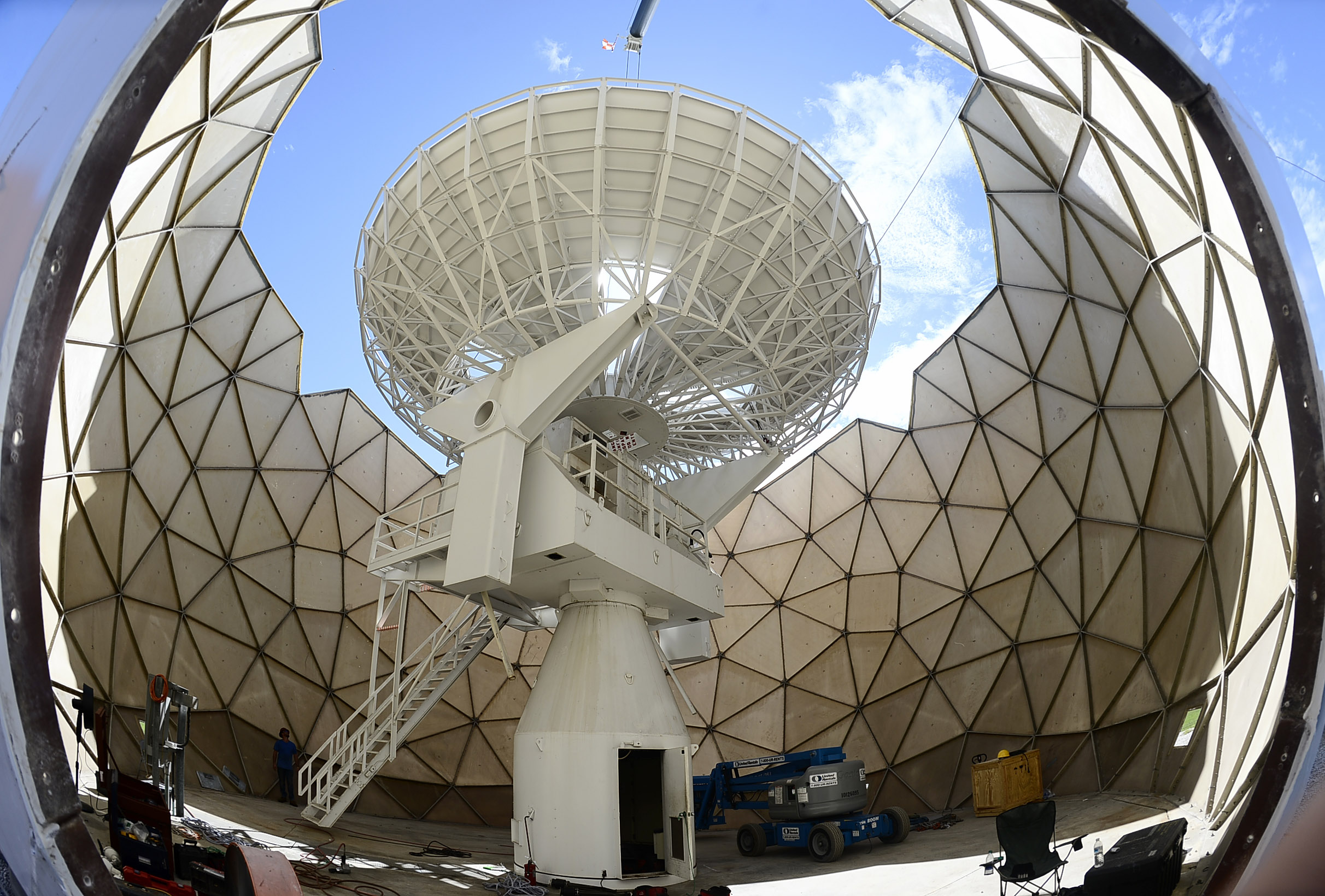
So another way to find out where a satellite is pointing would be to detect the transmissions its receiving or "landing" right?
So then the military wouldnt need these radomes as anyone near by could detect the overlapping footprint of the signal hitting the ground, unless its no more accurate than using something we can find in mediaportal to work out signal strength and quality. [1]
So then the ground could detect where the satellite is, which renders the use of the radomes somewhat unnecessary.
And then there is the fact Space has its own jurisdiction.
Now I do know HP were working as a Mil contractor in the 90's developing line of sight laser communication for the battlefield namely because it used the property of light to highlight eavesdropping, whether that has developed enough to be an uplink to satellites I dont know, but that is a lot harder to detect for obvious reasons and then the law would seem to be rather ineffective if light is being used to land signals sometime in the future. Anyway off topic so no more from me on this deviation.
[1] https://media.defense.gov/2016/Sep/16/2001635620/-1/-1/0/160... [2] https://www.team-mediaportal.com/wiki/display/MediaPortal1/S...
Antenna operators build radomes because they provide resistance to weather and other sources of environmental damage (birds are a big one). The spheroid/polyhedron "golf ball" shape is mostly used on large antennas because it's a structurally strong shape for the weight. It's also volume efficient for circular & spherical antennas, and handles rotating elements well.
Also, it's impossible to hide a satellite in space. Every nation with a space program tracks every orbiting object that's even remotely big enough to be a functional artificial satellite. It's mostly radar, but also visible light, IR, and UV cameras. There are no "stealth" satellites, mostly because you can't hide a launch... And once you know about the existence of a satellite, it's trivial to track it indefinitely. Civilian satellite spotters even do this with military satellites.
The only important thing you can keep somewhat secret about an orbiting satellite is it's specific capabilities. We don't know exactly what kind of telescopes or radar are deployed on Russian spy satellites, and they don't know the exact details of American equipment... But it's not even that hard for ground observers to guess at a satellite's likely mission and general capabilities, based on its orbit, visible structure, etc.
The parent comment's terminology is kinda strange, but that might just be a non-native English speaker... I'm more focused on the fact that their two "endnotes" in the parent post are just images, they don't actually cite any useful information.
>Also, it's impossible to hide a satellite in space. Every nation with a space program tracks every orbiting object that's even remotely big enough to be a functional artificial satellite. There are no "stealth" satellites, mostly because you can't hide a launch...
This isn't entirely true. First, satellites absolutely and do maneuver after launch, so they are not limited purely by the orbit they launch into. That is of course limited by how much propellant they carry onboard, but it is done (and for spy sats particularly). Second and more generally, for any object in space it's impossible to have persistent [0] omnidirectional stealth across all bands (due to thermodynamics). However, it's very much possible to have single band stealth (a shape that is radar stealth for example) as well as unidirectional multiband stealth, and because space is so big often that may be enough for a given scenario. For spy satellites in HEO they may as well be presenting a single side all the time to any Earth-based observers, and while some nations could react to that by launching tracking sats even farther the vast majority of actors (anyone on the level of ground-based amateur astronomers for sure) lack that capability. Transmission out can use the same idea, in space P2P laser links are generally invisible out of path, so a stealth sat could stealthily have comms to a non-stealth relay even further out.
As a practical matter right now it seems extremely doubtful any serious such systems are in place due to the huge hit on mission-effective mass which gets worse at distance, though it wouldn't be surprising if there have been some experiments at least. But with launch systems like Starship and enormously more mass to throw at problems, we may well see a certain number of much more serious stealth spy platforms eventually.
----
0: In principle one could achieve perfect EM stealth temporarily by carrying onboard empty volume, a heat and a cold source (like a whole lot of liquid helium/nitrogen) then running as a closed system performing thermodynamic work averaging those out. Could run for some fixed period of time until the useful differential was exhausted and only be observable by interaction with mass in space or gravity. But who knows if that'll ever actually get utilized, since the unidirectional concept can be extended by an advanced space faring organization too. One can keep going farther and farther away from a target and compensate with a larger aperture with enough space capacity. If we imagine some aliens or something with an Earth observing stealth platform out in the Oort cloud say, it could be a kilometer across and very hot on the extrasolar facing side yet still damn near impossible for us to notice. Or of course someone could hide in the thermal noise of other sources. Interesting to speculate about from a hard scifi perspective anyway.
I'm unconvinced of that. Classified satellites are routinely tracked and sometimes even photographed by amateur astronomers; surely the peer competitors of governments can do better. I suspect these domes are primarily intended to conceal which satellite is being talked to.
It was one of the only places in the service area (most of the world, minus near the poles) that I know of that Inmarsat blocked out service.
(There was a way to override the GPS on the terminal to make it report to the network that you were somewhere else, but we tried not to tell customers about that - or Inmarsat obviously!)
StarLink is not licenced for use in India yet, but do you think the US mil or any other Nato mil will want some control over military coup's like when the military rolled into (Burma) Myanmar earlier this year and the internet was shut down? Not the only country to shutdown the internet or censor it when thinking about the Great Firewall of China either. https://www.bbc.co.uk/news/world-asia-55901774 https://en.wikipedia.org/wiki/Internet_in_Myanmar#Re-censors...
But I'm not sure how big the cells are. It could be that they are as big as to cover most of India? Doubt it though.
But yeah it would be great if we had a truly independent internet provider for an affordable price.
And if Starlink did start broadcasting in Indian airwaves without a permit (not really possible since they’d need a ground station but assume they place some ground stations around India’s borders), it would be a good opportunity for India to test its anti satellite weaponry.
> Reuters states that since Starlink officially registered its business in India on November 1st, it has already seen over 5,000 preorders in the country [0]
That's from The Verge's article a few days ago.
> And if Starlink did start broadcasting in Indian airwaves without a permit (not really possible since they’d need a ground station but assume they place some ground stations around India’s borders)
They don't need to. It could just as easily operate from across the border, the ground station I'm connected to is in Canada even though I live in the United States.
> it would be a good opportunity for India to test its anti satellite weaponry.
Maybe if they had a geostationary satellite, sure. Starlink is a LEO constellation though, so if they took down a satellite this weekend, SpaceX would launch 60 more by next Saturday (and service wouldn't be interrupted since there's considerable redundancy built into the system). Unless India intends to take out a few hundred satellites and be responsible for potentially catastrophic space debris, I think it wouldn't be a good opportunity for them to test their anti-satellite weaponry.
[0] https://www.theverge.com/2021/11/27/22804830/starlink-india-...
As to the economics of anti-satellite warfare, you only have to destroy a small number of satellites to create a gap in coverage that will periodically sweep across the whole globe.