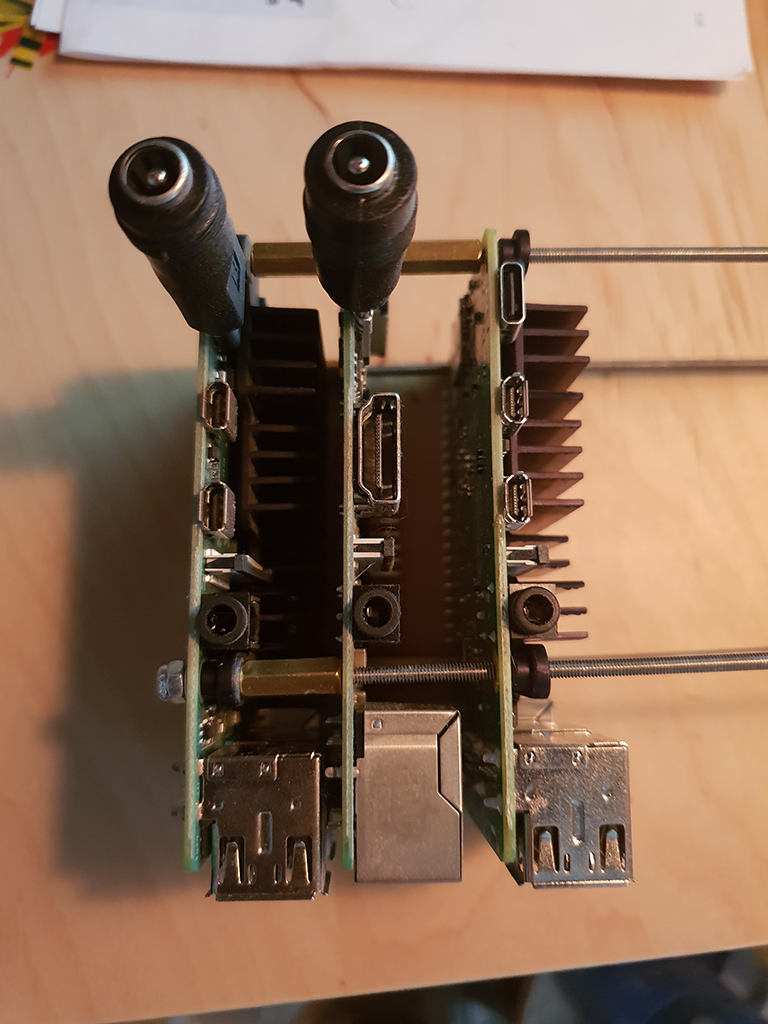
It's certainly not for the compute. Isn't the point of a Raspberry Pi controlling periphery on the edge? But that's not possible here?
???
It's not even needing ARM cores, as those are now cheaply offered by all the cloud computing companies.
Is it just for some cheap fun? But if I'm going to host something on cheap amateur grade hardware, why would I not also just use my home connection? Is this for the experience and education?
... I really don't see what it's good for (explanations welcome).
It didn't make much sense from a professional syadmin's perspective. But for a Mac user who already had their little project on a Mini and wanted to get it off their home bandwidth, it made sense to them in that it was one simple, incremental change. I imagine the market here is similar.
Edit: Ah, misread the article. Alright, then what you did was indeed pretty similar.
*Or really just shared hosting w/ containers running Raspbian on standard server hardware with a nice onboarding workflow for migrating from a real Pi would likely be sufficient for most people's use-cases—if you're not using peripherals I imagine you don't have any need for the real time OS features?
It may not work if you're running a tor node, depending on how cloudfront deals with them, but it does work for mostly-reliable dns resolution on a non-static, residential isp connection.
Not negating the project, just offering an alternative for people that want a static ip without renting vps/metal and without the isp static upcharge.
For this service you pay ~6€ per month (assuming 50€ for the Pi and two years of runtime, no SSD) for a rather powerful VM. Just as a comparison, at Linode, you get 1 shared CPU and 1G of RAM for roughly the same price, compared to 4 core and 4-8 gigs with the Pi. Storage is even more expensive, so if you attach a large SSD, the calculation becomes even better (but the 10Mbit might become a bottleneck quickly).
I wonder how they would feel if you add your custom electronics to the Pi's GPIO connector.
I’d like to see the same thing but with a Mac mini.
GPIO: Currently there are no plans for this yet. It is not possible at the moment, we point this out during checkout and on the colocation administration page. However, we think nothing is impossible. If you have a use case, feel free to write me at colocation@examesh.de ;)
Because that was my first reaction and thought it was a joke, like real, but done out of jest
Similar to how an engineer put a string concatenation function on a networked compute instance, NPM and released it on docker
It also means the colo is running whatever random power supply I send them, which seems like something they’d want to avoid and means that there’s all the inefficiency of 12 supplies per U rather than one beefy +5.1V supply (with battery backing) feeding the Pis via the GPIO pins.
Plus, they actually serve the Raspberry Pi foundation website and the raspian images /from Raspberry Pis/ so they know what they are doing.
I have also read all the other comments on this subject: Yes, currently each Pi runs with its own power supply.
Currently, our team is developing a dedicated power supply for all Pi slots within the rack. Then it will also be possible for users to turn the power on and off via the colocation dashboard. However, the development will still take a little time. The reason for this is that some components are not immediately available and especially not in large quantities. See analogously the availability of Pis.
One massive thing that seems to be missing here (unless I've missed it) is any kind of remote ability to manage the server, eg at a minimum remote power cycling, if the Pi locks up. It would also be nice to get remote console but that would require even more effort and potentially slight customization on the Pis' boot config (to enable UART).
I am not a fan of the lottery approach and being told you're lucky to do business with them.
First you have a limit of 1 stardust per datacenter per customer. Second, they only spin up a fixed number of new stardust servers per day.
It is a loss leader just like in any other business. They are losing money on one instance to get you in the door and you realize their other services are awesome.
For anything that is supposed to be visible on the internet, I'd always use a hosted server - if nothing else, because I really don't want to open an ingress into my personal home network, even if my ISP permitted that.
For use-cases were you have to handle certain incoming requests even though your setup is mostly LAN-only otherwise (webhooks, ACME, adding some dashboard you can access from your phone...), services like PageKite[1] sound promising.
Not unlimited data though. But I'll keep them on my list, thanks
From a pure compute-per-watt perspective using typical cloud workloads, I’d still expect a run of the mill shared cloud server to be more efficient. It would also allow for more burst overhead for individual workloads.
This is an interesting option for people who need a specific Raspberry Pi hosted somewhere.
What is that use case though? The page says that they only host regular Pis and optionally a USB SSD. So they can't do anything that a regular cloud server can't do - no custom hats, etc.
I have a Pi 4 home server, and the biggest issue right now is that my home upload is a bit weak for remote video streaming. So this product could interest me, in theory - saves me from having to migrate all my data & configuration to a cloud server. But I would rather pay Hetzner a very similar amount of money to get a VPS that's about as powerful as a Pi (probably more) and still have the physical Pi here at home as a fallback.
Maybe there are ARM-specialized, highly distributed tasks for which a fleet of Pis is particularly efficient?
"To ensure that every Pi at our decentralized locations always has enough network throughput, the uplink and downlink is fixed at 10 Mbps."
Not sure about your use case, but for me that is way less bandwidth than I have at home.
Scaleway will give you an 8 core 16GB RAM 256GB SSD M1 Mac Mini for €0.1/h. It may not sound like much of an increase from core count but it is ~10x faster for multicore which means it probably comes out on top for perf/€, perf/Watt, and total perf compared to a rack of Pi 4's for any such distributed ARM use case.
For pure traditional cloud a Graviton2 instance on AWS is probably more green, albeit probably less cost efficient to the user.
"Green", now removed from the title, but still on the landingpage refers to the power used by our data center. Our data centers operate inside wind & solar parks, therefor we only use green energy. If there is no wind or sun we directly purchase green energy. Of course every DC is connected to the public grid for continuous operation.
What x86 chip can idle on 4W when including RAM and the mainboard?
I have some very low power J1900 boards, but even they idle on ~10W.
Just trying to grok a legit use case?
The Pentium G6400 outperforms a Pi4 4-5x, and has a 54W TDP (onboard GPU so at least part of that is for the GPU, so CPU-only workloads will be less.) The Ryzen 5600x is 65W and is twice as fast (at least) as the G6400...so in theory a 5600x is twice as energy efficient as a Pi4 if fully loaded. Sure this doesn't account for system fans and the motherboard, but they don't use that much compared to the CPU.
The whole point of virtualization is that most systems are idle a lot of the time. At datacenter scale virtualization, you can dramatically over-provision and shut down/sleep unnecessary nodes, firing them up when you need to. You can get near 100% utilization on your hardware, making the very most of every watt that doesn't go to actually computing.
Here they're going to have a zillion Pi4's, most of them sitting idle, but still using a couple watts. They're not even bothering to use any sort of shared power to improve PSU efficiency. They're not even bothering to use Pi4 compute modules.
Now, the interesting bit is that now there's the Pi Zero Wireless 2. It has nearly the compute power of the 3B+, but the highest energy efficiency per watt of any Pi board so far...
That's more energy efficient, sure. But it sets a lower boundary on the power draw much higher than a normal Pi. A Pi plus a single external HDD draws 12W at the socket, according to my measurements. A PC CPU draws 4-5x that, just by itself. The other components on the motherboard need power too, even if you use integrated graphics or no graphics at all.
A PC only becomes more power-efficient if your load can't fit in three or more Pis. For plenty of uses, more than two Pis are an overkill.
You can use dropbear to ssh into the Pi and provide the key during boot.
You can have the Pi connect to a remote system to retrieve the key.
Some methods are obviously not perfect, but it'll definitely make it more complicated than just "copy the card." Remote key retrieval would let you audit when the system was booted and so on.
There's a more complex purpose-built open source software package specifically for handling remote disk unlocks but I'm blanking on the name and my google searches aren't turning it up. I vaguely recall it had fairly high levels of paranoia in its design.
Encryption of your data is the key here.
I had two gen 1.5 machines hosted with them; one with OwnCloud, and another hosted my music via SFTP.
I had "free" colocations in Sweden and Holland that then turned not free then got cancelled altogether.
Pi clusters are best for home hosting on your own fiber.
Also those Pi 4 need heatsinks like so: http://move.rupy.se/file/final_pi_2_4_hybrid.png
They're not offering it any more, no.
I moved to self-hosting after that. Even got a static IP address for it.
> It's 2021. We don't have a traffic limit for a Raspberry Pi.
> What is the data transfer rate?
> The data rate is synchronously set to 10 Mbit/s per Raspberry.
It's 2021, and you think 10 Mbit/s is enough.
I mean, not to disagree here, but that's pretty much the average internet speed in some third world countries, like Austria for example. :)
Installing the server anywhere else means there is a chance that its power is being generated by that wind turbine!
It seems a little silly to worry about where the specific electrons came from to power the equipment, though. If powering that equipment enables a wind turbine to produce more power than it would have without that equipment, then it seems like the existence of that equipment is "green" whether or not its power came from dirtier sources.
The power needed onsite (lights, control systems, energy to start the blades spinning, etc) usually comes from a natural gas generator or a direct feed from a fossil fuel plant if one is nearby. Due to circular dependencies, you can't power them off the energy they generate.
I saw this and thought “can I use kube sail and host stuff in a mini cloud?”
"Instead of using a public IP the Pi is accessed by combining a public hostname with dedicated TCP ports. The hostname points to one of the ExaMesh gateways and is assigned to the colocation along with the available TCP ports in the booking process."
So maybe useful for an extra node for redundency, but maybe not as useful as having an actual address. Perhaps an extra encrypted Syncthing node or something
However, we would have definitely pursued an overlap/commonality of the word with, say, beer!
Ok, thx, I have a 100/10 Mpbs link at home. The only reason I'd place my Pi in a colo is to get 100/100 Mpbs or 1 Gbit network.
Edit: https://contabo.com/en/vps/ (200Mpbs in the cheapest plan) or https://www.seedhost.eu/ (1/10G) is not too far from the €6,- price mark and I don't have to own the hardware.
At least I can have more confidence that the storage won't spontaneously fail, and network throughput greater than 10 Mbps.
This seems like a cool idea and all and it's certainly cheap for hobby projects. But I wonder how viable it really is as a business model. Doing the math on person-hour costs if just one pi requires 15 minutes of support/human attention from a person at the ISP, once, you're losing money on that customer forever.
10Mbps is also excruciatingly slow. I was ready to see a 100Mbps cap.
Pi co-lo for just four bucks a month sounded great until the fine print was revealed...
(Look at their cad drawing of 12 pis in a rack.)