With positive airflow around possible leaks, sufficient H2 to sustain a flame can be prevented. In a collision, gas released goes up and out of trouble.
Except for the cases when there's an open flame nearby or sufficient heat, as is the case in a non-insignificant number of collisions. What if a hydrogen engine collides with a standard petrol engine? Or if the gas becomes exposed to hot surfaces during the oxygen mixing? The gas expansion is also a major cause of explosion. You essentially pull oxygen into the fuel, and rapid fuel-air mixing is a known cause of detonation.
Well, ignoring one of the largest hydrogen explosions in History which occurred in the open air under the exact circumstances you say are impossible: https://en.wikipedia.org/wiki/Hindenburg_disaster. You mention earlier that this is not the hydrogen, and instead just the fabric. That's been debunked repeatedly: https://www.airships.net/hindenburg/disaster/myths/#hydrogen...
You also mention nobody died in the fire as a result of the hydrogen, which is also debunked: https://www.airships.net/hindenburg/disaster/myths/#hydrogen
"This is probably the most absurd myth about the Hindenburg disaster, yet it is frequently promoted by hydrogen fuel advocates."
In addition, hydrogen tanks are not just sitting there in a vacuum. In order for the hydrogen to "leap skyward", you have to have it, again like I said earlier, not come in contact with anything that will induce combustion. Also, you need a perfectly open environment. Your point about the mixture being above 75% just shows a somewhat naïve understanding of the physical chemistry at play here. All it takes is for an area near the fuel supply to hit the right fuel-air mixture ratio, which leads to combustion, as in common elementary school science experiments (the hydrogen 'pop' demo). This event leads to a pulling in of the air and fuel around it, sustaining the exposition.
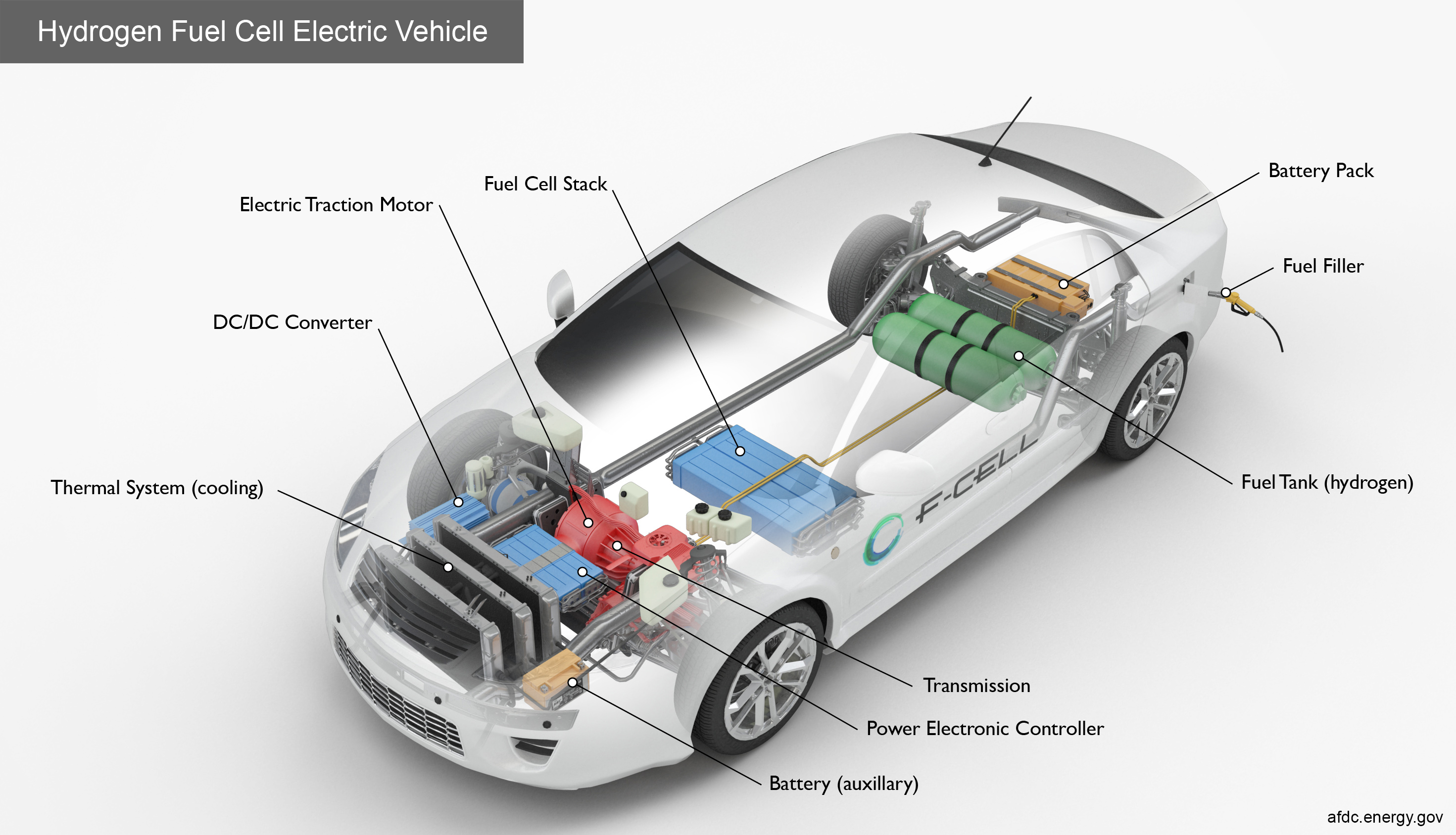
Hydrogen cars have the tanks contained within a sealed environment towards the rear of the car: https://afdc.energy.gov/files/vehicles/hydrogen-high-res.jpg
The problem is that hydrogen is a very small molecule and readily escapes containment. It can even travel along grain boundaries through solid metal.
"Traveling along grain boundaries" can only leak trace amounts. With, as I said, positive airflow, trace leaks can be constantly diluted below the concentration where ignition is possible.