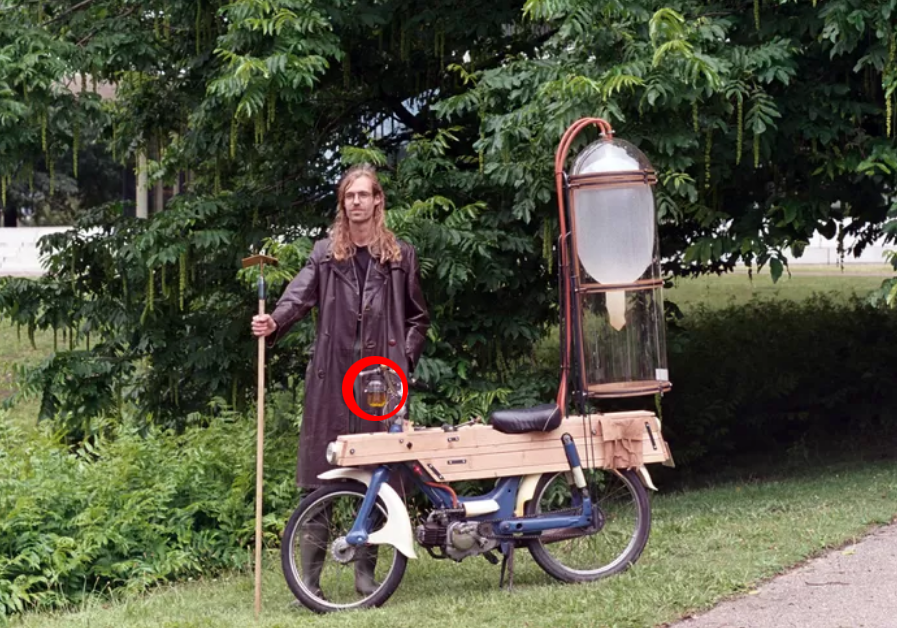
Hmm, this is an art project but you can cycle 20km fairly leisurely in an hour.
8 hours of toiling in the ditches probably might be better used growing vegetables so your food isn’t being driven in?
OF COURSE there's more efficient ways to get around, this isn't an attack on anyone's intellect or common sense and there's no need to react to getting nerdsniped by going "well ackchyually" and reinventing combustion engines and fuel from first principles.
It's fine to just go "that's cool" and move on with your life. The guy that made this knows it's not the most efficient use of his time.
I almost feel like we need a "Show HN an Art Project:"-like headline prefix.
If you ask me, these are more impressive/interesting technical feats, but with real world applicability and usefulness.
I cannot cycle 20km fairly leisurely in an hour: I live in a mountainous area, but lived most of my life on flat ground and going uphill is freaking difficult, even if I'm going at a leisurely speed - and sometimes, downhill is brakes all the way down.
And I don't know how much this person drives. Most places I go to are within walking distance, and I'm pretty sure 8 hours of ditches would be less work than an entire summer of gardening (where I'd have to rent a plot, since I'm an apartment dweller). The majority of my foodstuffs are going to still be driven in, too.
Not a good counter argument. In this case, the moped will also use more fuel.
The trick is to grow for value and flavour, not staples/calories. Probably still a terrible $ yield.
Nonetheless, I think the 1 abused apple tree is going give me months of apples.
https://www.motherearthnews.com/renewable-energy/other-renew...
I was very keen on the idea of making my own biogas (for cooking) when starting out in my self-sufficiency efforts some >25y ago, and the entire sewage system is designed to make conversion to biogas production easy, but the reality is it's just not ever going to produce any significant quantity of methane without some serious supplementation. Add to that, biogas digesters slow down significantly in Winter, even here where we never get freezing temps. In places that experience serious Winters you need to figure out ways to heat(!) the digester to keep it working lest the raw material inputs back up and cause... a mess that will thaw in Springtime with (cough) challenging results.
Most of the cooking and some of the lighting for the house was done using this thing. Most of the bigger houses in the village had one.
Methane itself is a very potent greenhouse gas. Everything you do with methane is only environmentally friendly if you have a very low leakage rate. Whatever homegrown DIY biogas facility you're creating very likely does not do that.
To a rough first approximation based on food intake, biomass is the residual of undigested food caloric energy in the waste stream, which I believe runs at about 25% of the input calories.
You can estimate this for a population by taking roughly 2,000 kilocalories/day * population * 0.25. Ignoring any collection or processing losses, for the US this translates to about 700,000 GJ, 110,000 barreloil, or 200 GWh electricity (assuming no generation or transmission losses, in actuality about 1/3 this amount).
Actual US energy consumption is closer to 45 million barreloil day (equivalent, only 18.3 million barrels of actual oil), or roughly 400 times the maximum amount of energy available in food waste.
There may be other biomass wastestreams available (say: the input feedstock for livestock, pork, dairy, and poultry), though this won't add up to the 400-fold increase necessary as typically the trophic loss is about 10x in a given foodchain level. Even were all US food consumption in the form of animal products, the wastestream would be 40x short of present energy consumption levels.
It's not clear if the artist here is aware of what they're demonstrating, but the process of methane harvesting employed is not dissimilar to how fossil fuels formed in the first place, with biomass settling to the bottoms of shallow seas and, over the course of hundreds of millions of years, being transformed to petroleum and natural gas.
We're presently consuming that bounty at roughly 5 million times its rate of formation. The fact that it takes 8 hours to produce fuel sufficient for 20km of travel is actually millions of times more efficient than the net energy cost of fossil fuels.
Jeffrey S. Dukes, "Burning Buried Sunshine" (2003) details this with exquisite clarity.
https://www-legacy.dge.carnegiescience.edu/DGE/Dukes/Dukes_C...
Anaerobic digestion of food and green waste yields ~0.22 toe/tonne of biogas, and manure yields up to 0.04 toe/tonne [1]. (toe = tonnes of oil equivalent)
Australia wastes 300 kg/year/capita of food [2] (across the entire supply chain, from farm through fork)
Americans generate 90 kg/year/capita of yard waste [3]
That's 1.07 kg/day, for 0.24 kg of oil equiv.
The average adult produces ~0.4 kg/day of manure [4], for 0.02 kg of oil equiv.
All up that's 0.26 kgoe/day, or 0.3 L [5] of petrol.
The most efficient scooter I could find (Honda Activa-i) does around 70 km/L (165 mpg)
So optimistically, you could generate 21 moped kilometers per day of biogas. In more normal units, that 3 kW/h or 11 MJ.
[1] https://www.iea.org/reports/outlook-for-biogas-and-biomethan...
[2] https://www.environment.gov.au/protection/waste/food-waste
[3] https://www.waste360.com/mag/waste_yard_waste_4
[4] https://www.emedicinehealth.com/ask_how_much_does_poop_weigh...
[5] 1 kgoe = 1.16 L of petrol
Also searching for "poly" doesn't yield any results, so I'm left to hope that the is using polycarbonate to provide some kind of safety shielding in case things go south.
Also not on http://uitsloot.nl/sloot-motor/
i.e. transforming it into carbon dioxide and water - both greenhouse gasses.
But even if it's art, I suspect that some objective benchmark comparison fits very well: assuming that you had serfs to do the dirty work for you, at eight man-hours for 20 km this would be clearly more efficient than having them carry you around in a sedan. And only slightly less efficient than a rickshaw. Great way to put our fossil every consumption into perspective!
Obviously I understand this is a proof of concept and not the solution to fossil fuels.
What are we supposed to take away from this project other than its kind of neat and that methane occurs natural in the environment? We are not about to mining ponds for methane - we already have plenty of it accessible at LFG, waste water treatment facilities, methane from O&G operations.
But BP serves millions of customers. If you normalize by that (ie. pollution divided by customers), my guess is that digging up ponds is more environmentally damaging than buying gas at the gas station.
The main environmental benefit isn't actually from the carbon footprint of biogas, it's the reduced methane and NOx emissions from capturing the gas.
[1] https://www.melbournewater.com.au/water-data-and-education/e...
I imagine there's a real concentration problem there. Sewage is incredibly diluted if you think about it (divide your estimate of how much organic waste you generate by the amount of water used in your water bill).
If, instead, houses had grey water systems (i.e. the sink in you bathroom is used to fill up your toilet tank), or if black waters had a separate sewer (sure, not feasible in suburbia), the energy budget would change considerably.
Either way, the affluent is full if nutrients even if we can't recover the energy. Nutrients our soil is rapidly being depleted of (thanks to our modern use of sewers!)
Gas bubbles through the water so the engine can't send fire back through to the gas bag.
But has he prooved there is only lubrication oil in there, oil also burns, maybe the methane bubble is just for show and he has actually converted the engine to some sort of diesel/ethanol/any other oil engine! ;D
I want to se the engine stop when the ballon is empty! :\
Also now I watched the video: he spends more energy collecting the gas than it would have taken him to use a regular bike. But fun idea.
For that special motorcyclist: how about a direct butt plug-in? A former co-worker especially fond of flatulent foods could likely get 10 km from a bean burrito.
https://www.lowtechmagazine.com/2010/01/wood-gas-cars.html
Due to the need for oil (major cause of second world war anyway) Nazi Germany produce 1/2 million cars run on wood gas.
(Had to google this but just remembered the image from "The Knowledge" well worth a read: https://www.amazon.co.uk/Knowledge-Rebuild-World-After-Apoca...)
Youtube is full of weird wood gas car projects such as this pickup truck: https://www.youtube.com/watch?v=9AFw3Agg7SM
I don't see how these could be street legal in general, but pretty fun.
[0] https://survivalring.org/pdf/fema_wood_gas_generator.pdf
It's actually more interesting than I thought!
Add a fountain to aerate the water to speed it up.
True, and highly disruptive of orthodox economic theory which posits the primacy of convenience.
I'm reminded of the biodiesel people of some years back, the ones who'd each hit all their local fast-food places to ask for waste grease so that they could make enough biodiesel to hit all the local fast-food places the next time.
And why is that a good thing?
But to attempt a serious answer to your question; a large quantity of CH4 is produced in nature which eventually - after about 8 years - turns to CO2 and water in the atmosphere. But carbon in the form of methane is about 30 times more potent than CO2 as a greenhouse gas.
If this hastens the natural process and turns the CH4 into CO2 immediately, then the earth will be subject to less greenhouse effect then just allowing the methane to naturally oxidize.
This remindes me of those guys who collect grease from diners and others foodshops to refine it into fuel for their cars.
This shows the true cost of using fossil fuels has to be payed by something else (our planet) but not by its users.
What was invented?
Also, on a side note this sort of "environmental solution" reminds me of the 1970's beached whale disposal in Oregon.
edit: reference https://en.wikipedia.org/wiki/Exploding_whale