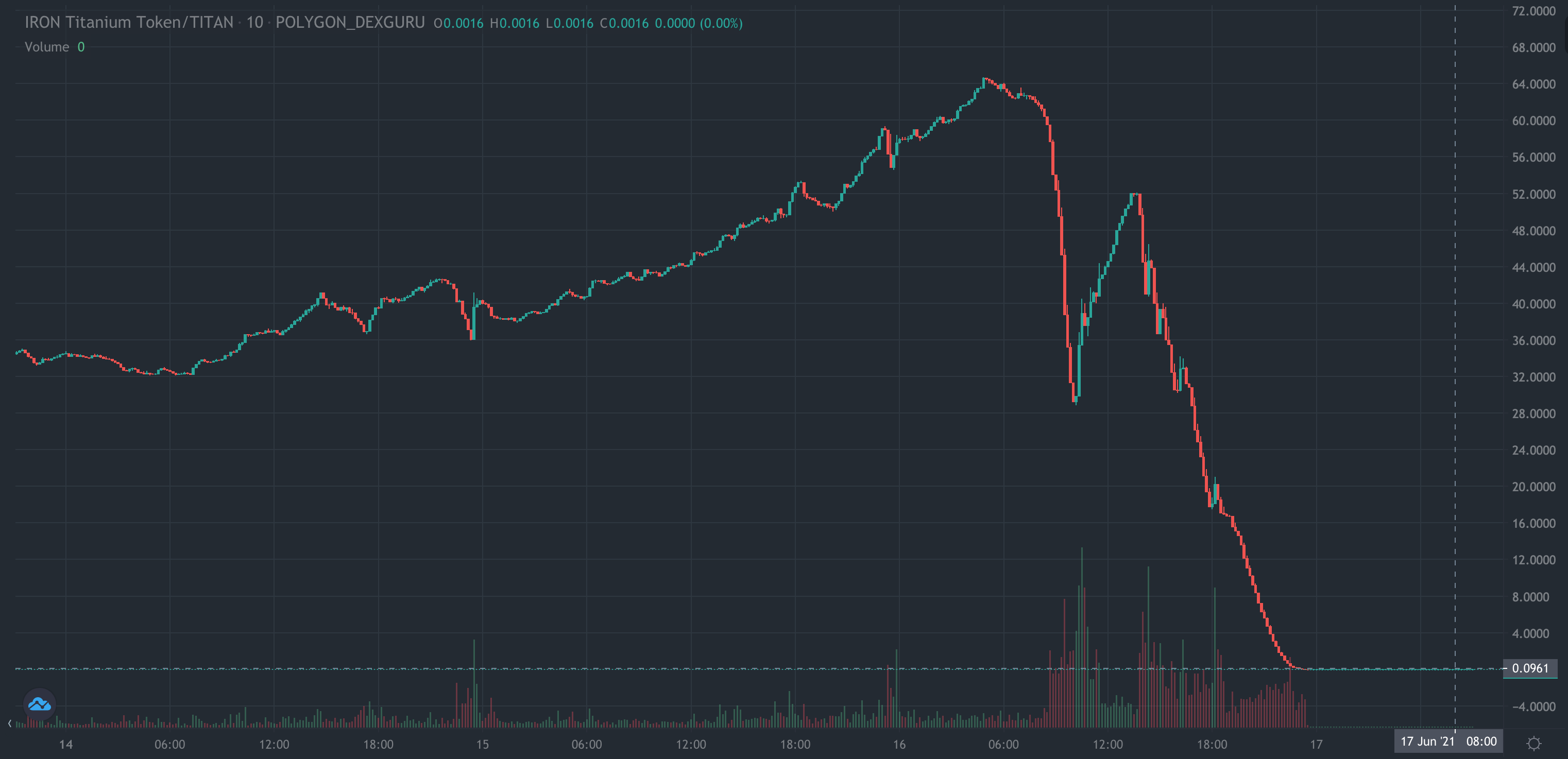
To program one you need to think about all the edge cases. The programmers here likely did want >0 here. The possibility that the thing feeding price data return zero incorrectly was higher than the price legitimately being zero in their minds.
There is no court or lawyer who can interpret the spirit of the contract.
That's obviously the point, though. You are trading one set of risks for a completely different set of risks that might suit your use case much better; your counterparty being able to contest a contract in court could very well be a "bad" thing for you.
But that's exactly the point.
People are not able to interpret "smart" contracts. For normal contracts most people can understand the contract and if there is a dispute you have laws and courts who can interpret in every case.
In case of "smart" contracts even the contract developers more often than not seem to not be able to understand all consequences.
So if we are trading one set of risks for another it kinda seems to me to be a a really shitty tradeoff.
Evading the law (whether the court or a regulatory body such as the SEC [civil] or DOJ [criminal]) is typically a "bad thing" for the person or people intending to or successfully doing so.
https://www.sec.gov/spotlight/cybersecurity-enforcement-acti... (SEC Cyber Enforcement Actions, control-f "blockchain" | "crypto")
https://www.ropesgray.com/en/newsroom/alerts/2021/March/The-... (The CFTC Signals New Era in Enforcement of Cryptocurrency Trading with Action Against Antivirus Software Pioneer John McAfee)
https://www.jdsupra.com/legalnews/doj-activity-on-cryptocurr... (DOJ Activity on Cryptocurrency: A Six-Month Review)
https://www.reuters.com/world/us/us-court-authorizes-irs-see... (U.S. court authorizes IRS to seek identities of taxpayers who have used cryptocurrency)
There is no trade of risks. The judicial system is still going to assert their authority over contracts. Your counterparty will still be able to contest a contract in court. The guys with guns the court sends out to enforce their verdict are not going to be impressed with "code is the contract" and "blockchain". They will lead you to a (jail cell) block in chains (handcuffs) if you try to defy the court order.
Instead you are trading specification of contracts in a legal language where there has been centuries of experience in writing and interpreting those contracts, for specifying the contract in a new language that is still evolving and where there is not a whole lot of legal precedent on how to interpret them and how to resolve bugs.
These "smart contracts" are not decreasing your risk, but rather increasing it.
(We've seen disastrous bugs overturned by community-consensus hard fork but not to my knowledge by court order). Not yet, but it seems inevitable.
This is the true reason they needed to special case <=0.
So it is, in fact, a dumb contract. Humans want contracts that make them whole at the end of the day, that's the point of the contract: jurisdiction over the human realm.
Sorry; decentralized autonomous finance is here to stay. There will be less disasters as we go along, but they will be much bigger.
As with vending machines, they have their use cases, but they aren't lawyer "smart" and they certainly aren't legal contracts. I'm not sure how much trouble a better name would have saved everyone, but it might have done a better job of setting expectations.
https://bitcoinmagazine.com/technical/daos-scary-part-1-self...
But a lot of it's good, and more good things will come out over time. It's currently the equivalent of like 1998 in the smart contract space right now.
It's code which does stuff and if you want to be on the safer side of it, you allow time and liquidity to test them out.
If you want to assume risks and possibly higher rewards you get in early (ape, in crypto speech).
It's pretty simple.
What makes it complicated is that they are called smart contracts.
Also, it's worth noting that this contract wasn't audited, a baseline practice in the industry. Most larger contracts go through multiple waves of audits, while this was apparently released with exactly 0 (so hard for me to be shocked when there are issues).
> A code audit likely would have caught this (this type of bug is so common in software development, I’ve probably made it hundreds of times myself), but of course this smart contract was not audited. Only its sister-contract on the Binance Smart Chain, written in a different language, was.
The alternative is our current, arcane legal system - only interpretable by lawyers who charge $600/hr.
Law is law, code is code. They're two very different things. Code can't prevent someone from using violence to force you to overturn a smart contract's decision. The law can because it's enforced by the state. You could certainly choose to build a system of law that uses code, but code by itself cannot substitute for law.
> only interpretable by lawyers who charge $600/hr.
What do you think the going hourly rate would be for software engineers capable of writing bug-free smart contracts? If adoption takes off I'd bet that it will look a lot like the hourly rate of a good lawyer, or even exceed a lawyer's hourly rate given the impossibility of an appeal if the smart contract is poorly coded.
Also lawyers don't interpret contracts. They draft them and advocate on behalf of their clients in disputes. Judges interpret contracts, and are available as a public service paid for by taxes.
except for the DAO fork of course, when commit rights were law.
The lawyer problem is even worse than not being able to interpret the contract. The code isn't even a contract, legally. When conflicts arise from these deals, courts will settle them the way they always have. They won't read code and then decide that "code is law." That's something programmers made up that will also never be true.
In comp sci, the halting problem says we can never guarantee that, given some input, a program won't halt. "Halt" is another way of saying "stop without doing the intended thing," which is what we call a bug.
One of the ways this translates to everyday debugging is that humans cannot ever know the range of all possible inputs or conditions to a program. We don't have that ability any more than we can give someone a list of all the words that can be made with the letters A-Z.
If we cannot write down what all the possible inputs might be, we cannot be sure that one of them doesn't cause halting!
By the same token, as useful as they are, no set of regression tests can prevent all bugs for the same reason: it simply isn't possible to come up with a set of regression tests that is in any real sense "complete" (ie: ensures no halting).
The halting problem was proved mathematically by Alan Turing and applies to all Turing computers, so we know it applies to smart contracts. In fact, the inability of the developers to conceive of one possible input (a zero value from the oracle) is what led to halting in the case of IRON.
To make the problem worse, even knowing that halting (aka bugs) was a possible outcome (a likely outcome, even), not only did the company apparently not seek any outside code audit, they locked down the contract (because it's "law," lol) so that the code can't be fixed even though it's now known to be broken.
So there's the stupidest kind of programming ever. Smart contract is a name in the same vein as the Ministry of Peace in Orwell's 1984. It is anything but smart. It is known to have bugs (halting problem) and they cannot be fixed (locked down "by law," rotflmao).
This is particularly the case with ownership of money. If you've put money in a bank, and the bank says "sorry, due to a programming error you can't get your money back," that's on the bank. They are legally required to try and get you your money back.
Similarly, legal contracts (as opposed to defi smart contracts) must contain certain elements to make them legally enforceable. These include such elements as capacity (the capacity of the signer to enter into a contract, which can take into account whether they can fully-understand the contract) and adequate consideration (whether the contract is blatantly unfair to one party). So a contract that seems reasonable but might have some complex edge-case that requires extreme fine-grain parsing or auditing to see how you might end up with no money may not be legally-enforceable at all.
In the defi world, it seems like you're entering into a contract that's written in code, but there's no requirement to be able to actually parse and have the capacity to understand all the code that is written in the contract (or omitted, in the case of edge-cases the programers didn't think about). This seems like it wouldn't fly in any legal contract.
Literally no conceivable parody could work as an actual parody, I think. There are coins people are getting rich off of with names and logos like "Pregnant Butt", "CumRocket", racial slurs, etc.
There's absolutely no doubt in my mind that if it hasn't already happened, coins named "Scamcoin", "Rugcoin", "Ponzicoin", "This is a scam coin, please ignore", "If you invest in this you will lose all of your money and be the laughingstock of your friends, family, and communitycoin" could probably quickly reach million/billion-dollar market caps.
You could make a token with a smart contract which self-destructs itself at a random time, and explicitly disclose this fact, and it'd still probably get a huge market cap and retain it up until the day it explodes. Or you could make one that does this, don't disclose the fact, have millions of dollars flow in without a single person ever looking at the code, and get the same result. (Doesn't matter if you do or don't publish the verified source code; if you do, no one will look at it, and if you don't, no one will notice/care that you didn't before investing their life savings in it.)
Poe's law doesn't even quite describe it, because it's not that you can't distinguish between parody and sincere absurdity. There's just no difference between the two in terms of actual real-world outcome. Whether you make an intentionally or unintentionally terrible coin, and whether or not you're open about it and whether or not people are aware of it, it's still going to receive a ton of investment.
And it pretty much makes sense why this is and will be the case (unless the US government starts cracking down). People are buying because they find it entertaining and think other people will find it entertaining and buy and that they'll think other people will find it entertaining and buy, etc. And then they just wait until their initial investment multiplies a bit and they try to get out before the inevitable collapse. It's a fast-paced psychological arcade game. In some sense it's a distillation of Wall Street to its purest essence, for better and worse.
As someone who doesn't know much at all about crypto, it seems insane that apparently coins can be closed source? But how? How does the chain know what code to execute?
That's two items, but there's more. However, cyberpunk in the early 90s was so gonzo that it was not an obvious parody to many readers.
completely unusable as a currency, even maximalists cant seriously tell people to use it as such. "cryptocurrency" at this point means less useful than any currency in any mmo
Coins that support smart contracts show that "cryptocurrency" isn't a great term. Even if you never try to use ether as a currency (and indeed, most people don't), Ethereum can and does still do lots of things completely unrelated to finance in any way, with ether just serving as computational fuel.
The interesting part is fully trustless peer-to-peer networks, not e-currencies. E-currencies are just an example of one thing you can run atop such a network protocol. They've already existed to some extent for a long time via protocols like BitTorrent, and these just expand on those ideas.
I recently needed to buy something from a merchant, who was not able to acquire a traditional credit card merchant account, or a business checking account. I had three options to pay to that merchant: cash in the envelope, money order, bitcoin (merchant also run a promotion for bitcoin method of payment, discounting the total of the order by 20% when paid by bitcoin).
Bitcoin turned out the best option out of these three.
Here's a snapshot before it shut down: https://web.archive.org/web/20140312233243/http://ponzicoin....
Searching for Diamond Coin Token or DIAH token got me results for DiarrhoeaCoin!
I mean, there are some people there basically saying "yeah, I brought $0.10 worth of it, now I just have to wait until I'm a millionaire", even those I can't decide if they are joking or not.
Aside from the amusing programming error, the main problem with much of the "smart contract" activity today is that doing anything remotely interesting requires an oracle. An oracle is basically a server that reports the outcome of an event. And servers can be attacked in ways that systems like Ethereum can't.
So a lot of the hype around Ethereum and its "smart contracts" is really people just misunderstanding the security model. The weakest link is a server in a dorm room or data center reporting a number.
Here the oracle is doing the right thing. But it could easily go the other way.
This has been the problem with smart contracts since day one. It is that simple.
Thank you! I've tried to put it into words before but I think this is as close to perfection as one can get while describing why smart contracts are not what people believe them to be.
This has been seen in practice, for example in the Fulcrum hack:
https://gist.github.com/alexvansande/edcc9fe935b61526766c956...
https://dappradar.com/blog/defi-flash-loan-attack-what-just-...
It doesn't have to be an API. Side channel attacks can provide unintentional oracles. For example, if you have a password checking function that takes longer to return a false result for "close" inputs, then it leaks information that can be used to crack passwords (simple O(n) string comparison would be an example)
My uneducated inference is that an oracle is a data source and you can hook into it from the smart contract. The oracle seems to live off-chain and live on a traditional server/DB.
Please correct me if the above is way off!
Isn’t that just a Ponzi scheme?
In a ponzi scheme, the perpetrators will not willingly directly reveal that it's a ponzi scheme.
In cryptocurrency, the perpetrators are honest and transparent about it being a ponzi scheme, but surround it in so much techno-babble that they make it sound like a ponzi schme is what you WANT.
There were ponzis some years back like OneCoin and BitConnect.
I think this isn't quite right in all cases. I think some people know it's a Ponzi scheme and genuinely do want a Ponzi scheme. They just want to get in and out quickly. It's gambling. Sometimes you're a victim and you lose money, and sometimes it works out and you make money.
> If the price of IRON goes down from $1 (good) to $0.95 (bad), you just issue some TITAN (worth $65) to buy some IRON until it’s worth $1 again. And if IRON keeps going down, you just issue some more TITAN (worth $60) and buy more. And if IRON keeps going down … [you can fill in some more iterations here] … you just keep issuing TITAN (worth $0.000000035) and at that point you’re not accomplishing much. If you could sell 286 trillion TITAN at $0.000000035 each you’d raise $10 million. That’s probably hard. There are 285 million IRON (formerly worth $1) outstanding.
So probably not a Ponzi scheme but also not a scheme that was created by someone who can think two steps ahead.
What you're describing is what they tried (and failed) to avoid. How can you make it to the "I’m wondering if this can last mathematically?" part of this article and still think there's a mastermind behind all of this?
The main innovation is that there's no one to sue. The founders can just print themselves a bunch of coins and remain basically anonymous.
They also bypass regulation, because its on the web?
Regulators are asleep at the wheel. This entire category of 'technology' should have been snuffed out years ago for the good of us all. Now, look around us as GPUs and other chips are out of stock, cities face blackouts due to coin mining, and the major use of these coins is to fuel ransomware attacks that take down critical infrastructure.
All entirely pointless - or even outright negative - activity.
This is more like if you bought a lot of dollar bills that were 75% backed by gold and %25 backed by Dogecoin. They are comparable in that both keep working as long as no one tries to cash out, and money keeps coming in.
So...a Ponzi scheme?
>EDIT: I’ve since learned that the developer(s?) behind this are already the laughing stock of the DeFi community, having wrecked each of their 3 previous projects (now 4) — though this might be their biggest hit yet
And people poured $262 million into this?
Con artists are good at what they do. People are a thousand times easier to hack than a database server. And there's no security patches for human emotion; we are full of 10,000 year old zero days.
As a sidenote, I almost always got out just before a crash by when I was playing with altcoins by waiting for people to get over the top enthusiastic in their subreddit and then selling everything. Might as well have been luck though, so don’t try it ;)
https://ironfinance.medium.com/iron-finance-post-mortem-17-j...
I've seen some pretty amazing examples of charismatic people spewing absolute nonsense with the audience hanging on every word like they are a genius. Put far more interesting ideas in the mouth of someone with no charisma and they are ignored.
Humans are merely clever. We are not truly intelligent.
If a stablecoin issuer like USDC can make arbitrary decisions to null any USDC token and they use that power, that is a good argument for the point that they are not following aml/kyc on every hop or transaction of USDC, even though they are allowing the transfer of dollars behind it. USDC can be charged with violating money transmission / bsa / aml/ kyc requirements.
Yep, short of the fed issuing USD tokens directly that's always going to be how USD stablecoins work.
>so what's stopping coinbase from just nulling the locked usdc and minting 262MM new ones
Nothing, other than that they have zero incentive to do it. I doubt whatever goodwill they get will come close to the $262 million that they don't have to pay back.
But now that I've looked at their website, I think I can say that the writing just has a low budget BS-y tone to it.
I'm not claiming to have an infallible BS detector. But this thing in particular gives me an overwhelming sense of they're trying to sound intelligent to people like me who don't understand a word.
They sound very like the writers of spammy financial news that clogs Google search results for public companies these days. The ones that aren't actually bots, I mean.
"Market shocks provide the best stress tests for stablecoin pegs, and IRON’s strong peg retention should go a long way to grow trust in our community. IRON has shown itself to be a shock-proof stablecoin, and the stabilizing protocol is now battle-hardened."
[0] https://docs.iron.finance/iron-finance-on-polygon/titan-dist...
[1] https://www.coingecko.com/en/coins/iron-titanium-token
edit:
On further inspection, it seems like they'd just need to get the price up to the 6th digit[3]. I'm not sure it's feasible though.
[3] https://github.com/IronFinance/iron-polygon-contracts/blob/m...
This is exactly what crypto-enthusiasts claim is going to happen to the US Dollar and I've never heard mention of crypto taking pity on fiat by offering to give them crypto when the bottom finally falls out of fiat.
So why should anyone else be responsible for people who took a calculated risk that blew up in their face?
Yes, this sucks for them. But this shit happens. Don't throw good money after bad.
Profit.
There are a lot of people with USDC locked up in the contract and they might be willing to pay a share of it to unlock it.
A calculated risk is that you put money into something which may end up losing all of its value; not that your collateral becomes locked in a safe with an accidentally lost key. They had a reasonable expectation that even if the value was totally lost, they wouldn't have their collateral locked forever. Their investment, yes, but not their collateral.
Sure, one always has to account for extreme scenarios when doing anything, like the risk of a critical flaw in the code. But to give another extreme gambling scenario:
Let's say you put your car up as collateral for a huge gambling bet. You of course take a calculated risk that if you lose the bet, you lose your car. Then let's say you back out of the bet after putting up the collateral, or you even win the bet, but there was a mixup at the casino and they thought you lost the bet and they took your car without you realizing it and it's on another continent now.
In both scenarios, you hope that you can at least get some kind of compensation from the people you entrusted the collateral to, since it was just a complete fuckup on their part. You know you're not guaranteed to get anything, but I think it's reasonable to try to ask for compensation. If you just took a bet and the value plummeted, then you know it's tough luck for you and just a standard high-risk high-reward scenario that you ended up on the losing side of, but this is something else.
(At least if I'm understanding this properly and the collateral really was purely collateral. Seems to be a bit complicated because they were attempting to make a... stablecoin... pegged to an intentionally volatile asset, somehow.)
>This is exactly what crypto-enthusiasts claim is going to happen to the US Dollar
It's mostly just Bitcoin maximalists who think that, and they're a small subset of people who own Bitcoin. This is Binance Smart Chain (basically a copy of Ethereum), and I'm sure some BSC/Ethereum users believe something similar, but it's a much smaller percentage than even Bitcoin's small percentage.
Also, I don't think they think every dollar is secretly embedded with nanobots that'll encase the bill in titanium after someone at the Fed trips and falls on a big red button, which is what would be analogous to this. I think they think the dollar will lose most or all of its value due to hyperinflation. I think that's a completely unfounded belief based on an unfounded philosophy, but it's a different and entirely unrelated thing.
Reasons why this might NOT work:
1. The oracle "broadcasts" the price to the network, which other services may rely on. Broadcasting a false price could hurt those services, and the oracle would lose credibility.
2. The oracle's price is somehow tied into other blockchain mechanics (i.e. it can only report a price that the network consensus agrees is true)
I'm not sure how #2 could be true, since the purpose of an oracle is to provide information that the blockchain can't determine on its own.
EDIT: More info on the price oracle in use here: https://docs.iron.finance/mechanism/pricing-oracle
Still not sure the exact mechanism, but #1 seems to be the concern. Chainlink can't readily tamper with the price feed that may be in use by others.
edit: Nevermind, I misread. It's -0.0961, apparently.
I don’t know what the Oracle is using but it would be amusing if something else means the price is “stuck” at zero once it hits zero.
[1] https://www.cnbc.com/2020/04/26/why-oil-prices-went-negative...
read: "ponzi scheme". This is pretty funny.
I guess they are comparable in the way that they both require a inflow of capital, is that what you're saying? That would make them similar to pyramid schemes and startups too. "Ponzi scheme" is more specific than "scheme."
The difference between this and a startup is obvious- a startup intends to become financially independent at some point
Much later I learned all you had to do was copy and paste a Solidity program and then promote it.
Guess I dodged an ethical bullet in my ignorance, but still...
Pyramid Schemes have the originators (the "top" of the pyramid) win lots of money, while the base (the "bottom" of the pyramid, where most people are) losers. And the top barely did any work to get there: they just took the money from people below them.
The general rule is that if the majority of money does not come from selling to retail customers (either directly or downstream), but rather from recruiting new members, then it's a pyramid scheme.
Aunt Meg, is that you? I told you to stop it with the essential oils already.
On a forum I used many years ago a regular was forever pushing an MLM and I investigated how it worked, just to try to understand how screwed he was rather than out of any misunderstanding that MLMs are a good idea.
It was one of those health juice MLMs, and what I realised was very clever was that the business structure was set up so as to on the one hand make it less obviously an MLM, and then on the other hand ensure the scammers were insulated from the scam.
There's a pretty ordinary over-complicated compensation package, with tiers of distributors getting a percentage from those beneath them in a structure that sure looks like a pyramid - and imaginary "consumers" who buy at the supposed retail prices at the bottom of the pyramid. But the juice itself is bought exclusively from a separate company at an inflated price.
If the government shuts down the MLM company, few there were getting rich, it's just a handful of people out of an office somewhere. The big money flows into the juice manufacturer selling this awful tasting muck - and they can claim they know nothing about any pyramid scheme. Selling cheap juice for lots of money isn't a crime it's just capitalism.
This space is a giant house of cards.
Crypto is reinventing the same system as traditional finance and hitting all the same problems that we encountered in the last 100 years.
At least here everybody who opens their eyes can see that it's a house of cards.
And TITAN is printed by the system itself, whenever IRON is < $1?
Outside of abusing the oracle, that seems like a pretty pickle.
https://www.bloomberg.com/news/articles/2021-06-17/mark-cuba...
I read about it. Decided to try it. Got out. Then got back in when the TVL start to rise back up As a percentage of my crypto portfolio it was small. But it was enough that I wasn't happy about it.
But in a larger context it is no different than the risks I take [in] angel investing. In any new industry, there are risks I take on with the goal of not just trying to make money but also to learn. Even though I got rugged on this, it's really on me for being lazy. The thing about de fi plays like this is that its all about revenue and math and I was too lazy to do the math to determine what the key metrics were.
The investment wasn't so big that I felt the need to have to dot every I and cross every T. I took a flyer and lost. But if you are looking for a lesson learned , the real question is the regulatory one. There will be a lot of players trying to establish stable coins on every new l1 and L2. It can be a very lucrative fee and arb business for the winners.
There should be regulation to define what a stable coin is and what collateralization is acceptable. Should we require $1 in us currency for every dollar or define acceptable collateralization options, like us treasuries or?
To be able to call itself a stable coin? Where collateralization is not 1 to 1, should the math of the risks have to be clearly defined for all users and approved before release? Probably given stable coins most likely need to get to hundreds of millions or more in value in order to be useful, they should have to register.
An independent auditor, with reputation on the line, could, for a fee, offer independent coin analysis and risk assessment. Perhaps something similar to the Underwriters Laboratories model... knowing a coin was "Coincheck-certified" or something could give similar confidence to knowing the UL sticker on a lamp means it's a bit less likely to burn your house down.
I don't think this will matter. Moody's and S&P are two rating agencies that both failed to give useful info before the 2008 financial crisis. Their reputations weren't affected much as far as I can tell.
What's the best DeFi project? One where the value proposition is actually clear, there are actually people using it and it's actually at parity or better than a traditional financial system offering?
Runner ups are Compound and Aave — two large overcollateralized lending platforms. And the Maker: the USD-pegged “stablecoin” which gives anyone who doesn’t want ETH price exposure access to these DeFi tools. That’s the area where a lot of people think there’s room for improvement, hence all the experiments like the project this article is about.
Most of the stuff people use essentially seems to be one form or another of shuffling the unit(s) of account around, like the ones you listed.
You have a cryptocurrency. What are the uses for the cryptocurrency? Well, you can swap the cryptocurrency for another cryptocurrency or let someone else borrow the cryptocurrency in exchange for some more of the cryptocurrency or use the cryptocurrency to obtain a cryptocurrency that's a derivative of another cryptocurrency so you can make more of a different cryptocurrency. And what can you do with that cryptocurrency? Well, you can swap that cryptocurrency for another cryptocurrency or...
There's a bit of a "pull yourself up by your bootstraps" thing going on (in the initial sense of the term).
Despite the cynical question, I'm genuinely fairly optimistic about the future of smart contracts and Ethereum. I think there are some interesting non-ouroboros ideas in the space, like Kleros, but none of the ones I've seen seem too popular, valuable, or useful yet. But I could be missing some, and I know it's still the very early days.
You can easily get 50%+ APY a year on various stablecoins and crypto.
Smart contracts being immutable is a joke, almost. And more importantly, even if they were immutable, proving that formally for a Turing complete language is impossible.
Bitcoin smartly avoided this by making its smart contracts dumber.
> Other on-chain stablecoins like DAI are over-collateralised. For every $1 of DAI, there’s ~$1.75 worth of crypto assets in the DAI system.
The article mentions a boundary condition ("_share_price > 0"), not an off-by-one error.
And these are discrete numbers, so I don't see the problem.
A huge fraction of off by one errors are > vs >= or < vs <= in a for loop.
require(_share_price > 0, “Invalid share price”);
https://github.com/IronFinance/iron-contracts
Is it in a different repo? Does it exist?
(If verified source is published, you can see the actual code; else you'd have to decompile the EVM bytecode. But basically 100% of the time, if verified source isn't provided then it's a scam, so it's safe to just ignore things without source. And, of course, even if verified source is published, there's still a high chance any given contract picked out of a bucket will be a scam, but at least you can review the code and spot the backdoor.)
I kind of agree with you, but then, since it would fit for integers, I can’t think of a better name and could live with some generalization of “off by one”. I’m not a mathematician but maybe something like “off by n; n -> lim 0”
With DeFi, you're simply exchanging one type of risk for another. Without due diligence you're pissing your money away- as it is to be expected. And as it was brought up before, this was an unaudited contract that had been running for what, weeks? Months?
Personally, I cannot say I understand DeFi deeply enough to get into the intricacies of "yield farming" and such, so I just avoid it altogether. Only have a relatively small amount of USDC and DAI accruing interest on Compound, which has at the very least been audited [0] a few times before, but even if it were to go tits up tomorrow for whatever reason, at least I understood there was that risk.
I think the real story is the insatiable appetite for get rich quick schemes in today's world, because without that many of these projects would simply not be used. IIRC they had some insane yields of like 50k% apy on their token, anyone with any sense would know to run away from anything promising that.
Who did the transaction though? These people? The eth network? Was it considered money? And where? Do these people live there who did the transaction? I am not saying you are wrong but this 'war on X' attitude never was a great idea, it also does not work as it is not a singular entity that is to blame. It is a vast network spanning countries.
The biggest issue for me wasn’t TITAN itself, that was a risk I considered and had a plan to manage.
What really got me was the Polygon network crashing and breaking all of the safeguards I had put in place.
There is evidence that a DDOS attack was carried out against Polygon while this was happening, blocks were packed with self transfers for 0 MATIC.
This took down rpcs and shot gas fees through the roof, preventing many people from exiting their positions.
TFA suggests that this line:
require(_share_price > 0, “Invalid share price”);
Isn't everyone passing around uint256's these days?
If you ever run into negative prices you want them to be negative, not positive in the trillions.
Is there any better description of these coins?
https://www.bloomberg.com/opinion/articles/2021-06-17/titani...
Someone has to make this into a meme. It will definitely be my excuse for my next multi-hundred million dollar value destroying software bug.
It wasn't any more honest than this; it was just kept quieter with private meetings and less publicity for the collapsed scams.
I'd be looking for the banker-adjacent people in these. The folks that don't work for the banks directly, but consult; somehow always seem to have some extra connection to someone at the bank, related, married, side projects...