If that's not the case, how do you propose to enforce that all use cases use less electricity, and how do you punish those who use too much?
To paraphrase Alan Watts slightly, do you know of a law that set everything to right? Let's just all sit around twiddling our thumbs eh? Since you obviously didn't really offer a counter solution.
https://news.ycombinator.com/newsguidelines.html
Perhaps it's not idle pedantry to observe that many of those who are angry about crypto energy usage couldn't care less about the energy wasted and pollution generated by other endeavors.
It's like an uncle of mine who is outraged that mosques get tax exemptions, but he doesn't care that churches get tax exemptions.
Clearly tax policy isn't a genuine concern for him. He's angry about something else that he won't say out loud.
Industrial production of greenhouse gases is nearly an order of magnitude larger than consumer production, but often inordinately the "guilt" burden is pushed to the consumers: Do you have an EV? Have you changed all your light bulbs to more efficient LEDs? Are you Vegan enough?
Here too: Bitcoin alone has risen to an order (or three) of magnitude more energy consumption than Facebook could ever use/do ever use to track people. (Cumulative, the rest of cryptocurrencies only further dwarf Facebook's comparative energy costs.) We can be angry about two things, we can be angry at both, but why can't we discuss the bigger problem first without getting into the weeds of all the smaller problems?
(And of course, the two order of magnitude problems above are inextricably linked: Bitcoin is on track to make many industrial users of electricity look like chumps and dwarf them by an order of magnitude. Nearly all of the consumer-side gains from veganism, LED lightbulbs, EVs has been offset again, if not entirely dwarfed, by cryptocurrency mining.)
People are bad at reasoning things at large enough scales, have a hard time gut understanding order of magnitude problems, so the fallacies keep creeping up, and keep getting weaponized by bad agents (the consumer "green guilt", the consumer "recycling guilt", so many other "demand-side fallacies" that if consumers just bought "smarter", problems would just go away, when really it's the suppliers that are in control).
Gold mining uses something like 140 terawatt-hours of energy annually, and produces enormous pollution and environmental destruction in addition to that.
That's greater than Bitcoin's energy usage.
Since gold mining is so much more harmful to the environment, maybe we should outlaw that first before we work on smaller problems.
People seem to be intentionally conflating some things. A carbon tax is nice precisely because it avoids getting into weeds and is a general approach that applies equally to everything. Some people are proposing this and others are saying "don't get caught up in the weeds." What? Makes no sense. It just reinforces the poster's point: that some people's real motivation doesn't seem to be environmental, there's a strange focus on crypto specifically that makes it seem like they want it to be reigned in for other reasons.
It seems like you implicitly draw the 'fair' line between FB and BTC.
BTC's market cap is roughly equal to Facebooks. If a POW coin used facebook levels of energy at the same value, would you find that acceptable?
To your point, though, I'm willing to wager that most of the people whose biggest problem with crypto is energy consumption would happily also support other harsh measures against all manner of pollution generating entities. I know I would.
So long as pollution and carbon are free or cheap, people will find wasteful ways to generate it.
Incentives work, and taxing carbon and pollution will incentive green alternatives.
Have you observed this, or are you simply speculating?
Best i found for Bitcoin was 40-100 TWh per year: https://digiconomist.net/bitcoin-energy-consumption
And for Facebook it appeared that they used 5140 GWh in 2019: https://www.statista.com/statistics/580087/energy-use-of-fac...
So essentially:
  Entity    Consumption (GWh)
  Facebook   5 140
  Bitcoin   40 000 - 100 000
Attacking the motive or whatever is not said out loud is responding to a weaker interpretation
I don't think that's correct. I think that it's possible to care about both, but to be dismissive of misdirecting subject changes, i.e. "whataboutism".
Nicely done, nicely done.
The (counter) solution is not to discuss for what to burn coal, but to finally stop burning coal, oil and gas. USA and EU could do that within a few years. And then stop or tax imports from countries that still do burn coal.
But that is inconvenient for many, so they prefer discussing nerdy Bitcoin PoW instead.
And secondly and most importantly, the government should not decide what products are allowed to be traded: Governments should lift all bans on products currently banned, all drugs, all books, all music, all banned clothing, etc.
Is there a concrete plan for how this would work documented somewhere? The ways I can think of doing this in the USA are all politically nonviable.
Which makes it a self-inflicted injury. Like corruotion in Russia - it can't be adressed by anyone else.
I can think of many things equally or similarly energy wasteful as Bitcoin.
https://news.climate.columbia.edu/2010/06/04/the-problem-of-...
https://blogs.scientificamerican.com/anthropology-in-practic...
If you spent the same energy used to mine bitcoin on producing Legos or In-N-Out burgers, then you'd have much bigger problems.
I
It's a nondescript pollution factory from the Captain Planet cartoons.
Every other wasteful activity has just been overconsumptive, decadent, or externalized, not an actual burning of resources for no reason.
All energy production will have an environmental cost, not just carbon dioxide emitting ones.
Why not both?
It is very possible to bring up edge cases in a productive manner. Expand the conversation to include them. there's no need to assume the first solution idea posted is meant to be the final form
By banning that because it uses "too much" energy now - what are we potentially losing? What developments in renewables, energy storage, or grid development simply won't be there, which we won't know we don't have, because we banned the largest for-profit, skin-in-the-game competitive contest for low-cost energy that the world had ever seen 25 years prior?
Banning it outright is short-sighted. Thinking about it from a higher level is a way of addressing the real issue of carbon emissions while allowing a phenomenon that has the potential to massively help, not hurt, to thrive.
On this particular topic, I particularly hate the amount of fossil fuels getting burned on cryptocurrency. I'm less concerned about the amount of energy getting "wasted" on data centers in general. At least in most cases, there's alignment of interests when it comes to efficiency optimization. Facebook has an incentive to make their servers more power efficient over time, and scale their capacity to the size of their customer base. With proof-of-work, there's also incentive to increase power efficiency, but also incentive to scale up to capacity limits.
I think it is possible that proof-of-work cryptocurrency algorithms could be tuned to the point of striking a sustainable balance long term, but that would require the world economy to converge on one or two of them. The issue with that I think is the speculative nature of the currency's distribution of ownership. With large portions of the currency being held by a small number of anonymous people, and no clear path for the majority of normal folk to exchange their wealth, it's just not going to happen without some sort of societal collapse. I also struggle to have faith in a system meant to disrupt the global economy when its existence depends on global scale internet infrastructure.
And banning isn't really a proper solution in the first place. It's a literal avenue for tax revenue for countries at this point. The fact that PoS coins like Cardano and L2 solutions like Polygon are bullish despite the crash in Bitcoin shows something about investor sentiment surrounding the whole energy consumption ordeal. Voting with your wallet is a real possible solution and IMHO, people are starting to take the hint.
Here's my issue. There is such a thing as too-late in environmental matters. Once it's too late, it's a fire that sustains itself. Therefore, acting quickly matters. Addressing the source directly is obviously the superior solution. But I just don't see it happening at a fast enough rate. I see nuclear power in the same way. Yes, it's a little bit of trading one problem for the next, but it's a very necessary stop gap to buy us time.
In this case, tax carbon. Then people will decide what they want to spend their (expensive) energy on.
As for the carbon side of the issue, that isn't something which is specific to cryptocurrencies or any other kind of energy usage. I support carbon taxes and import taxes on CO2-producing goods/services, including cryptocurrency services, and I am certain that many cryptocurrency believers feel the same way.
OP proposal to ban cryptocurrencies for 'damaging environment' while we have companies who's entire business model is giving their customers cancer and preying on addicts.
2. For all their many flaws, those industries also provide something of value. If they shut down tomorrow, people would miss having cars, pesticides, fuels, medications, etc. but if every cryptocurrency suddenly halted tomorrow nobody outside of a few speculators would find their daily life any different. That doesn’t mean that those externalities aren’t real and don’t require action but they’re widespread because there is some kind of real value to society and you’d need a transition plan to avoid disrupting a lot of processes.
That doesn't mean that threads on HN can't take a nosedive and become flame wars. But that's what good moderation is here for, and I believe HN has that.
modern politics in a nutshell
You're presupposing this is a problem that needs a solution. I think myself and the commenter you are replying to would agree that either: A) it's not or B) it does not need to be solved by a regulatory body.
Instead of getting annoyed by people pointing out edge cases, it would be more productive to explain what criteria should be used, or admit this is a half baked solution.
unless of course those regulations are about regulating "big tech" for "censorship".
- There are those who are OK with high carbon emissions for various things that are a proven net-negative to the society or the planet - examples being, as I mentioned, social media, user tracking and advertising server farms, plus anything directly related to that. If these things are not a net-negative, then at the very least they could operate at the fraction of their current emissions, were they built with externalities in mind. To be OK with that but not with Bitcoin where it objectively provides some value by directly helping human lives (it is a store of value and a way to transfer money for people whose home currency is unstable or restricted by hostile governments, for instance), is hypocritical.
- Literally all legislation surrounding cryptocurrency (well, anything else too, really) by necessity has to be based on someone's opinions. Whose, is my question. Because that will shape what's allowed and what's not allowed to a great extent. Badly chosen opinion-givers lead to clusterf*cks like Disney, Sony and a few other giants effectively being in charge of worldwide copyright durations, which causes untold damage to the cultural commons.
In this particular situation, I may not have the solution, but I know that the offered one is a short-sighted knee-jerk reaction which has terrible implications for other things
Because it is an incredibly common fallacy to ignore boundary conditions and unintentional consequences when proposing a pie-in-the-sky regulation that is supposed to just fix things.
Any regulatory mechanism is essentially a machine that will need to work with every input and minimize some class of error, be it precision or coverage or some other system level metric. Turns out the most interesting part of such a system is indeed around the edge cases, and the difficulty of handling such cases is essentially the bulk of the difficulty of building such a system to begin with.
It is like saying "why don't we build a system that punishes criminals", which sounds very agreeable and popular at that level of construal, but is incredibly complex and sophisticated at the actual implementation level; e.g. to have a process to minimize false positive convictions rather than maximize conviction rates.
> It's SO trite, predictable, wearisome and boring
Not to sound harsh but HN does not owe anyone their favorite type of entertainment and honestly criticisms on those metrics are more trite, predictable, wearisome and boring themselves than anything else. Many find intellectual stimulation and systemic thinking entertaining and thus those comments enjoyable.
I will say that given the text based medium of HN, it can be hard to gauge whether one wants to have a mindful discussion or if one is just trying to mindlessly ding a poster.
Choose an argument which requires you to offer a viable and compatible alternative and you'll probably get a lot more ears.
Be kind. Don't be snarky.
Comments should get more thoughtful and substantive, not less, as a topic gets more divisive.
When disagreeing, please reply to the argument instead of calling names.
Please don't post shallow dismissals
That’s the first time I’ve ever seen someone describe Facebook as an “edge case”.
If $900,000,000,000 of market capitalization counts as an edge case, I’d think you must be hard to please at Christmas - those are some really high standards!
Maybe it's time to grow up and realize that the real world is highly complex and requires sophisticated tools, mathematics, and questions in order to better live in it?
Instead what people are doing is advocating for the government to come and point guns at people who don't do what they want -- even if they happen to be wrong. And when they are wrong, there are disastrous consequences as is currently extremely apparent in California. There are all kinds of perverse incentives which have resulted in the severe homelessness and extreme government waste.
The people advocating for this neither listen to the wisdom of Murphy's law, nor do they understand that when regulation impacts the market that regulation becomes what is bought and sold. Have you never heard of regulatory capture? That has worse human-cost impacts than leaving people to their own devices.
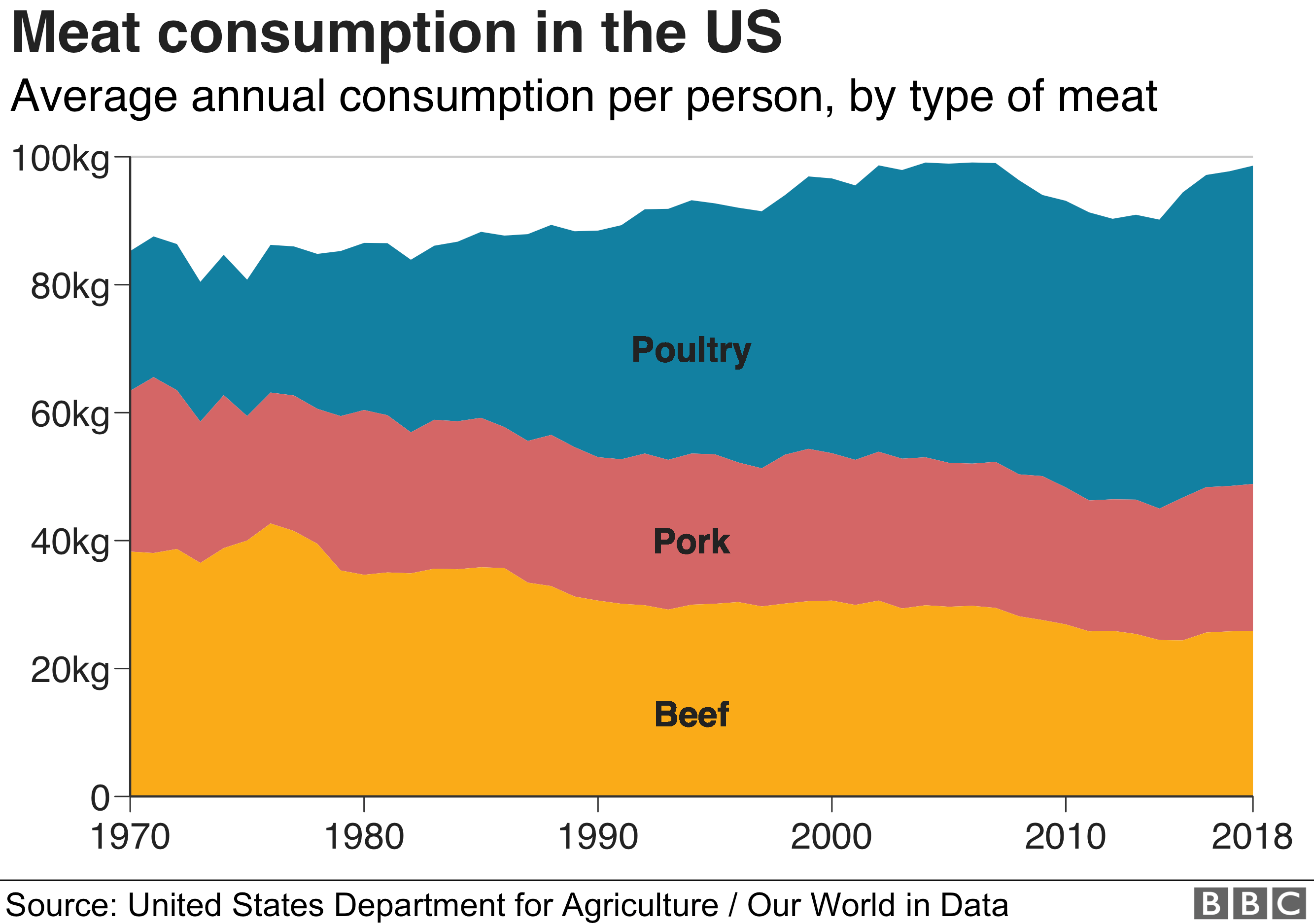
Vote with your wallet. Don't like the environmental cost of beef? Don't buy it. This works -- you can see it playing out.
https://ichef.bbci.co.uk/news/976/cpsprodpb/BA65/production/...
One of those is the assumption of perfect competition. Electricity is far, far from being a market with perfect competition. How many electricity providers are you able to choose from at your house? I'm going to guess 1.
Another assumption that doesn't hold here is the absence of externalities. The full cost of damage to the environment is not included in the price you pay for electricity, so people are going to over-consume it.
You rail against laws and regulations but even in the second sentence of your post you assume their necessity with the phrase "create an economic system..." Laws and regulations are how you create such systems.
Regulatory capture is a real thing, but it's not a good argument against all regulation. Maybe it's an argument for relatively less regulation than we'd have otherwise. It's also an argument for doing regulation better.
Sorry, sometimes there are great reasons for regulation.
Fixing the problem is up to you.
~"The reason things things never change is that those who stand to lose by change are the ones who hold all the power" -- Machiavelli
As another good counterexample to your "market solutions for everything": I don't want rhinos driven to extinction, so I vote with my wallet by never buying powdered rhino horn or other poached products, and donating to environmental charities to protect them. However, it's very likely that rhinos will be extinct in the wild within our lifetime. Does this mean "the market" has decided to exterminate wild rhinos? Should we eliminate poaching regulations and remove red-tape to stop distorting the free-market price of rhino horn?
Current 'free market' is just fancy name for barbaric ransaking
Don't address of any the things that you are proposing need addressing, because they don't need to be addressed in the same law, or really addressed right now at all.
The law doesn't need to try and anticipate the actions that occur in the future, we will still have a legislature in the future capable of addressing the future when it comes about. The law needs to address the actions of today.
That's an incredibly dangerous idea.
Subsidized coal mining and untaxed carbon emissions are dangerous ideas.
I don't think this applies to laws. In fact, I'd claim the opposite. Laws are something you REALLY want to get right
If we won't legislate it now, it's possible we won't get a chance to do it later thanks to bickering from lobbyists and fossilised laws and practices. See IPv4.
Banning PoW cryptocurrencies is not a big enough priority for anyone that it will be a motivating factor to move past the other issues surrounding the climate debate, especially not anyone on the side of "don't do [thing] to fix the problem". I don't see any other mechanism by which it makes passing other climate legislation harder.
Banning PoW cryptocurrencies removes money that is currently on the side of "don't pass climate legislation because it will harm my PoW cryptocurrency business" from the table. That makes passing future legislation easier.
In general, trying to solve all the worlds problems at once doesn't work. It's too complex, you paralyze the decision making body with too many tradeoffs. When something is obviously bad, banning it immediately not only has the effect of meaning it's gone immediately (and doesn't hang around until you solve the whole problem), but it simplifies the remaining problem for the decision making body. This makes them more likely to come to a consensus on exactly what to do in a finite amount of time.
Does it? And, do you have data that backs this up? It stands to reason to me that PoW miners only want cheap power; they don't really care too much how it gets generated. Considering that the cheapest power source you can build out today is green energy, it sounds like a win-win to me for them to put their money into "advocate for more cheap power."
But that’s exactly what the law should do...
The question was about how to choose who is using too much and how, and the response was basically "don't think about it, we will exist in the future and can think about it then." But we exist now. And even if we were to wait, it's still a question we can answer now to have enacted later. The response provided was a bypass, a non-answer.
Instead, they explained why these questions are (partially) misguided.
That's also an answer.
once again, you have merely just assumed the role of arbitor. What makes this opinion better than the opposition?
What needs to be addressed isn't energy usage, but the cost of energy in the first place. Why isn't the fix be passing a law to tax carbon properly? Tax the externalities, and the rest would follow. I don't care if people burn up energy for crypto, as long as they pay for the cost properly.
This is literally the role of legislators. What makes "my" opinion better, is in the event that this sort of legislation passed, the majority of the elective representatives in both houses agree we should ban proof of work crytpo currencies, nothing less, nothing more.
> [alternative proposal]
I mean, I happen to like this proposal too, but you haven't given any reason not to do both...
So while carbon pricing would be a more ideal solution, OP is suggesting that a targeted ban on POW crypto is a good-enough bandaid that might actually pass.
Nothing about the opinion is better than any other. But the only thing we have to achieve is that it is a majority opinion, which frankly doesn’t seem all that hard to me.
And Bitcoin is hardly used for any transactions, and its energy usage will increase linearly with BTC price.
(If someone has a direct source that would be great. Statista is not good)
Update: seems the FB figure is correct, for 2019: https://sustainability.fb.com/report-pages/renewable-energy/
However, in Facebook's defense it's per-user per-transaction energy costs are going to be much lower than Bitcoin.
Did Ye Olde BBS support 1:millions broadcasting, and real-time viewing of high-definition video? Uploading and viewing thousands of high-quality photos?
Calling Facebook 'basically a giant BBS' is a lot like saying 'Oh, I could build Twitter in a weekend'.
Especially when talking about CO2 emissions absolutely everything is included, including plane trips and whatnot.
Therefore, if the price of Bitcoin doubles, miners can afford to burn twice as much electricity. (Roughly. This is a simplification of course.)
I'm curious if someone driving an electric would get ticketed as well.
EDIT: Specify the part of the post that bewildered me.
The tax avoidance schemes in Europe are well documented for all tech companies.
And what do you mean by employment taxes? Just the employers part of the income tax?
So 21% + 15% to 20% capex on individuals = a tax rate around the same.
Now, if you really want to look at the big picture, look at a company's tax rate of 21% on profits, but they also pay taxes on employees of ~21% of salary in the USA not to mention health care (which in europe would be included as taxes so maybe in Europe 46% to 50%). So if payroll is 40% of your costs that is another 8.4% of taxes added in there. And, you can probably add health care as a tax as well.
Legal tax avoidance is legal. I hate when people bitch about companies doing legal maneuvers. It is very easy to stop that, apply a tax on gross receipts for all income created in the country.
Washington State does that for example if you have a company operating in their state.
Always the same fucking slippery slope!
Without Proof of work, cryptocurrency would have never been established as a novel concept. Proof of work was the only rationale way to decide who should initially own how many units of the currency.
Just tax the carbon sources and ban building new coal power plants or reactivating defunct ones.
Instead of downvoting please give me one other example why would rational market entity build more renewables than to satisfy demand when production peeks. Because to go full renewables without batteries (and we barely have any when compared to our renewables) we need to always meet the demand even when renewable energy production is the lowest. And what should rational market entity do with the power at all other times where production is far higher than demand?
Because "mine cryptocurrencies with it" seems like the only reasonalble answer in the world where cryptocurrencies exist and people with too much money buy them enthusiastically.
Spinning up cores to do intensive math for the sake of its difficulty is wasting energy by design. PoW's financial incentive is to waste power.
Facebook spends a massive amount of money on compute, and their profit is only as good as the margin they can make over that compute cost. Therefore they have a financial incentive to save power.
The legislature and the regulatory agencies it has created, obviously.
The exact same way literally every other environmental regulation has ever been passed.
There are entire divisions of agencies dedicated to drawing the line of "too much" in all sorts of areas, for pollution, poisons, contamination, energy usage, etc. In fact, pretty much everyone but extreme libertarians agrees this is one of the main functions of government.
So while you might not agree on the resulting policy or even the mechanisms that arrived at it, it is a solved problem. You don't need to wonder how we'd accomplish it -- that part is easy.
I see a lot of people replying with a slippery slope argument of this nature, which makes me think I should explain my argument better.
I'm not arguing that burning electricity alone is the problem. I'm arguing that burning electricity for the direct purpose of making a financial product is a problem for society, when 1) the financial product explicitly incentivizes burning up as much as you can to make more money and/or 2) burning up that energy can be alleviated by other technical solutions.
I'm not arguing that mining should be illegal. I'm saying the 'sale' of the results of that mining should be illegal. Using or making incandescent lightbulbs is not illegal, but the sale of them is banned or restricted in large portions of the world [1]. Less harmful alternatives exist, so sale is disincentivized, the world moves on.
This is not the government deciding how you spend energy resources. You can continue to mine all you want. But you shouldn't be rewarded for that.
One thing I should point out is that I recognize that an alternative solution for these incentives is to make electricity always so expensive that it costs more money in electricity spend to mine crypto than you can make money of it. Make electricity price depend on crypto price. Needless to say I don't see that working out :)
[1]: https://en.wikipedia.org/wiki/Phase-out_of_incandescent_ligh...
The difference is that Facebook’s energy use potential is limited and gets better with improved computer tech.
There is a limit to how much analysis you can do. As you get more efficient hardware, the energy use would go down. Facebook also invests a lot of effort in optimizing their code to run more efficiently.
With proof of work crypto, the only limit is the price of crypto. Despite any efficiency gains, you can always expect the energy use to scale with the price of crypto. For example, a 10x more efficient miner, won’t cause 10x less energy use, it may actually increase energy use as more people mine with higher rate electricity.
There is a chance that we develop a situation that the most monetarily efficient thing you could do with electricity is to mine proof of work crypto. If that becomes the case, then even a carbon tax won’t help because proof-of-work crypto can easily pay the tax compared to all the other uses of electricity.
Fundamentally it's become too big a waste to ignore, like so many other things. We banned incandescent bulbs, we can ban proof-of-waste, which is basically an incandescent bulb that never illuminates anything.
Yep, I hate to say it, but even FB is more useful compared to BTC. No one uses BTC for actual payment but to hold a value. People holding BTC could just switch to MtG cards and saved tons of energy without losing any benefits that they are currently using.
Bitcoin is an endless energy pit. The same isn't true of things like Facebook.
The laws set up the playing field, and the market responds to the incentives. There has never been any such thing as a "free" market, and it's a good thing too.
Congress, courts, Department of Energy.
Regulating the energy consumption/efficiency is more akin to fuel efficiency standards for cars.
"If there is a clear and obvious better with minimal impact." It's just that simple.
We make choices like this all the time. Here in the US we set CARB rules to slow emissions but we don't just ban old cars even though that would be better for the environment. Grey is okay in laws if the black and white bit behind it is clear! (Reduce emissions if possible with least possible impact on people.) Otherwise you will never be able to improve anything until the harmful methods have grown too much.
With crypto it's too decentralized to implement either.
> who's the arbiter of what's "too much" power for a use case
Ultimately Mother Nature will be the arbiter. If people spend too much time arguing about politics instead of either lowering power usage or moving to clean energy, those people will be killed sooner or later.
Electricity usage has almost no negative externalities. Electricity production does. Attacking people for using their own resources on something that they find to be useful and worthwhile is foolish. Confront the actual problem, and quit harassing innocent third parties.
The quick google says facebook uses 5 while bitcoin uses 143 terawatt-hours
At some point the shaming would begin, web devs would respond, and then I'd generally get what I'm really after -- much faster page load times!
You don't need to worry about how much electricity was burned, only that it wasn't done in exchange for a plaque saying "I filled a swimming pool with gasoline, then lit it on fire"
The king. The digital crypto king.
CO2 taxes