With PoW the state can influence the existing miners, but cannot prevent new independent miners to pop up and counter act.
PoS is resistant to state attacks because it would require buying up tokens on an impossible scale, and in the case an attack somehow succeeds a fork can be created that deletes the hostile stake. This can be repeated indefinitely. That's impossible in PoW more than once, once a gpu PoW gets attacked it's over.
PoS has no economies of scale, so contrary to PoW it can stay decentralized forever. There's no way to make existing stakers unprofitable by adding more nodes, like it's possible with mining hardware in PoW.
PoW is also vulnerable to takeover of existing miners because mining at scale requires big industrial warehouses with industrial power owned by registered companies. Impossible to hide. PoS can run on anonymous home nodes.
In every single security and decentralization aspect PoW is hopelessly inferior to PoS.
You don't need to buy the tokens. You make laws which the stakers have to follow, otherwise you seize their tokens for breaking the law. You can also use electronic warfare to steal the tokens of stakers outside your juridiction. If you are doing this as a big country such as USA/China, then other stakers might be tempted not to fork because a compromised system that works with those countries might still be more valuable than an uncompromised system that has not access to a large part of the world economy.
>otherwise you seize their tokens for breaking the law.
that's not possible, there's no mechanism to seize eth. What can be trivially seized, though, are physical miners.
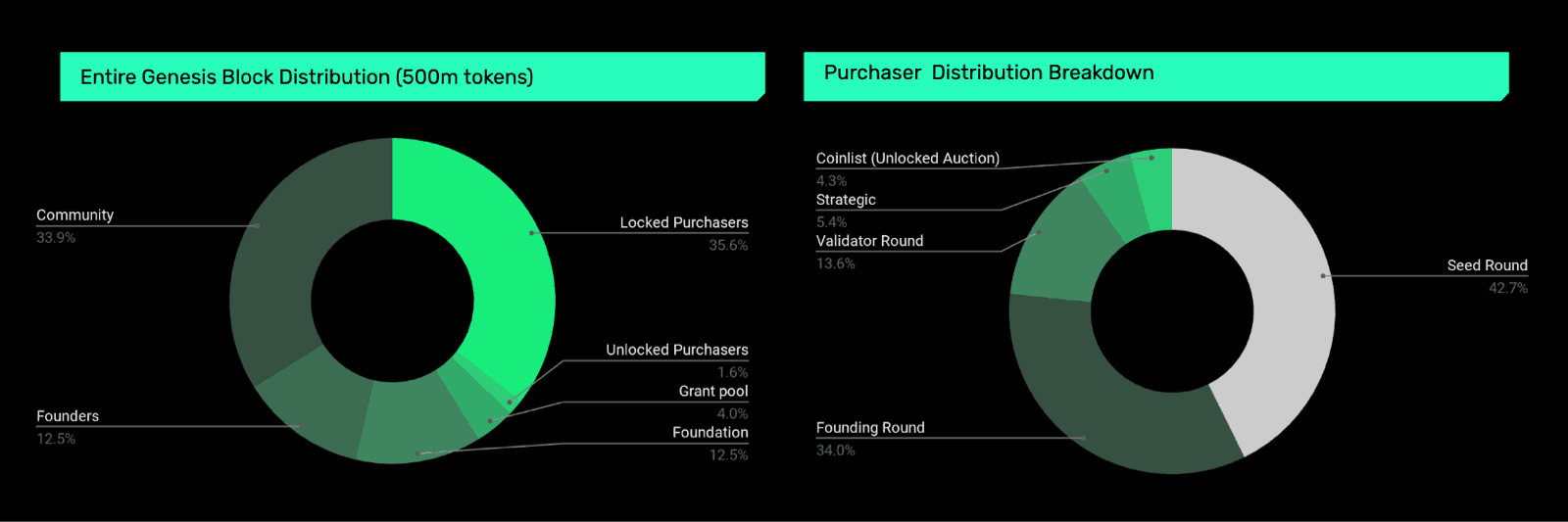
Additionally except for eth all have the fundamental problem of extremely centralized distribution. This [1] extreme centralization is representative of new VC coins. That tiny sliver of 'Coinlist (unlocked auction) 4.3%' is the only part that was available to non-insiders.
[1] https://icodrops.com/wp-content/uploads/2018/04/Solano-token...
I'm also wondering about the resiliency of PoS. The PoW used in Bitcoin has demonstrated resiliency against attacks, and none of the attacks have been successful so far, that I know of.
It's not just miners, it's also full nodes that validate.
Full nodes can disagree with miners: instant fork.
If say Putin would acquire 51% of mining hash rate people would realize (before he gets there) and would fork.
My comment is not in support or against PoW, I'm just stating the fact that PoW isn't inherently unsafer than PoS.
After that, if the fork becomes popular, the attacker moves and attacks it again. Are people supposed to fork once per week? At that point it's not PoW consensus anymore, because the interventions move from emergency to normal, and you're under something else.
Bitcoin (the network with the most mining effort) lost 25% of their hashing power due to blackouts in Xinjiang. (Soure: https://twitter.com/nic__carter/status/1384938089748041730?s...) State capture of a majority of Bitcoin miners is comparatively easy.
In addition, independent miners have less hardware and that hardware is generally less efficient when compared to the large ASIC farms. In reality a recovery would probably require social consensus and a hard fork
Many of you in this thread need to read up on how the staking is designed to work.
With PoW you can corrupt many miners, but the other superpowers can spawn new miners to counter act.
And other methods introduce the possibility of stake grinding.
BOTH converge to the same energy usage as mining.
OTOH, the legacy financial system is significantly more energy intensive for a given financial network value. You don't think banks and wars in the middle east to maintain the value of the network have an environmental impact?
Slashing stake is significantly more arbitrary. You basically need to reset the coin's ledger in order for it to make any sense.
It's only possible once, and this move is so obviously predictable any determined attacker is going to have gpus ready.
That isn't relevant to the conversation of stakers having misaligned incentives to change the rules. The most a state level actor can do is censor transactions if they were to take over a chain.
With PoS you'd need to slash the validators stake on a fork; which isn't going to happen because the stakers run the validators everyone is using. You already saw this with the steemit takeover.
In PoW coins, the miners and validating economic nodes are two separate groups. Watch what happens when exchanges slip over to Eth2 nodes and call it Eth.
During the BCHA/BCH split the exchanges were the ones that decided the ticker. Most users have ZERO CLUE about what happened. They went on their with their lives calling the fork the exchanges chose BCH. Once exchanges are validators there is no bulwark against changes.
Proof of Stake as setup gives all the power to people/companies who have large amounts of liquid assets.
Consider Amazon, they keep a rolling window of cash in-between when an item is sold and when the seller gets paid. This effectively gives them billions in interest-free capital. If this were Etherium, it would translate into huge amounts of voting power.
Likewise, if/when people deposit their etherium into banks, those banks can then leverage that "free" capital to grab huge voting stakes that wouldn't otherwise exist (because no person living paycheck to paycheck has the equivalent of 100k sitting around).
This leverage simply does not exist with proof of work.