https://i.imgur.com/g78YNla.png
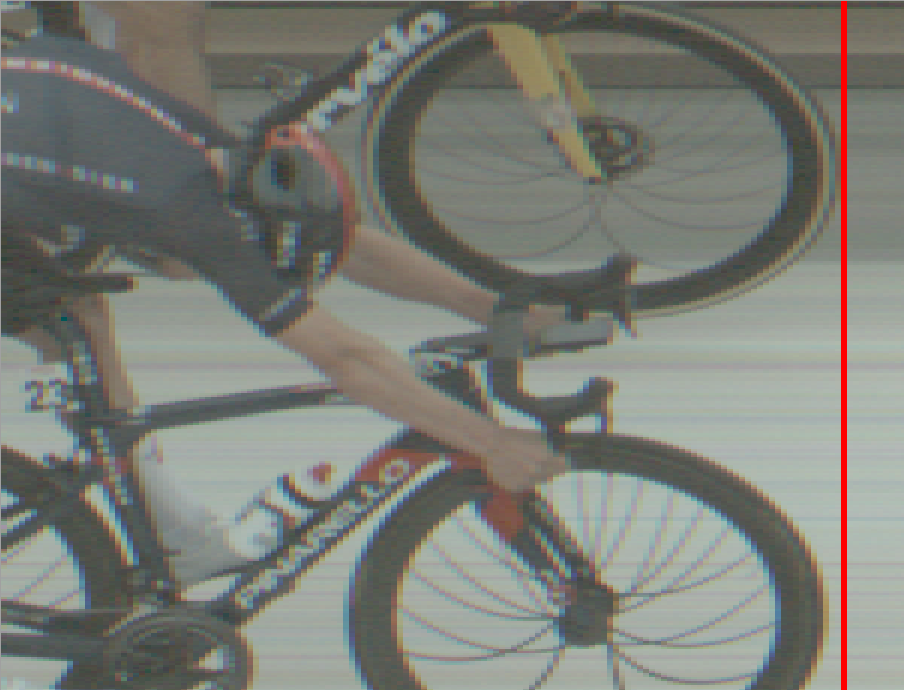
Each pixel column is a specific point in time. I added a few landmarks: when the front of the wheel passes the camera view, when the axis of the wheel passes the camera view, and when the end of the wheel passes the camera view. Blue for the top biker (Wout) and green for the bottom biker (Tom).
Every single event happened earlier for Wout. Both wheels are the same diameter. Therefore, the entire period where the wheel intersected the camera view, Wout's wheel was ahead. Including the exact period where Wout passed the actual finish line.
If Tom would have passed Wout, you would expect that the bottom wheel would be more "squeezed" such that the end of Tom's wheel would have passed the camera line earlier than Wout. Same for the other landmark (centre of wheel).
You can add more landmarks if you want (e.g. approximate when the wheel passes for 25% and for 75%), but it should be clear by pure margin that Wout had the lead for the whole duration where the front wheels passed the camera view. Pretty much all the computation in this article was unnecessary.
Amstel gold made the good call, though I agree that it was probably more luck.
Unfortunately, there's no reason to assume this was true. Almost the opposite! If the operator did set up the camera correctly initially, and we know the far end ended up pointing to the wrong panel (got a knock?), this makes it more likely it was skewed so as to advantage the most distant rider. And that was Van Aert.
If this is correct, then it suggests a way to estimate, and correct for, the skew, as we have other photos and videos showing approxinately how far the riders were from each other and from the camera, as well as their trajectories as they crossed the line.
The argument is that if Tom was travelling faster, the distance could have been made up in that time, potentially for a win.
My point is that Wout was ahead for the /entire/ duration where the front wheel intersected the camera line. The wheel's diameter is bigger than 20cm, so the moment when Wout passed the actual finish line is included in this interval. Therefore, Wout was ahead when the winner passed the actual finish line. QED.
As the OP demonstrates Wout was ahead even at landmarks over 20 cm from the front of the wheel the only way Tom could win was if his front wheel physically elongated over 20 cm in those last milliseconds.
If it was nudged by a gust of wind or something, it seems very unlikely that the camera would have moved a full 20cm but remained parallel to the finish line.
For the center of the wheel, Wouts looks slighty too early and I think due to the larger size of Pidcock's hubs it's hard to determine the center here too. As for the rear of the wheel, Wouts gum wall tyre is hard to see.
So all in all, it does seem likely Wout held the lead. However, a well times bike throw can change a riders speed momentarily for a short period of time and based on the video Pidcock's bike throw was significantly more effective than Wouts. So while I'm not going as far to say Pidcock would have won, I'd say there is a chance Pidcock had the lead momentarily, and that moment may have occurred as Pidcock crossed the actual finish.
Maybe you could also look at how deformed the wheel perimeter compared to a perfect ellipse to estimate the speed at different points?
EDIT: Or you could calculate whether it's humanly possible to move a bike a few centimeters forwards and back again in about 15ms, which I think the hypothetical bike throw must have been for Pidcock to be the actual winner?
Even if the camera were 10 cms off, the fact that the back of Wout's front wheel passed that mark before the back of Tom's front wheel must means that the front of his wheel was still ahead at that moment. (Assuming same sized wheels.)
https://en.wikipedia.org/wiki/Photo_finish#Strip_photography
The main point of the post is that the photo you are showing is not the photo at the time the two guys crossed the line
This was my first thought. Then I thought about it some more, and became persuaded I was wrong. I definitely did read the article.
According to the explanation in the article, it’s a narrow slice, so the back of the wheel would be photographed when that passed the finish line, even if ~30cm out – at which point the front would be clearly over the finish line.
The point being that the wheel is bigger than 30cm. It’s subtle, but I’m persuaded – unless I’m missing something, like them not having or not actually enforcing wheel-size regulations.
I personally find it very difficult to reason about something that looks so much like a photograph where only vertically-aligned points were taken at the same time.
Unfortunately this isn't true if the camera line is not parallel to the finish line, which it probably was not.
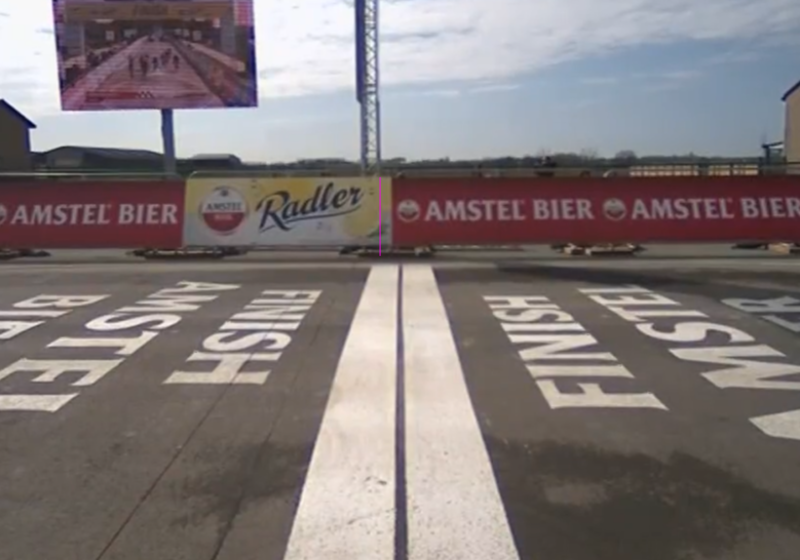
https://www.tglyn.ch/blog/images/amstel_barrier_closer.png
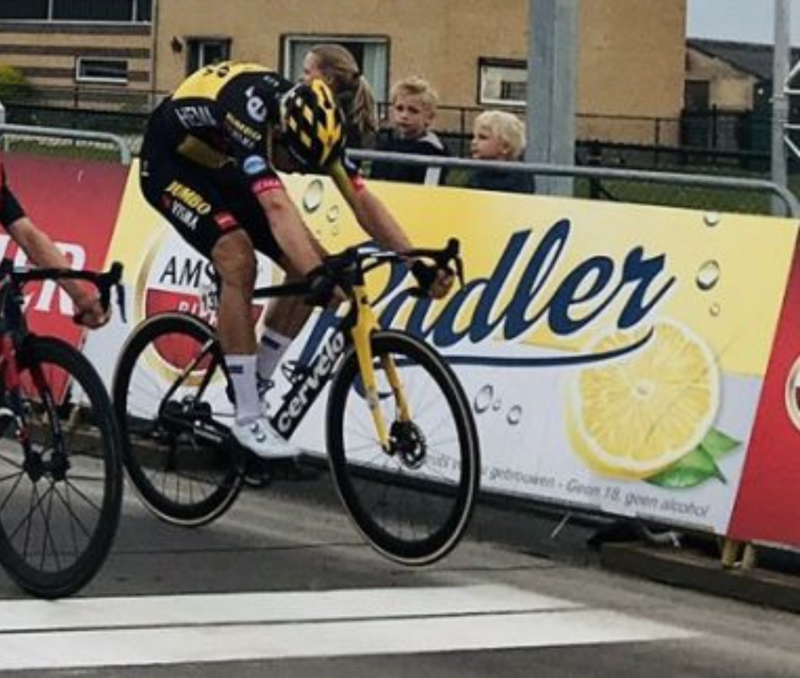
The left bike is on the white paint while the right is not. Clear that the left one is slightly ahead of the right
However, I question humanity’s sanity when we declare a winner in a 216.75km long race by someone who (possibly) won by 0.016 seconds (and poorly declared either way from the article).
At what point do races become a tie instead of 1st/2nd ? Just because we can doesn’t mean we should. I mean, if we had a camera that could take 350,000 photos per second does that mean we should use it to declare the winner?
I remember this issue came up in swimming a few years ago, and people were arguing that the timing measurement was finer than the tolerance for error of the measurement of pressure on the pad. We still talk about that race venue today: https://www.theringer.com/2020/7/29/21345181/milorad-cavic-m...
This article seems to make the argument quite well: https://olympics.time.com/2012/07/27/technologys-touch-how-a...
https://deadspin.com/this-is-why-there-are-so-many-ties-in-s...
Cycling races are much the same with a team dynamic included. It's a matter of choosing between setting a pace that a sprint finisher can't follow over a long period, or sheltering a sprinter from the wind so he can put in maximal effort at the end of the race. There are all sorts of variations based on strength of team, weather, terrain, luck, politics between teams, race goals, etc...
Moral of the story is that human error (be that of a mechanical nature) will always exist, but more care should be given in competitive sports. If you do not have the means to decide the winner, call it a tie, but if you do, even at the cost of a 350,000 photo/sec camera, then do it, but by all means do it correctly, because it might cost someone a gold medal at the Olympic games, and for the sake of people who put their life into competitive sports, this should not happen.
In cycling races that are not time trials it is disadvantaged to be in the lead until the last 0.016 seconds. The peleton in the video was quickly catching up to the three lead riders not because they were tired but rather because they were fighting to be in third position. It is just as much like a strategic game of chess as an endurance sport. Because of this, the game only works if a contender can win by a hair's length.
In general I think in sport we should use replay tech to eliminate errors that human judges can make, not improve accuracy beyond what was possible for them to see (because fundamentally these are philosophically vague). And then just have rules for ties that are good for the sport: ties go to the runner in baseball, offsides go to the attacking player in soccer (I believe the dutch do something like this by using thicker lines for their VAR?), etc.
But with cycling the whole game is decided by the finish, so I think that makes a bit harder to come up with a satisfying approach.
I was curious what the actual rules are about calling ties. Apparently if there's no photo finish tech and the sprint between 2 riders can't be decided its called a "dead heat":
> if the finish takes place on a road, the two riders will race against one another over a distance of 1000 m, from a standing start
https://www.uci.org/docs/default-source/publications/practic... (page 26)
Which sounds awesome to me. If it's a group of 3 or more they are just declared 'equals'.
The rules for ties with photo finish tech (basically all pro races afaik) is kind of weird? All I could find was:
> If, after all technical means available have been exhausted, it is still not possible to separate riders for one of the first three places at the world championships or Olympic Games, these riders shall each be awarded the placing in question. No award shall be made for the following placing, or, where there is a three-way tie, for the following two placings
- Rule 2.3.043 in the UCI Road Race rulebook
Not clear what that means for races like Amstel...
https://www.olympic.org/news/double-gold-medal-joy-as-oleksi...
So to solve this they just don't measure beyond hundreds (no human can swim fast enough that the distance they travel within 0.01s could make a difference). And thus can not use photo finish either as again the lanes are not guaranteed to be the same length.
https://interestingengineering.com/significant-digits-and-po...
edit: In other sports like running it is easy to have accurate track length as you just paint the lines after building the track so you can have it as accurate as you want (+photo finish). In swimming it just does not work like that.
On one side it's unfortunate that technological details and possibly human error make it hard or controversial to decide the winner for this race, on the other side this event has kept the cycling community talking for 3 weeks (even HN is talking about it right now). And most likely in the next few months or years we'll see some rule/regulation changes to handle these cases better. Just like in politics, something needs to happen first before action is taken. All the recent rule changes were triggered by dangerous crashes or other events.
And imho all of this combined makes pro-cycling one of the most exciting forms of entertainment to watch or follow.
A little side note: Many amateur races don't have photo finish equipment. In my race days sometimes not even a camera, and 3 race officials would stand on a little platform above the finish line with voice recorders just calling out jersey numbers and then get together in a room for 20 minutes to compare recordings and compile the final result. Draws were much more common back then.
edit: all of the previous races and media coverage and drama and the first 250k in this race have led to this super exciting final 1k that is ultimately decided by millimeters. To me that is beautiful.
Interestingly, technology makes this trivial these days:
Pop a cheap Android phone on a tripod, and with the right software (or even just taking a video), you have a decent approximation of photo finish equipment.
(I say 'trivial', because a smartphones with the required capabilities are basically free, if you take an old, used one.)
Still, I think there will always be a place for a stone-faced commissaire with a clipboard, freezing their ass off in the finish-line rain, watching the bunch draw near.
The curve of the spokes should mean we can determine the distance the rider has traveled after the photo-finish camera.
I cover my other ideas in the 'Further research required section' about 75% of the way down the article. If you have any further suggestions please let me know. Tom
However, I think @gorgoiler [1] has made a valid point regarding the intersection of the "finish plane" and the plane recorded by the camera. (On the photo shown on your blog, the camera appears to be mounted slightly behind the finish line, thus, intersecting the "finish plane" at the ideal height, should point to just before the finish line at ground level. But there isn’t sufficient information in the photo to measure such a minimal angle, or to confirm, if there's any at all.)
To reason on why this might be true - consider that the bottom of the wheel is stationary, and the top of the wheel is moving at twice the speed. This is the case regardless of the speed of the wheel. If you rolled the wheel past the camera really slowly, the entire wheel would be stretched out horizontally, but the spokes would all be in the same arrangement.
The reason for this is that the camera is a fixed position line scan where the variable is time only. If we switch to thinking about standard video cameras with a rolling shutter, then these have a line scan where the variable is time and space - that is, the camera samples a scan that is moving at a known speed. If you have a video with a camera like this of helicopter blades, for instance, then you can determine the blade rotation speed from a single frame. But with this finish camera, that doesn't work.
So, to determine speed, the best possible action is to pick two points on the rigid body that is moving, and time how long it takes to pass the recording line. The further apart these points are, the more accurate the average speed determination will be. The trade-off for this is that the speed measurement will be the average between the time the first point and the second point passes the recording line, and we are only interested in the average speed at the point the front of the bike passes the line.
What we can show however, as pointed out elsewhere[0], is that one bike was in front of the other when the front of the wheel, the hub of the wheel, and the back of the wheel passed the recording point. When the back of the wheel passed the recording point, the front of the wheel definitely passed the actual finish line, so assuming the two wheels are the same size then the front of that wheel passed the finish line before the other one.
On the other hand, with the tight margins involved, it might be that the ratios are not comparable due to the fact that they are not the same distance from the camera.
Isn't it possible to extrapolate the movement from the last few frames of the image sequence?
If you’re painting a line then the “finish line” is where that plane touches the ground. For other races it might be a piece of tape held at chest height — the part of the body that usually goes through the plane first.
When the competitors are bicycles then they all the same height — the middles of the front wheels are all the same height off the ground, something on the order of 400mm. The finish line is floating about a foot off the ground.
The specialist streak camera photographs objects passing through a 2D plane. Ideally you would have that plane aligned vertically so that the finish plane and the camera plane were the same.
If for some reason you couldn’t do that — let’s say the camera could only be placed a few feet in front of the finish line so as to see around an object — then you would have to arbitrarily angle the camera plane to intersect the finish plane.
The intersection of these two planes will give you the “finish line”. For a bicycle race, do you set it up so that the finish line is on the ground, or floating 400mm above the ground? If you do the latter then the projection of the camera plane into the road will indeed give a line that stops short of the finish plane, but that’s irrelevant — the actual finish line at the middle of the front wheel is in the correct place.
I think the article assumes the former when the organisers did the latter?
In another comment I was discussing the tech being somewhat outdated - perhaps your suggestion is part of the solution. Would two cameras on different planes result in more accurate results?
Moreover, if the camera is used to identify the times and finish positions of all the riders, it’s probably quite hard to identify them from above. Perhaps a streak video synchronised with TV footage would be convincing?
How about a prismatic laser and fog machine at the finish? It’ll look like an 80s rave but the streak camera will clearly show where the finish is.
A man with one watch knows what time it is. A man with two is never sure.
An ordinary camera would work if mounted rigidly to the car, you could shoot a video and then take out the center line after the fact. 55 miles/hour is about 80 ft/sec so the horizontal resolution is a little bit more than a foot with a 60 fps video, you could make out houses but not read house numbers.
I think most webcams have a low-level interface that would let you read out part of the display without reading the rest so getting a better frame rate could be done at low cost too.
I think I'm going to try taking pictures of clouds first...
1. from the diagnostics port under the steering wheel I can get the speed of the car from the car's electronic control unit
2. a hiking or computer GPS could be used, probably anything that isn't marketed as a car GPS is OK, the car GPS probably makes awful tracks because they don't want you asking questions like "how much faster can I do the quarter mile if I wrap the exhaust pipe, load this software patch into the the ECU and, take out the passenger and rear seats, radio, glove box cover, wiper blades, and bumpers?"
3. You could add an accelerometer and use a Kalman filter to combine that with other information sources to estimate vehicle position. Consumer accelerometers aren't that good, you are taking $2500 or so for one that car racers use.
I analyzed it to death and came to the conclusion that 1 will be good enough for a project which is the reverse of the camera being described: that is, put a neopixel strip on the side of my car and generate i think high quality images at night if someone happens to be focused at about the right distance but NOT tracking the vehicle.
As someone who has both won and lost bike races determined by photo finish, I enjoyed this article a lot. Well done sir!
> The black line is a visual approximation of the placement of the finish, but the image from the photo finish camera is the true arbiter of the result – not the other way around. It’s technical and it’s a bit confusing, but it’s clear-cut and the riders and officials are playing the same game with the same known set of rules.
> According to UCI regulations, the photo finish verdict is final, because the finish line is what the photo finish says it is.
Which makes most of the detective work here sadly pointless.
Pidcock probably didn't need to tweet his take, in the same way he didn't need to post that ridiculous bogus 5k time! https://www.rouleur.cc/blogs/the-rouleur-journal/the-column-...
Either way, presumably both cameras ideally need to be aligned to the line as stated. That should be possible and perfect alignment between the two cameras isn't required. I can't see anywhere that it states the two cameras actually need to agree, isn't it fine providing one of them is used consistently.
a) in the horizontal axis, everything changes at 6 pixel intervals, I'm going to call those samples
b) I count ten samples as the narrowest of the front tire at both the early samples and the later samples of both riders. (including the fringing).
c) there's a two sample gap between the front of the front tire of the top rider and the bottom rider (pixels 835 - 840 for the top rider, and 823 - 828)
d) there's also a two sample gap at the back of the front tire (pixels 355 - 361 for the top rider and pixels 343 - 348 for the bottom rider)
I'm not invested enough to try to figure out other points of reference to compare, but it seems likely that if the riders were separated by two samples when their front tires entered the line of sampling, and also separated by two samples when their front tires left the line of sampling, that they were separated by two samples throughout that time. Since they would have crossed the (marked) finish line while their tires were being sampled, I'm comfyish saying the bottom rider was 2 samples behind the top at the finish line.
If my calculation is right, each front tire took 80 samples to clear the line of sampling; and if it was 2000 samples per second, that's 0.04 seconds for the bikes to clear the camera; might that be enough time for the second bike to have been pushed forward and pulled back such that it may have won; I dunno.
also e) now I've used up my evening time I had meant to do something else with :P
You guys may be on to something. Maybe worth looking at the axis of the wheel crossing the finish?
If the front hubs were easier to distinguish, I'd have liked to compare those, but it didn't seem clear like the tires.
Interviewer: Is it possible that the photo was taken a wee bit before the black line? Photo operator: I doubt it... I doubt it because we really took a good look if it's all been set up correctly.
While all folks involved here take great pride in their work, the alignment of the camera just never got the attention it clearly deserved. No one ever did the math and they just assumed the difference wasn't significant. Also, people just liked it better to align the camera on the white part of the finish line, since it greatly improves the contrast of the capture. I am sure the equipment has improved, but for a long time, the only thing you were concerned about was contrast, a sudden change in weather (lighting) was known to, at times, render the entire operation useless. Particularly since we were a small operation with only one (photo-finish) camera. Plenty of times I had to climb up ladders and vans to make eleventh hour adjustments to the equipment, with the contestants already in sight.
I feel super bad for the guy. To his defense, the responsibility lies with the UCI officials. To their defense, they do not check up on details like this. Until now, that is.
I remember at least one other time where the broadcast camera (they also tend to have one exactly on the finish line) seemed in disagreement with our "official" photo finish results. That time, a simple shrug did the trick: "hey, photo finish, you know".
And 99.9% of the time it wouldn't make a difference, he's just very unlucky that this time it may have (or may not have, but either way it's brought a focus to the camera position).
I see you're now a software engineer. How did you end up moving from photo-finish operations to software?
Or maybe rules are already exactly that?
Perhaps they could include some margin of error; if the photo is in that margin, the result would be a tie?
It might also be possible to undistort using some assumptions on colinear points in the video (i.e., the finish line and signs should have straight lines).
It might be possible to res it right up using that new photoshop feature. A joke obviously...
EDIT: nah nothing interesting there. It may have been stripped when they emailed it to me?
The computation by the author of the article indeed confirms this: https://www.tglyn.ch/blog/images/amstel_approx_line.png
My point is that it is the painted line that was not correctly placed rather than the camera.
There are usually tons of rules in sport about the equipment, the Race course etc . but how exactly the finish needs to be set up is often vague. In this case it was an alignment issue at fault. But the next problem is the arbitrary resolution finish cameras work at. How wide is the pixel slot? This can be the difference between calling a tie or a small margin.
[0] https://www.rowinginmotion.com/thoughts-fairness-rowing/
Wouldn't it be better to set up multiple high speed cameras at different angles
Not to mention a high speed camera misaligned on the finish is going to produce similarly skewed results. Anything not happening exactly along the optical axis is getting distorted by perspective. At least a line camera doesn't pretend to have accurate information on anything except the line you aim it at.
This error is pretty comical to me because aligning the camera is the first thing we do after putting the camera up and looking at their images, it's pretty clear it wasn't aligned properly. The cameras can auto-align, but we didn't trust it and manually aligned it, but I'm wondering if maybe the event organizers auto-aligned and didn't bother to check? The cameras are mounted on a motorized base that can move in 3 dimensions with very fine precision [0]. In the OP, you can see the event organizers have a black line across the finish on a white base. In order to manually align it you just have someone run back and forth across the line and move the camera with the computer until you pick up the very left edge of the black line, which is very clear because you can see the ground change from black to white in the image (or vice versa depending on where you start).
We also used to always put a white piece of wood behind the line so that the images would always have a white background. This makes it so much easier to detect the edge of a torso when clicking on a person to indicate their time. In the OP, if their camera was aligned correctly, red would've been a tough background color. Also a black line is questionable. I would've had a white line on black base for the same reasons.
[0] https://www.finishlynx.com/product/accessories/camera-mounti...
Wout!!!
> According to UCI regulations, the photo finish verdict is final, because the finish line is what the photo finish says it is.
https://cyclingtips.com/2021/04/making-sense-of-the-controve...