The deduction still exists. The current limit on the deduction was adopted fairly openly as way for the federal government to artificially incentivize state tax cuts.
The effort to eliminate that limit isn’t an effort to ”save the rich”, its an effort to save the state taxes that support the state services that are part of the recipe for economic success in states on which the federal government disproportionately relies for tax revenues. Limiting the SALT deduction wasn’t about raising taxes on the rich, it was about increasing federal extraction from certain successful states in the short term, strangling those state governments in the medium term, and—in easily forseeable effect if perhaps not actual intent—torpedoing the national economy and tax base in the long term.)
I never thought I'd move for tax reasons. I am moving to TX this year.
Every analysis I've seen is that (1) CA has small net domestic out-migration, but (2) the domestic out-migrants are significantly less well off the domestic in-migrants, and (3) at least before the last couple years (Trump immigration restrictions and then the pandemic probably changed this in the short term, but neither is likely to persist in current form and effect) the net domestic out-migration was more than balanced by international immigration.
California isn’t bleeding “people with money”, its bleeding “Americans without money”. Which is in part a sign of real issues that should be addressed, but its also in large part a symptom of success and the rich outbidding the poor for limited real estate.
Let's say a group of people with a government wants to build a park. The get together, vote to decide how much money everyone's going to contribute, everyone ____, and they build the park.
____ is the SALT deduction.
The only reason not to have this deduction is to discourage (non-federal) governments ability to do anything.
Arguments of 'it's free money for the rich' are a misdirection - if you want the rich to pay more money, increase their taxes, don't limit state and local governments ability to collect revenue.
The only hypocrisy is the folks arguing against it will turn around and holler 'States Rights!' when it's politically convenient for them.
The cap on SALT deductions does no such thing. All it does is cap how much state and local taxes someone can deduct from their federal taxes. State and local governments are still getting their tax revenues. 90% of tax payers were completely unaffected by this change, the remaining 10%, who make up the highest income brackets, paid more federal taxes as they could only deduct $10K of their state and local taxes from their federal taxes.
> increase their taxes
Capping deductions increases their taxes.
Either 1) A local government increases taxes to build a park
2) The federal government increases taxes to build a park
And Either A) A SALT deduction exists
B) A SALT deduction doesn't exist
And independent of this, the federal government collects tax on income to do whatever it currently does.
1A) people end up paying: (income - income.(park tax)).tax - income.(park tax) -for-> park + std_services
2A) people end up paying: (income).(tax + park tax) -for-> park + std_services
1B) people end up paying: (income).tax - income.park_tax -for-> park + std_services
2B) people end up paying: (income).(tax + park tax) -for-> park + std_services
Note 1A, 2A and 2B are all equivalent. In 1B people pay more overall tax to get the same services.
So under B, any reasonable person given the choice between 'should the local government build the park (1B), or should the federal government build the park (2B)', should logically choose 'federal (2B)'.
IE the local government's ability to do build parks is weakened by the lack of a SALT exemption.
The number of people itemizing before the TCJA was about 46m, the number after the standard deduction was doubled is only about 16m. There are about 143m people filing returns in the US (taxpaying units).
So about 10% of US taxpaying units still itemize meaning they're deducting more than $12k individually or 24k jointly.
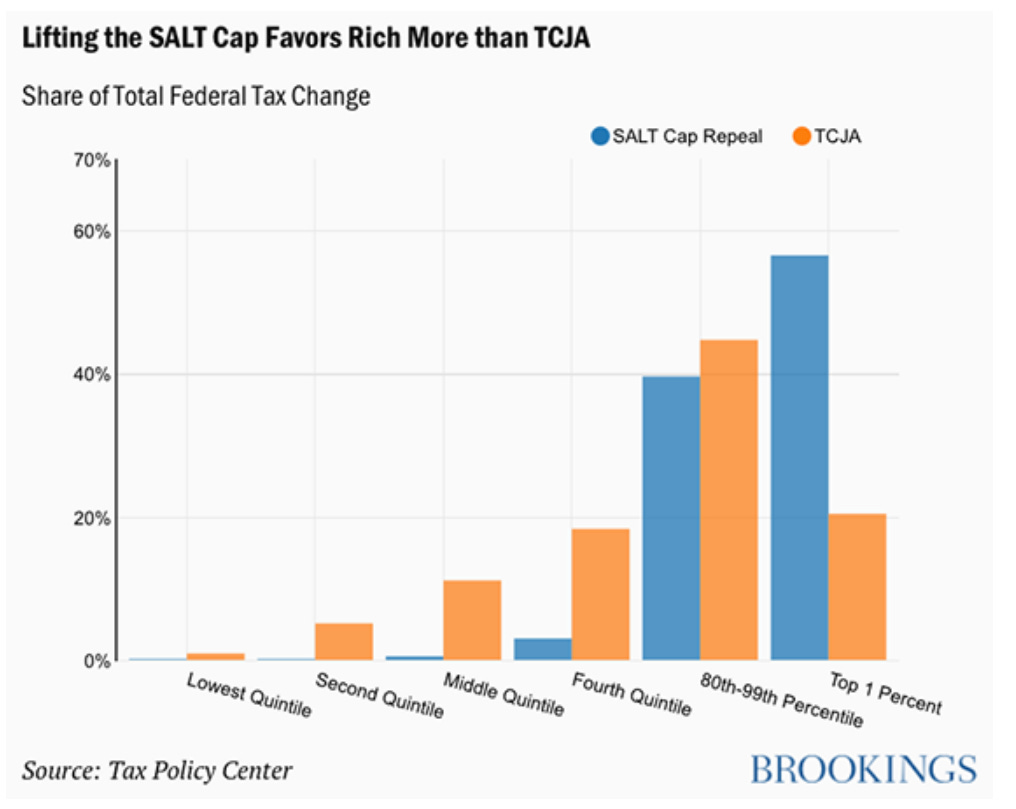
This issue disproportionately affects the wealthy. The top 10% of income earners are getting bitten by this, and the top 1% especially so.
As the TK article illuminates, the US would lose $600 billion in revenue by repealing the SALT cap. That money comes disproportionately from the top 1% as illustrated by the graph from the Brookings Institute: https://cdn.substack.com/image/fetch/f_auto,q_auto:good,fl_p...
The article quotes a guy saying the SALT cap was the only clearly progressive tax policy the Trump administration ever implemented.
So yes, it's funny though not altogether surprising to see the Democrat senators and senior House members (all of whom seem to be in the affected income bracket themselves) pitching this deduction for the wealthy as a fight for 'working families'. It is impossible to even entertain the idea unless open to the idea that supply-side, trickle-down economic theory has merit, which is also a humorous dimension of the Democrat rhetoric.