It sounds like it's complaining about the use of ES modules. This script is loaded with `<script type="module">` and uses ES imports (`import App from './App.svelte'`).
Yes, Safari is expected to go bang (doesn't support module Workers).
I target Chromium's featureset — I developed on macOS Edge. macOS Chrome and Android's Chrome WebView work for me too.
It needs a few modern features in order to work:
  - Web workers
  - WebAssembly
  - top-level await (on Web, and in Worker)
  - ES modules + imports (on Web, and in Worker)
  - requestAnimationFrame in Worker
  - WebGL2
  - OffscreenCanvas
So the primary blocker to Firefox support is support for OffscreenCanvas, and requestAnimationFrame in Worker. There's other options there: render on the main thread instead. Harder to develop (syncing timing + state between threads). Can probably be done performantly with SharedArrayBuffer.
In truth, I did include error-handling to provide a compatibility explanation if the worker explodes. This displays in Firefox. But I hadn't expected the main thread to explode too.
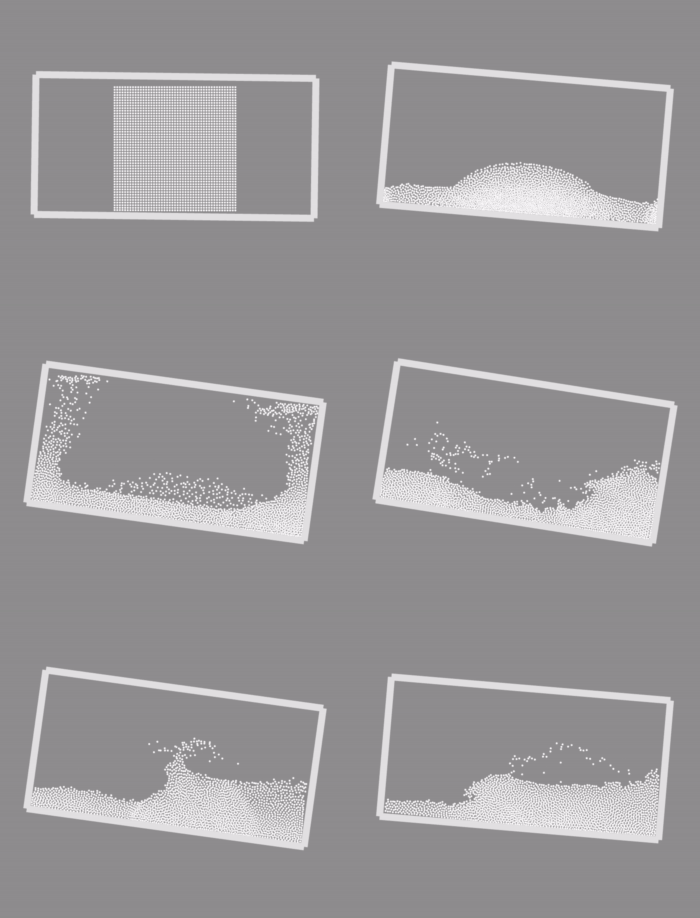
Here's a GIF of what it's supposed to look like!
https://developer.mozilla.org/en-US/docs/Web/API/OffscreenCa...
nor does it support top level await
https://developer.mozilla.org/en-US/docs/Web/JavaScript/Refe...
But I'm not sure using top level await was a good idea at this time. Can't really open it in Firefox mobile either (due to import syntax).
(I see reports here of it also not working on Firefox, which must be another reason, as FF does support WebGL2 and WebAssembly.)
60 second explanation of the three APIs:
WebGL 1: vertices and triangles are stored on the global GL context object and need to be rebuilt every frame. Shader language is a very goofy, somewhat obnoxious GLSL lookalike. You can write vertex and fragment shaders, which are the necessary ones to render, but also the least interesting. Post-processing is a serious pain. FPS is limited by bandwidth to submit to the GPU and CPU usage can be stupid high.
WebGL 2: improved shader language (much more similar to GLSL, better compilation, better branching), still only two pipeline stages. Render buffers, depth buffers, multidraw, allowing for modern techniques like deferred rendering and efficient shadowmaps. Vertex attribute buffers are their own thing amd dont have to be freshened for every draw call. At this point webGL is similar-ish to native opengl with a bunch of missing features. In webGL 1 you had to do things very differently from a native api, which was very slow, messy, and annoying.
WebGPU:Vulkan came out! And everyone learned that oh, actually having everything on a single thread really sucks, huh. OpenGL has a global context that prevents great threading- have to make draws from a single thread, even if you can construct buffers etc in job threads (minor improvement) you have to sync back. Vulkan and webGPU let you submit to command buffers with their own contexts. In WebGL 1 you had to rebuild and rebind all of an object's vertices every time it had a drawcall. In WebGL 2 you built them once and just have to rebind each one in series for every frame. In WebGPU, you can bind in parallel from webworkers. Not ideal parallelism, but shockingly good for javascript. For some things like shaders, you don't even need to recompile, which is a hard-to-avoid main thread blocker in WebGL 1/2.
WebGPU can also do compute, which rules- many complex AAA techniques really require this and don't work on WebGL because it wants to send all its render buffers back to the CPU.
Zero assurances that a WebGL page actually works, given the browser, OS, and possible list of black listed devices.
No debugging tools, SpectorJS is the only surviving one.
While WebGL 2.0 lags behind GL ES 3.2, WebGPU at least a decade away to even reach WebGL 1.0 market share.
What's the benefit of using WebGL compared to Canvas?
Does the WASM bring a performance improvement in practice, relative to the equivalent JS library?
Keep it up!
And that just optimizes the physics—there's even more parallelization with the actual drawing! Drawing a bunch of points like this can be achieved using a single fragment shader that takes a big array of positions. Drawing new positions involves just copying the array of positions from the CPU to the GPU.
But if you're using both vertex and fragment shaders, the GPU might entirely handle updating and drawing points over time (and thus can be parallelized across hundreds of cores), only needing the CPU to set up the initial point positions and get things started.
With canvas, all the work (including rendering each frame) takes the JS main thread, running on the CPU.
Here's a cool demo of how much better WebGL is at rendering a ton of 2D sprites! Be careful turning up the number of sprites with canvas—it might lock up your main thread and be difficult to undo.
https://bl.ocks.org/DevAndyLee/raw/a901617de28912b1e3cbdc6e8...
As an aside: there are new standards in the works for getting even the CanvasContext2D rendering off of the main thread. On an HTMLCanvasElement, you can call transferControlToOffscreen(), which will retrun an OffscreenCanvas object. That object can then be transfered to a Worker. From there, you can create the 2D rendering context (make sure you don't create any 2D contexts on that canvas in the main thread) and draw to the canvas in the worker (you can do this for WebGL contexts, as well).
All the drawing ops performed on the OffscreenCanvas will appear in the HTMLCanvasElement immediately, without having to perform a callback message from the Worker back to the main thread.
https://developer.mozilla.org/en-US/docs/Web/API/OffscreenCa...
Unfortunately, OffscreenCanvas is still in development in Firefox, only accessible behind a flag. In my testing with the feature enabled, it also seems that Mozilla hasn't implemented 2D contexts in Workers, only having the WebGL context available, which is quite annoying.
I don't know the status in Safari, but Apple has historically been very slow about implementing new features.
Ah, how was it again regarding IE?
SyntaxError: import declarations may only appear at top level of a module