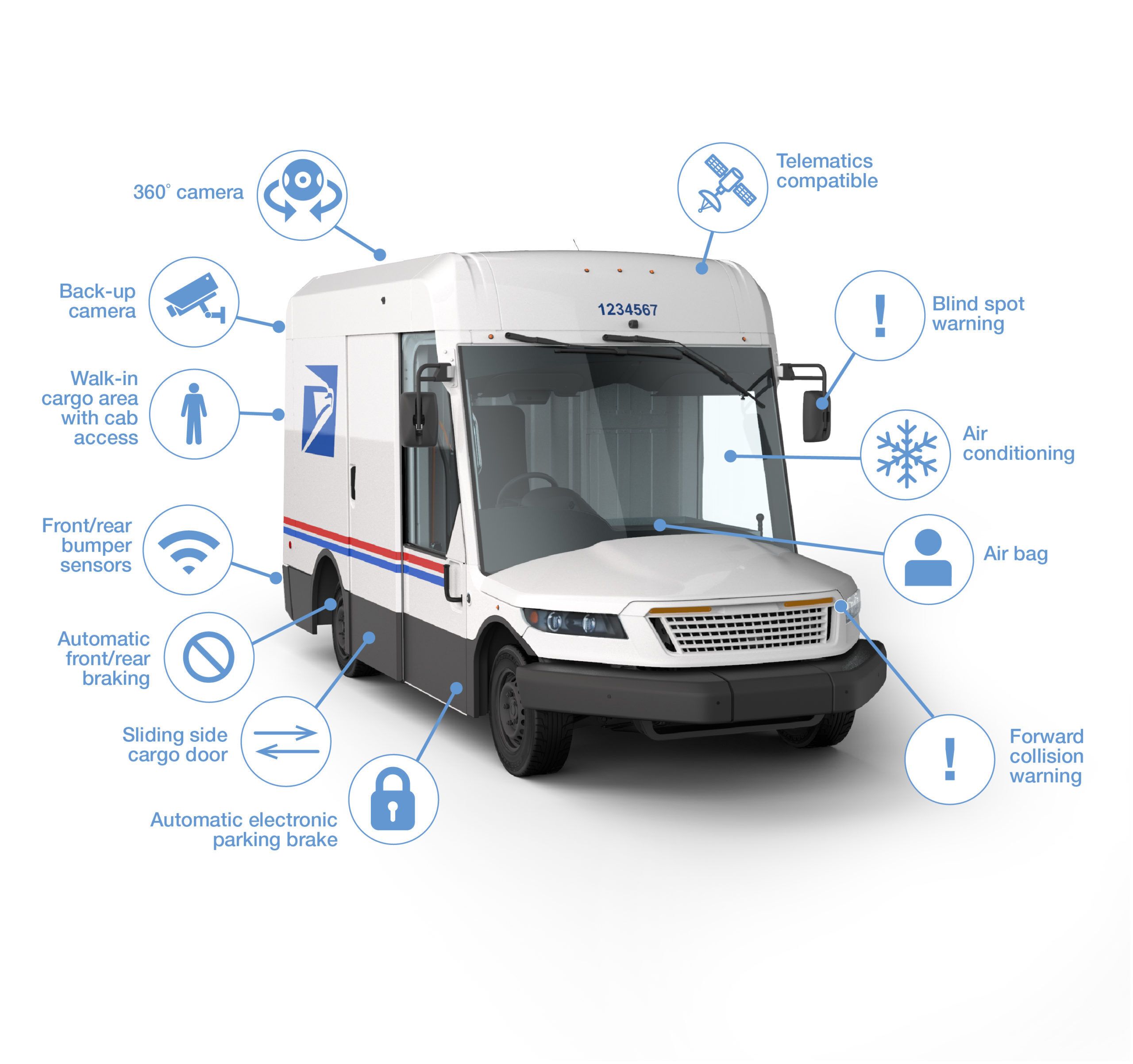
Also, these have air conditioning!! What a luxury! The previous ones did not have that. Just a sad little fan that barely did anything.
Postal workers don't care what the vehicles look like, they want practical safety features that help them do their jobs.
Form really follows function.
US should be on the left side right? The figure shows right side...
However, postal drivers get out of their vehicle all the time, and often on roads not meant to have vehicles pull over. Therefore them getting out from the right hand side prevents them from having to exit into traffic.
What's my maintenance costs and times gonna look like?
Will it be ergonomic to get in and out all the time?
Can this vehicle pull out into traffic easily?
Is this vehicle gonna be a fatiguing pain to drive?
The features list almost raises more questions than answers. Half the tech they highlighted comes with a very high risk of being worse than the manual solution it's replacing if the tech is not up to par. Nobody wants to wait for the automatic door to close to put it in gear.
Edit: So why is this opinion so unwelcome here, because I'm not on the "more tech more better" bandwagon or something of actual substance?
Also, they are too small to make a decent food wagon.
This is a cop-out. Especially when it's the government (notoriously hard to sue) selling. "You couldn't normally sell this stuff to consumers" gets sold on govdeals and ironplanet all the time.
Additionally, the LLVs likely meet applicable NHTSA regulations and FMVSSs for the year they were made and their class of vehicle.
Edit: Also, the other direction, you'll see a lot of LHD cars in the UK where American troops are deployed. That's a pretty specific loophole, but I remember getting a lot of confused looks driving around.
I have an Oshkosh P19, an aircraft/structural fire truck. The thing is unstoppable with a fully locked drive train on demand and great construction quality. They also fixed a bunch of issues in the FMTV that were inherited from BAE Systems. The MTVR, JLTV, and HET are all well regarded AFAIK.
Cool! What do you use that for?
And more importantly, that same data collected over time. Being able to monitor the daily changes in weather or traffic or erosion.
With the right contracts in place, it might even be profitable for them to go off route just to collect data.
As to everything else: no, that would be creepy and the post office shouldn't do it. They don't need to become profitable or do off-mission things just to please the people that think it should be run like a business for some reason even though the whole point of the post office is to actually go everywhere (even where it wouldn't be profitable for FedEx et al to go) and be cheap (ie. not to be run like a business, to be run like a public service, which is what it is).
And I'm talking about truly hyperlocal data. When I load up Weather Underground or Purple Air, there are a bunch of sensors near me, but the closest is one mile away. I know the route of my postal carrier. He starts his day less than one mile and stays within one mile of my house his entire day. I'd love to have daily temp and air pollution readings from sensors that are near my house all day.
We can't even do something as simple as upgrading the post office vehicles without bringing in defense contractors. Give me a break. Put that money towards a company of peace, or at least the company that will cost USPS the least.
Oshkosh makes tons of industry specific truck bodies. That's one of their business lines. Same for Grumman before them.
Despite what the internet commenters seeking validation for their decision to purchase a 3yo Tacoma at 2k over MSRP will have you believe, the edge between vehicle manufacturers is quite small to the point where USPS contracting somebody, anybody to build them a bunch of purpose built vehicles will likely be cheaper in the long run than slapping a bunch of shelves in a RHD Transit Connect.
And this is coming from someone who thinks most commercial fleets are over-equipped for regulatory compliance reasons and that the broader economy would be better off if that didn't happen.
They don't make much sense as a commercial vehicle designed to get in and out of all day and load and unload. So your car manufacture would make a bunch of modifications, and at that point you are right back where you started.
Now if you were suggesting buy a bunch of whatever some other country had developed for the same purpose, you might be onto something.
> they'll have that right-hand-drive that Postal workers love so much.
Maybe you know, but the vast majority of Europe is right-hand-traffic, left-hand-drive like the US. AFAIK only the UK and Ireland are left-hand-traffic in Europe.
https://www.wired.com/story/biden-wants-government-run-evs-n...
USPS tends to order these things with the expectation that they'll last forever (400k+ miles) with relatively little upkeep. Most cars out today, even if they get to e.g. 200k miles, will probably have taken on some pretty major repairs.
History:
https://en.wikipedia.org/wiki/Jeep_DJ ('55-'84)
https://en.wikipedia.org/wiki/Grumman_LLV ('87-'94, still used today)
https://en.wikipedia.org/wiki/Next_Generation_Delivery_Vehic... ('23 onward)
Further reading:
https://postalmuseum.si.edu/object/npm_1989.0563.1 - Jeep DJ
Also odds are this thing will be a mish-mash of GM or Ford parts bin with just the body and body specific stuff being different (like the LLV, or that handicapped van AM general used to make). So they may very well be buying a "customized Ford Transit" where it just so happens the body is also custom.
Everything about this seems thoughtfully engineered, but clearly our design sensibilities these days are more oriented towards golden ratios than functionality.
Pedestrian deaths are rising in the US, both total and per-capita. In large part this can be attributed to the increasing popularity of taller crossovers and SUVs, which strike passengers higher on the body and are more likely to knock passengers under the vehicle and towards the wheels rather than bouncing over the hood.
Those things were named after their actual weight and made of aluminum. Obviously driving around in a 500 or 1000 pound vehicle when every other car weighs considerably more is anxiety producing. Plus the driver seat is inverted compared to every other US vehicle, so my visibility to the left side and rear was poor. Plus other drivers can't be expected to know or understand that my ability to see them is different from what is typical of other drivers. Plus if the vehicle was damaged in any way, I would be fired, even if it was clearly not my fault.
Fun times! And great memories. What a unique summer job to have while in college.