Light is only traveling at around 2/3 of speed within Fibre.
The previous decades have been around Bandwidth. Is time we shift out focus to latency. 5G is already part of that , and 6G is further pushing it as standard feature. I wish other part of network start thinking about Latency too.
May be not network, but everything. From out input devices to Display. We need to enter the new age of Minimal Latency Computing.
Well, yes and no. I recall they wanted to pursue hollow cables in the early days of optical cabling, but it turned out solid fiber was the answer.
(sorry, can't find a good reference)
So FTTC (Fiber Through The Core) is what you want.
I don't know of any being deployed long distance, though in principle they'd be really valuable for intercontinental backbones. Starlink fills a huge gap in existing infra, and there are places that won't see any sort of fiber, let alone fancy microstructured fiber, for the foreseeable future (or ever, obviously in the case of ships/aircraft). But the bandwidth isn't great. Each current sat does I think 20 Gbps, and though no doubt that'll increase over time that's literally orders of magnitude from this single cable alone. Having the sats support direct ground optical links for backbone usage might be interesting someday, but weather attenuation will never stop being a problem with that. Starlink is filling in the gaps for fiber infrastructure, not replacing it. They're complementary.
So I agree it would be great to see more advanced fiber deployed long distances and start to shrink latency for everyone, and interesting to know what technical obstacles remain if any (maybe a lot remain?). A 40% speed boost while still having massive bandwidth isn't nothing.
Each hop will add latency since signal needs regeneration. So it’s not clear to me a swarm of satellites is a real winner from a latency POV. Furthermore, given costs to put the constellation up there, it’s extremely expensive on a $/bit basis and not sure how it could compete against fiber.
The value of Starlink is providing service in areas lacking existing broadband infrastructure where the cost to provide service exceeds the cost of Starlink.
I mean input lag [1] is easily 50ms. But some of them requires software changes. And any thing software is expensive. The cost of this new Cable is only $300M. Hardware innovation is getting faster and cheaper than Software.
I also wonder what kind of permissions and licenses you need to seek to run a cable across the ocean floor?
Yes it's long, but it's so worth it!
And there are likely laws about not obstructing the shoreline.
https://www.cnn.com/2019/07/25/asia/internet-undersea-cables...
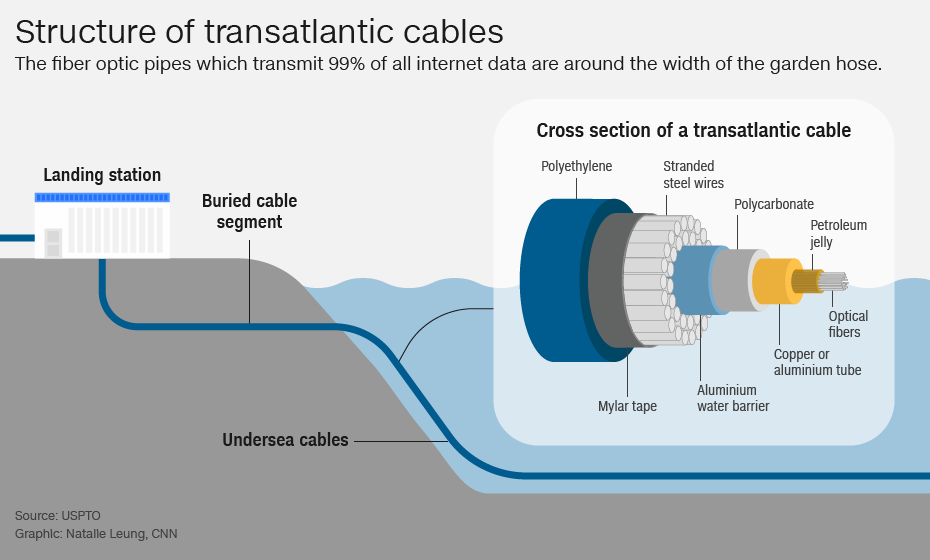
As for physical security, there isn’t much on the sea floor. There are various instances of nation states tapping cables due to the ease of access when it comes to actually “listening” to the data. Obviously the issue there is getting to the undersea cable.
https://www.theatlantic.com/international/archive/2013/07/th...
Multiple nations have specialised subs to tap into them. I doubt you'd find anyone willing to make such a guarantee. They are impossible to secure in any way and you need to rely on security assurances at different layers instead.
Now we just compromise the servers/routers. https://gizmodo.com/the-nsa-actually-intercepted-packages-to...
[0] https://www.geoportail.gouv.fr/carte?c=5.372494831681247,43....
[1] https://www.sigcables.com/index.php/cableliste/fiche_cable/5...
[2] https://twitter.com/jlvuillemin/status/1238414261774401537
[3] https://twitter.com/jlvuillemin/status/1238433769935319042
[4] https://twitter.com/jlvuillemin/status/1238479381145751553
It is generally buried either under the sand or inside concrete. But yes, there are places where you can get very close to these things if you know what you are looking at.
https://en.wikipedia.org/wiki/Cable_landing_point
Here is a pic of the landing for the US base in Cuba.
https://www.dvidshub.net/news/186633/uct-1-unit-choice-gtmo-...
https://media.wired.com/photos/59546c71be605811a2fdcfd0/191:...
Webdevs: is there a reason why a page would be designed so that JS being on is mandatory? Especially for something as prosaic as a couple of paragraphs of text.
If you meant mandatory in terms of the actual medium requiring it, I can only hint to interactive applications, aside from that I don't think it would actually be mandatory.
Here's an idea: add some HN logic to automatically move a comment that begins with "TL;DR" to the top of the thread.
I think in the case of Google, it's because they've been told they are the best developers, the top 1% of SWE's, they went through rigorous interviews, are paid a small fortune twice as much as they would get at a regular coding job, etc.
So it's dick shaking. They need to show to the world that they're better than plain HTML websites, that they have a massive schlong, that they out-chadded the vast majority of software devs. Plain html? Psht, we can invent our own language, gonna put those six years of uni to work! Wordpress? This is beneath us! It has to be a client-side rendered JS-pulled-through-GWT behemoth because on my system it's... wait it's slower, but nevermind that it's technologically ALPHA.
edit: actually looked at the source, looks like a Polymer / Web Components website. I've had to work in that once, it was dreadful compared to libraries used by real people.
Is this due to more and more content simply generated by javascript frameworks?
So, we rang up, a sales guy picked up the phone and got a million pound pay day, and resigned that evening.
But our customers were happy so thats what counts :-)
Good times - they were a wonderful company, thank you
Reference: https://en.wikipedia.org/wiki/T-carrier
Their Oregon to Japan cable, 9000km and laid in 2016, cost $300M.
https://www.computerworld.com/article/2939316/googles-60tbps...
[1] https://siliconangle.com/2013/07/19/how-the-nsa-taps-underse...
A lot of surveillance is done both *illegally* and secretly.
Forcing carriers to install black boxes next to their routers is not always the preferred choice.
[0]: https://zeenea.com/metacat-netflix-makes-their-big-data-acce...
1 - https://blogs.loc.gov/thesignal/2012/04/a-library-of-congres...
I'm sure a Shakespeare play or The Great Gatsby are barely a few megabytes.
But if you asked Joe Shmoe on the street "In Great Gatsbys, how big was the last picture your iPhone took", they would rightly have zero idea.
It's so useless.
I used to use that metric when folks ask why it took so long to debug. Like, our project is 600,000 LOC and more complicated than any of his works. He didn't have it all memorized and neither do I. It's a metric PMs can understand.
The "state-of-the-art" AFAIK is to use many wavelengths per fiber, each one carrying ~192 wavelengths each wavelength transporting at up to 100Gbps (this is known as DWDM).
So so with SDM, you just have more fibers? So what? It seems like I am missing something here? Why is "SDM" the key concept rather than "DWDM"? Why not just say DWDM with 12 fiber pairs?
Multi-mode fibers are not feasible for long distance transmission. For long distance communications, using suggested approach, may be better to use multi-core fibers.
Seems crazy since oversea transit (tcp & single-channel) is usually latency (or loss) bound.
I would expect it's better than going over public transit and legacy subsea fiber, but it would have been useful to see some comparison tests between POPs.
(And I assume that Google has enough demand: If it didn't, why would they build such a large cable?)
No. Good market socialist solution in situations where network investment (electric grid, railway, telecom) creates natural monopolies, is forcing separation of the network and content.
For example electric grid owner must allow other sell and buy electricity trough the network. They can only get maintenance fee determined so that it cant be used to distort energy markets in favor of the company owning the grid.
In telecom it usually applies only for the last mile.
https://cloud.google.com/blog/products/infrastructure/announ...
I presume that the other trillion-dollar companies are getting in on the action too.
What is the limit on how many fibres can go in a cable? Should we expect future cables to have 50 fibres, or 100, or 1000, or more?
I suspect that the repeaters and associated power equipment along the line is pretty big stuff. So the fact that this cable is able to "share" that equipment across the 12 fibers is a breakthrough in technology.
Not a big deal, but...sheesh. It's not like it was a troll comment; just a relatively lighthearted poke.
They are losing billions because they are paying for growth. It is the proper strategy.
This is what happens when a marketing company starts a cloud right? turns it into a loss leader and everyone who buys it becomes and apologist at all cost.
i don't get it.
So only the raw texts, probably. 10TB sounds about right for that.
[1] https://nplusonemag.com/online-only/online-only/the-library-...
Damn. Anyone else just agog at this figure?