One consequence of using a moving average is that if the CPU has been idle for a long time then starts running a high power workload instantaneous power consumption can momentarily exceed the TDP while the average catches up. This is often misleadingly referred to as "turbo mode" by hardware review sites. It's not a mode, there's no state machine at work here, it's just a natural result of using a moving average. The use of EWMA is meant to model the heat capacity of the cooling solution. When the CPU has been idle for a while and the heatsink is cool, the CPU can afford to use more power while the heatsink warms up.
Another factor which confuses things is motherboard firmware disabling power limits without the user's knowledge. Motherboards marketed to enthusiasts often do this to make the boards look better in review benchmarks. This is where a lot of the "Intel is lying" comes from, but it's really the motherboard manufacturers being underhanded.
The situation on the AMD side is of course a bit different. AMD's power and frequency scaling is both more complex and much less documented than Intel's so it's hard to say exactly what the CPU is doing. What is known is that none of the actual power limits programmed into the CPU align with the TDP listed in the spec. In practice the steady state power consumption of AMD CPUs under load is typically about 1.35x the TDP.
Unlike Intel, firmware for AMD motherboards does not mess with the CPU's power limit settings unless the user does so explicitly. Presumably this is because AMD's CPU warranty is voided by changing those settings, while Intel's is not.
https://www.intel.com/content/www/us/en/architecture-and-tec...
And on the flip side, if you're building a desktop PC with a more high-end Intel processor, you will usually have to change a lot of motherboard firmware settings to get the behavior to resemble Intel's own recommendations that their TDP numbers are supposedly based on. Without those changes, lots of consumer retail motherboards default to having most or all of the power limits effectively disabled. So out of the box, a "65W" i7-10700 and a "125W" i7-10700K will both hit 190-200W when all 8 cores/16 threads are loaded.
If a metric can in practice be off by a factor of three in either direction, it's really quite useless and should not be quantified with a scientific unit like Watts.
May be we should use a new term for it, something like iTDP.
If they gave it some other name, it would be only misleading. Calling it TDP is a lie.
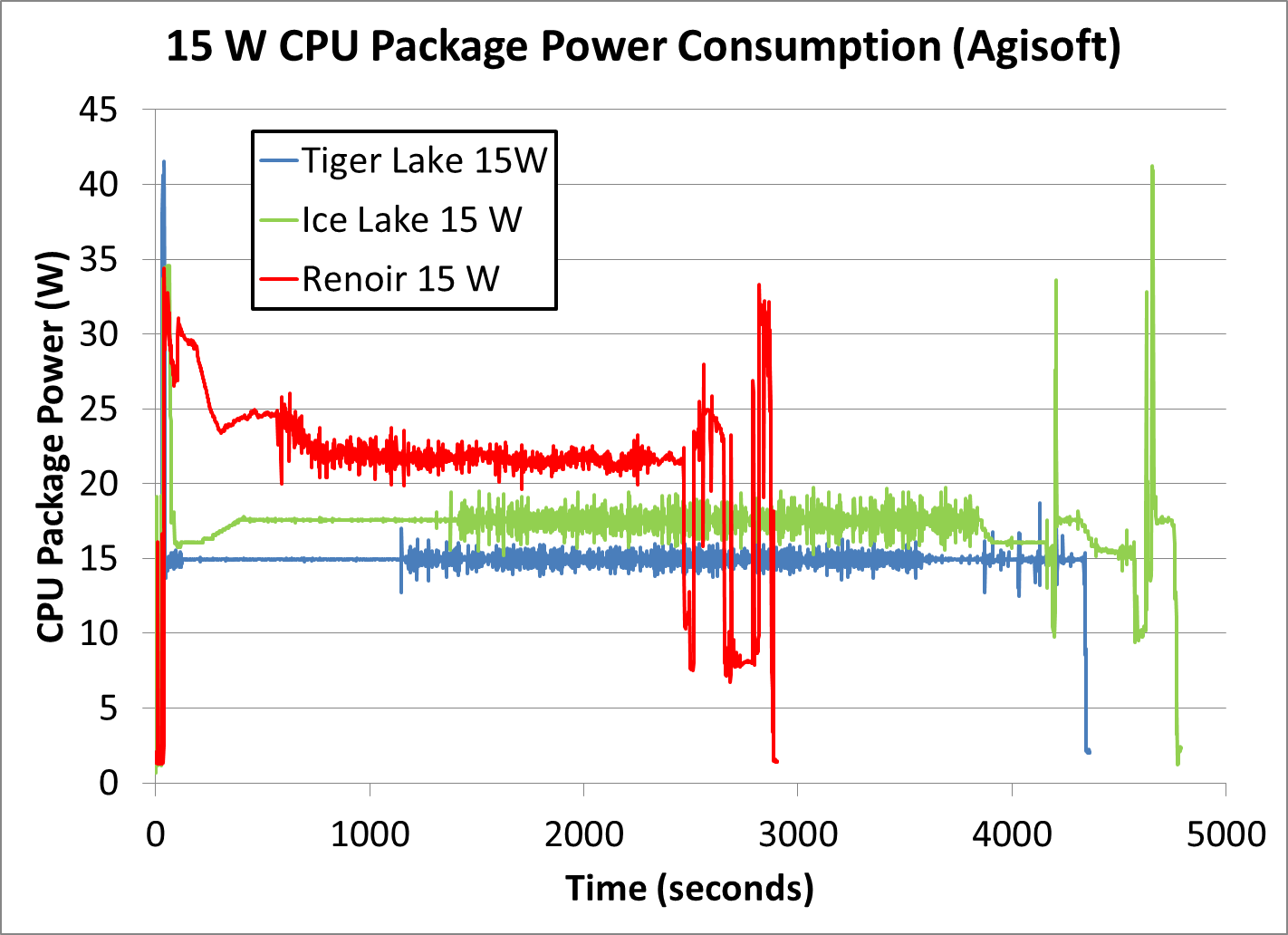
Intel mobile processors actually obey TDP better than AMD processors do - Tiger Lake has a hard limit, when you configure a 15W TDP then it really is 15W steady-state once boost expires, while AMD mobile products will pull up to 50% more than configured in steady-state operation. (the gap is larger than desktop)
https://images.anandtech.com/doci/16084/Power%20-%2015W%20Co...
"the brands measure it differently" is sort of theoretically true but not in the sense people think, and in practice it is not true.
On AMD it is literally just a number they pick that goes into the boost algorithm. Robert Hallock did some dumb handwavy shit about how it's measured with some delta-t above ambient with a reference cooler but the fact is that the chip itself basically determines how high it'll boost based on the number they configure, so that is a self-fulfilling prophecy, the delta-t above ambient is dependent on the number they configure the chip to run at.
In practice: what's the difference between a 3600 and a 3600X? One is configured with a TDP of 65W and one is configured with a TDP of 95W, the latter lets you boost higher and therefore it clocks higher. Configure them both to a 65W PPT limit and they will boost to pretty much the same place.
Intel nominally states that it's measured as a worst-case load at base clocks, something like Prime95 that absolutely nukes the processor (and even then many processors do not actually hit it). But really it is also just a number that they pick. The number has shifted over time, previously they used to undershoot a lot, now they tend to match the official TDP. It's not an actual measurement, it's just a "power category" that they classify the processors as, it's informed by real numbers but it's ultimately a human decision which tier they put them in.
So in practice, for both brands, it is just a number they pick. They have different theoretical methods for getting there but ultimately the marketing department looks at where the clocks would put them and pick a power number that they think represents that. It is not, in practice, a pure measurement from either brand, it is just a "category" they use.
Real-world you will always boost above base clocks on both brands at stock TDP, at least on real-world loads. You won't hit full boost on either brand without exceeding TDP, the "AMD measures at full boost" is categorically false despite the fact that it's commonly repeated. AMD PPT lets them boost above the official TDP for an unlimited period of time, they cannot run full boost when limited to official TDP.