Buy a “security focused” computer where the compiler is not open source, and the CPU/ICs have not been decapped, imaged and analysed from a manufacturer with ties to the Russian government? No thank you.
I would not be surprised if there is a hardware Trojan in this machine.
[0] https://pics.me.me/our-blessed-homeland-their-barbarous-wast...
AFAICT, this has much less documentation than the Itanium, so even from a tinker's perspective, this is really uninteresting.
That's why the author wasn't able to obtain one before: they simply never bothered releasing it for non-government use.
The performance is probably ~5 years behind industry standard and price is probably 5-20x more. But that's fine, when the only buyer is government agencies and military contractors.
And probably more than adequate for the kinds of applications you'd use this in. Military technology needs to be state-of-the-art for ruggedness and reliability, not performance.
For a similar example, look at the CPUs used in space missions: based on performance specs alone, the best ones would have been state-of-the-art in the 90s.
So unlike Transmeta, you can actually disable the x86 emulation and run native VLIW code on an Elbrus CPU? It's interesting. But I guess it's still not useful to independent developers in the FOSS community, it appears that MCST’s proprietary C/C++ compiler is the only compiler that can target the CPU.
What better chip to use than one that the Russian government assumes is only going to be used by loyal compatriots anyway? Anyway, that sounds like something a Russian spy would say, so make of it what you will.
I'd contemplate buying it if it had less binary blobs in it than an Intel or an AMD does. But maybe we don't have to go to Russia for that, as it feels like PC compliant ARM builds are going to be a thing soon.
However, while it's often proposed as such, I don't think it's actually useful - thermal fault injection is a real threat, but I said "theoretical" since it's the least of your problems when the attacker has physical access - both clock and power fault injection are easier. Nevertheless, at least a countermeasure to thermal faults is reasonable if you are just protecting a smartcard where everything is on a single chip. On the other hand, for a computer motherboard, such a sensor looks pretty useless. The target is simply too large to be protected (unless you can seal the entire system in a box fitted with sensors like a hardware security module). But I guess it is still a theoretical security feature, thus it was listed as such despite its uselessness.
[0] https://eprint.iacr.org/2014/190.pdf
> [...] We further presentheating faults by operating the devices beyond their specified temperature ratings. The efficiency of this kind of attack is shown by a practical attack on an RSA implementation. Finally, we introduce data remanence attacks on AVR microcontrollers that exploit the Negative Bias Temperature Instability (NBTI) property of internal SRAM cells. We show howto recover parts of the internal memory and present first results on an ATmega162. The work encourages the awareness of temperature-based attacks that are known for years now but not well described in literature. It also serves as a starting point for further research investigations.
I don't think I've seen anyone do that in practice though, it might just have been that they had to put _something_ extra in the security features and just added whatever sensor wasn't listed yet.
Not said anywhere but the spec looks like this is a good fit for military or industrial control panels.
wha-
Edit, there’s more info on other sites, it does look like the compiler cache? https://images.anandtech.com/doci/15823/VVolkonsky-RSCDays-2...
I have a few systems running 9front from CF. I also use CF cards in IDE adapters to replace spinning rust disks in retro systems. (edit: typo)
https://www.youtube.com/watch?t=3125&v=buWzWtXHimk&feature=y...
It ram poorly on 386 machines, and wasn’t until the 486-66 that it was acceptable and the first Pentium (P6?) that I remember it being smooth.
1. No price.
2. Bootloader is proprietary.
3. (less concerning) No performance data.
It's really hard to buy this as a security-focused open-source system without an open bootloader.
It reminds me of my Loongson 2F laptop powered by a Chinese MIPS processor, same model previously used by Richard Stallman. For a while (before Thinkpad X200), it was the go-to choice if one wanted a laptop with 100% free boot firmware and zero binary blob (the original boot firmware codebase is buggy and ancient, but with source, later GNU developers made it run GRUB 2). I got it just because it was an interesting non-x86 machine.
It's a bit disappointing that a would-be Russian equivalent couldn't do the same (an understandable problem, the designers of the board have no control over it), otherwise it'll also be a more hackable and interesting platform, at least for those who are fans of exotic non-x86 systems and don't care about price or performance.
I find this to be the most interesting fact of the blog post...I wish author could elaborate more.
Btw, couple months ago MCST established an official public forum for Elbrus users/partners/etc. Mostly in Russian, though most people there would understand English too. That is performance numbers - various Elbrus-es vs. i7 2600 - posted by a user there http://forum.elbrus.ru/viewtopic.php?f=38&t=6193
https://www.anandtech.com/show/15823/russias-elbrus-8cb-micr...
https://www.yumpu.com/en/document/read/54543367/the-elbrus-a...
So, a SPARC like CPU, but the use case appears to be running either native Elbrus OS (Linux) or x86-64 through some sort of optimized emulation.
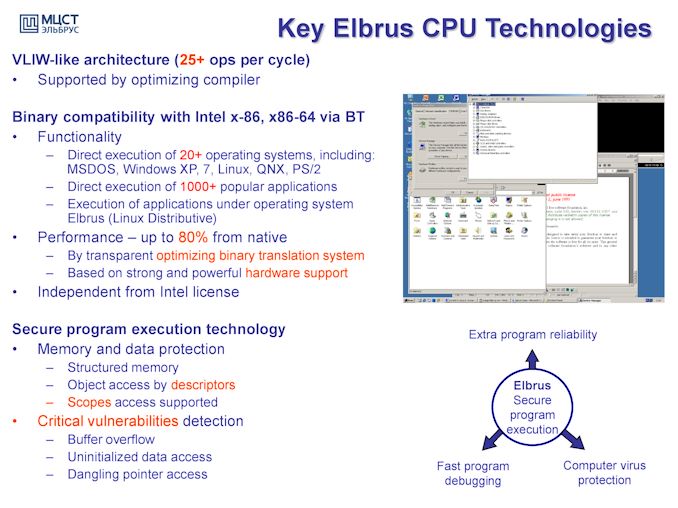
"Direct execution of 20+ Operating Systems, including: MSDOS, Windows XP, 7, Linux, QNX, PS/2."
This seems to indicate the emulation is somewhat like what Apple is doing with the M1: https://images.anandtech.com/doci/15823/VVolkonsky-RSCDays-2...
No, it's clearly a Russian national security project around supply chain security. IIRC, while the US is pretty good on the processor front, they have similar concerns around other ICs and components.
There is not a chance that they hope to make money on it.
Also, amusingly, I read "Fall detection sensor" as "Fail detection sensor" at first, and was really confused as to what that was. :P
I very much hope to be able to buy one at some point.
The ECC RAM could make this a good candidate for ZFS.
I've subscribed to the CrowdSupply campaign: https://www.crowdsupply.com/sra-centr8/icepeakitx-elbrus-8cb