What is with the ridiculous hyperbole that's so common when talking about America on the internet, especially by non-Americans? Talk about "American exceptionalism" - just in a different way.
It also varies quite a bit by subject-area. In Germany, the constitutional court held (around the same time as Roe) that legalized abortion was unconstitutional, violating the fetus's right to life. Today, it is technically still illegal, but decriminalized up to 12 weeks. (Shorter than in almost every state in the U.S.) The abortion rate in Germany is much lower. The Democratic party's views on abortion would not be considered center-right in Germany. On gay rights, Germany got legalized same-sex marriage a couple of years after the U.S. And things like surrogacy, which gay male couples often rely on to have kids, is illegal.
Or, consider that Merkel, a member of the center-right Christian Democratic Union (CDU) has called for a ban on burqa. To my knowledge, even Trump has not said anything like that. Similarly, on immigration, while Merkel allowed Muslim refugees, her successor declared that a "mistake" which the country had "learned from." Democratic favorability to refugees would not be a center-right position in Germany.
In the area of religion, the U.S. is extremely left wing compared to every country but France. In the U.S., teaching religion (as such) is banned in public schools. In the U.K., Germany, Italy, and Spain (four of the five largest EU countries) it's actually required, either by statute or by the constitution. Children have a right to receive a religious education at the public expense in these countries.
In the area of taxes, the Democratic Party is center-right in some ways but quite left win in others. Merkel has championed Germany following along with Trump's corporate tax cuts. The Democrats' proposal to repeal that would not be a center-right position in Germany. The Democrats' proposal to tax capital gains as ordinary income is quite left wing. Most Western European countries, including Germany, have preferential treatment for capital gains taxes. In general, the U.S. has the most progressive tax code in the OECD: https://opportunitywa.org/u-s-federal-income-tax-structure-m...
But Democrats' tepid support for labor unions, for example, would be considered center-right or even right-wing in Germany.
On the whole, on social, religious, and immigration issues, the current Democratic Party is solidly to the left compared to western Europe. On labor issues, it's to the right. On corporate and investment taxation, it's solidly on the left. On healthcare, its to the right, but mainly for reasons that have to do with minimizing disruption to peoples' current private insurance. Where they want to end up, single payer public insurance, is solidly on the left.
Our next Vice President will very likely be a Democrat who, in 2019, supported single-payer public healthcare, treating capital gains as ordinary income, a 35% corporate income tax rate, a financial transactions tax, publicly funded abortion with no compromises such as waiting periods, Green New Deal, free healthcare for people who immigrate illegally, etc. If she actually believed those things, she would be a solidly mainstream left politician in most European countries.
Democrats generally agree that there should be universal access to health care, and a mostly agree that that should involve a public plan (not just a private subsidy) available to at least some section of the population beyond the current Medicaid population.
There is not general agreement within the Democratic Party on universal single-payer as even a long-term goal. The currently dominant neoliberal faction of the Democratic Party supports a public option as a long-term component of healthcare policy to acheive universal access, but does not generally support single-payer as a goal, in either the near or long term.
> In general, the U.S. has the most progressive tax code in the OECD
As your own source notes, net of transfers and taxes, the US has one of the least progressive systems in the OECD.
> In the area of taxes, the Democratic Party is center-right in some ways but quite left win in others. Merkel has championed Germany following along with Trump's corporate tax cuts.
You seem to be really obsessed with the CDU as your measure of center-right parties, but AFAICT the CDU is to the right of most parties labelled center-right, not just in Europe, but even in Germany specifically (which has a fairly wide range of center-right parties.)
But, yes, its really only the dominant faction of the Democratic Party that is center-right, the "progressive" faction is center to center-left by European terms, and the whole (today, with the gains the progressive wing has made over the recent years considered) is probably more center than center-right; the "Democrats are a center-right" party was most true at the height of the Clintonian neoliberalism of the Democratic Party which as faded over the last decade or so and particularly since Bernie Sanders 2016 campaign reenergized the progressive wing, though it has still not become dominant.
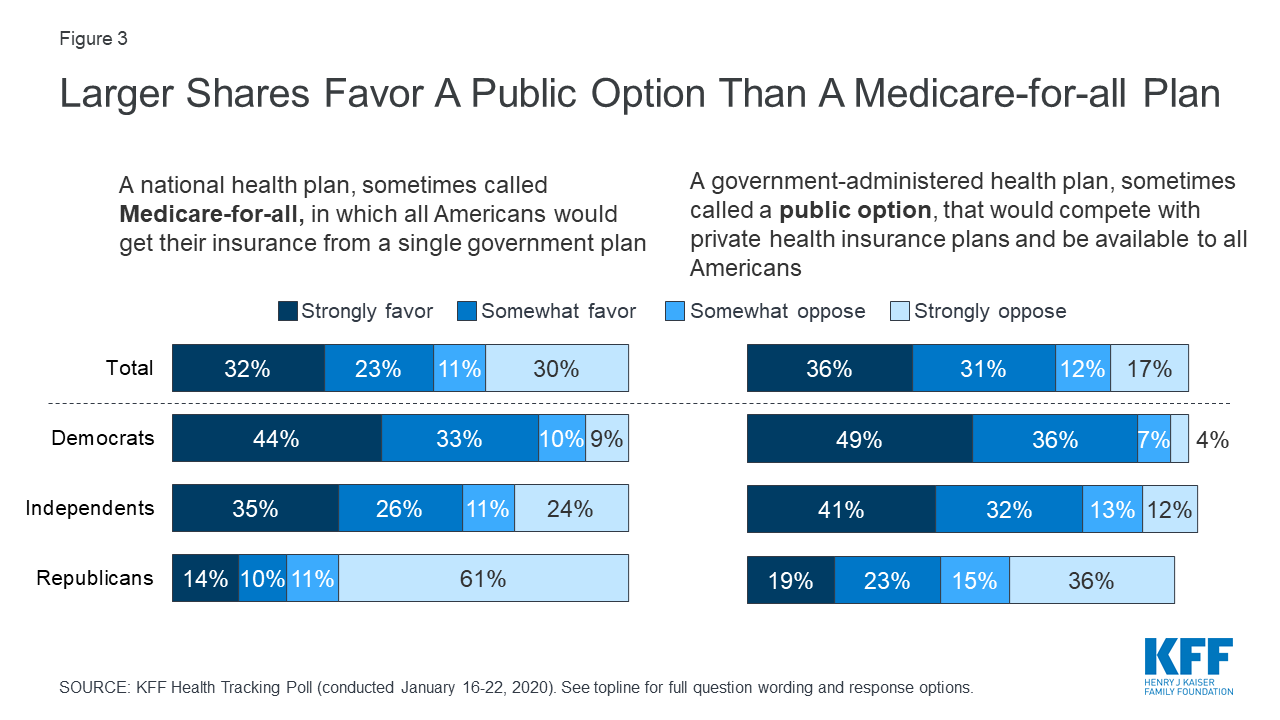
A big majority of Democrats support Medicare 4 All: https://www.kff.org/wp-content/uploads/2020/01/9394-Figure-3.... They support a public option somewhat more, but to me it seems more like they do so to soften the transition to a single-payer system. A “public option” wouldn’t be like the multi-payer systems of Germany, Switzerland, or the Netherlands. Since it would kill private competitors in the long run, it’s just a slower road to single payer.
Regarding taxes: netting transfers mixes up the tax system from the welfare system. As the article points out, our taxation is progressive but our spending is regressive. It’s a system designed to redistribute money from the rich to the middle class, not the middle class to the poor.
As to Germany, I use that as an example because it’s a large European country and I’m familiar with it. CDU has been moving left for the last 15 years: https://fivethirtyeight.com/wp-content/uploads/2017/08/hazar....
Like the above, various international party comparisons show Democrats moving left of center by 2012: https://fivethirtyeight.com/wp-content/uploads/2017/08/hazar...
As to social or religious issues, Italy or Spain would be more conservative in some respects. (Islam isn’t a recognized religion in Italy.)
The recent rise of progressives has moved Democrats sharply left in part because Europe has been moving to the right economically for decades. Low corporate and investment taxes and deregulation is gospel across the European center, but it’s disappeared among progressive Democrats. That wasn’t remarkable in 1975 but it’s remarkable today. Macron, for example, is campaigning on deregulation and a government takeover of Islam, and his major competition is to his right. Center left parties in France aren’t questioning the country’s fairly low corporate and investment taxes. Neither are those in Spain. Democrats (in particular Warren’s utterly cockamamie proposal) really stand out in that area as a throwback.
Green New Deal is a great example of this. It’s an FDR era jobs program. It stands in stark contrast to Europe, which is doing carbon pricing. Progressives seem to have developed an allergy to markets, and while the center isn’t there yet it’s not pushing back either.
I mean that’s before you get started on Sweden’s center-left party continuing to cut corporate taxes and partially privatizing social security.
Oh, I forgot about school choice. Democrats are far to the left compared to Europe in that.
Any other Western democracy (including some Western-model democracies outside of the West proper), sure. But then the left-right axis is not really readily transferrable to outside of that domain, anyway.