> Enter '1', '2', or 'p' within 2 seconds or take default...
Wait, tens or hundreds of millions of cable modem startups are delayed by 2s on each start just in case somebody has soldered up a serial interface and wants to load a different image?
This is pretty much a universal feature of any device with a bootloader and an OS. If it weren't there, you wouldn't be able to diagnose anything. 2 seconds is reasonable.
If you want to talk about human productivity being pointlessly wasted while waiting for things to load, let's start with modern web apps.
You could make that require a jumper somewhere, but 2 seconds added to the boot time, when a working modem probably doesn't boot more than once a month is simply not a lot of time.
You should consider cycling more often if your ISP purges IP assignment records and tries to assign new IPs upon reconnect.
Mine keeps records for 30 days after lease expiry (usually your session end date)
That's some amazing work in my eyes, how long did it take?
(... and I can't help but add IANAL, IANYL, TINLA, etc.)
I tried to CTRL-F "SDR" on the article page, but there was no mention of what the abbreviation stands for. I realize it's meant for technically inclined readers, and it is a great article and project. I should've checked the linked websites first, but it was easier to just Google it :)
I'd include a short mention of what SDR stands for (maybe with a link to Wikipedia) at the top so people unfamiliar with it can get an idea of what they're about to read. Just imo.
I bought these boxes which use the Coax at very high frequencies to do Ethernet between sides of my house using MoCa which is used by TiVos and newer set top boxes. I had trouble understanding "how is this secure" when my modem is also connected to the same coax and this is clearly not behind my firewall. Well, of course, you filter out the signal from leaving through the Coax which provides you cable!
I would rather just run ethernet and keep it behind a firewall, but this reduces punching holes in the walls for now.
Back in the days nearly everyone had the experience of connecting an outdoor antenna to a coax cable.
BTW, you can even run Wi-Fi over a random, abandoned RG-58 TV coax in the wall by simply connecting a suitable coax adapter. Some will mention the problem of impedance mismatch, but it's negligible [0]. The downside is that MIMO is not possible, only 1T1R is possible, and 150 Mbps is the best possible speed for 802.11n (but I wonder if it's possible to use a mixer at both ends to convert the second antenna port to a different frequency, so both bands can operate simultaneously in a single coax cable with a duplexer for MIMO).
> I had trouble understanding "how is this secure" when my modem is also connected to the same coax and this is clearly not behind my firewall. Well, of course, you filter out the signal from leaving through the Coax which provides you cable!
A Coax-to-Ethernet modem and a Cable modem doesn't even have the same analog front-end or use the same modulation, software-only attacks are practically impossible. It can only be a problem if the attacker has physical access to the coax cable, or if the coax leaks (which always occur). But then, G.hn uses AES encryption with Diffie-Hellman key exchange [1][2], you shouldn't worry after all. Man-in-the-Middle attacks can still be a problem, it's more secure to set the password (a.k.a. Device ID) manually via Ethernet instead of using the automatic pairing. But still, it's unlikely that anyone is injecting traffic during the initial pairing.
[0] A 50-ohm transmitter into 75 ohm ideal coax has a VSWR (a metric of impedance mismatch) of better than 1.6:1 at 2.4 GHz, real cable loss can make the apparent VSWR even lower.
>Back in the days nearly everyone had the experience of connecting an outdoor antenna to a coax cable.
>BTW, you can even run Wi-Fi over a random, abandoned RG-58 TV coax in the wall by simply connecting a suitable coax adapter. Some will mention the problem of impedance mismatch, but it's negligible [0]. The downside is that MIMO is not possible, only 1T1R is possible, and 150 Mbps is the best possible speed for 802.11n (but I wonder if it's possible to use a mixer at both ends to convert the second antenna port to a different frequency, so both bands can operate simultaneously in a single coax cable with a duplexer for MIMO).
This reminds me of a hack we did at work. We needed to connect the networks of two of our labs without going through the official IT equipment (don't ask). The difficulty was one of the labs is a Faraday cage, so essentially no accessible ways of routing cables in and out. However, we do optics research so we had some fiber connections between the labs, they are a limited resource though. What we ended up doing was connecting a media converter to use the fiber connections. But ethernet over fiber uses separate fibers for duplexing and the fibers between labs are a limited resource. We ended up using a circulator (which essentially separates the forward and backward transmission from a fiber into two fibers), and used a single fiber for full-duplex without issues.
Take home message, if you have enough SNR (the media converter bridges are designed for 15 km) you can get away with all sorts of hacks.
* s/RG-58/RG-59/
* s/duplexer/diplexer/
The original comment is too old to edit.
If that mishap on an SOIC chip occurs, don’t fret, you can usually shave off a bit of the plastic and get enough pin surface to solder a jumper to VCC.
An alternate method is to follow the VCC trace and cut it, then solder your own wire to the unlifted lead and a nearby capacitor with a switch. Beware that you might power more than the chip if the trace continues, but that’s usually fine. Sometimes this is a good thing because you still power pull-up resistors.
Yet another option is to place a glob of solder across 4 pins, heat them all up, and lift half the chip. The other 4 legs will be hot and soft enough to bend easily.
Finally for the non-VCC connections, could follow the traces and find easier places to solder to rather than a bunch of side-by-side leads.
There is actually an unpopulated footprint for a bigger package around the 8-pin flash, which can conveniently be used for this.
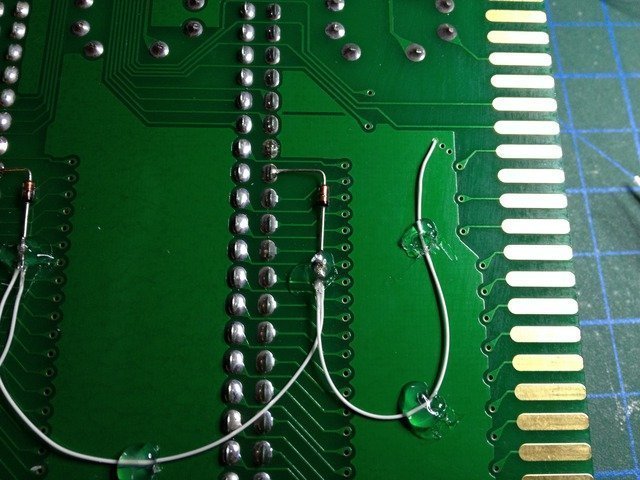
Use a dab of hot glue to keep your wire in position:
http://www.yavuzg.com/images/6in1jamma/IMG_2570_zpsf0b4kind....
This was a side project of a few people that had previously been making documentaries for NASA, and you could feel that "swelling music new frontiers and science" vibe you might from a decent documentary.
[1]. https://www.imdb.com/title/tt4477292/Glares at system that ran RS232 levels (-12 & +12) into 5V Atmel MCU 24/7 for a couple years successfully
Did require inverting in code since RS232 uses -12V as logic 1 and +12 as 0.
I tried to search for this forum thread, but my google-fu must be failing me. Does anyone know where it is?
And this page confirming they can still be detected: https://www.kg4cyx.net/the-oddball-embedded-spectrum-analyze...
Mine reports version 7220-5.7.1.15 in the admin console. I would be interested to know if anyone else is able to access it.
I use this modem for my internet service so unfortunately I can't just take it apart to replicate this experiment!
After all, a modem has to be able to send as well as receive, and a transmit-arbitrary-IQ-samples function would be useful for calibration at manufacture time.
That said the post was a tour-de-force in cross functional engineering, truly impressive stuff.
You mentioned you were getting distortion/noise when downsampling below 928kHz. Are you lowpass-filtering before you decimate (but after you demodulate)? Otherwise you will get all kinds of aliasing.
Looks like FM radio stations have a bandwidth of 200kHz so you should be able to lowpass with a cutoff of around 50kHz then decimate to 232kHz.
To further boost performance, it might be worth skipping past interrupts and going straight for DMA, as the CPU probably doesn't need to be doing anything. I imagine figuring out how that works on an undocumented chip would be quite tricky though.
There's a thing called Cycript for jailbroken iOS that, among other features, allows you to attach to any process and then gives you what's basically a command line interface to the objective-c runtime. It's a godsend for reversing iOS apps.
It should also be trivial to implement a similar tool for Android using Xposed framework.
>It can currently stream I/Q data to a peer via TCP
mean? Does it somehow stream data over the modem's ethernet connection?
A buddy an I had this idea ~6-7 years ago, and had a couple of the zoom docsis 3 modems handy. They have something like a 100Mhz fairly high bit depth A/D on them. At the time the price/bandwidth was crazy (and still is if someone managed to pull it off with a modern docsis 3.1 system). I got some boot logs/etc but didn't get very far into reverse engineering the chip. Its too bad that the chip vendors go to such lengths to hide what is basically mostly repackaged 3rd party IP from designware/arm/etc.
Current DOCSIS has ~200Mhz sampling per OFDM channel, given a 3rd party tuner in front of it, the results might be pretty crazy.
Sure, the buffers will have some random amount of data in, but by pre-erasing them, it ought to be possible to figure out where it got up to.
Failing that, just keep poking registers - there will certainly be a continuous capture mode, since that's what it will use for real operations.
Specifically, I have a basement full of old (some non-working) hardware for various gadgets/computers/electronics and I'd love to upcycle them into ... something else. Instructables and WikiHow are the usual places, but it's usually things that require "the thing you're building"[0] to build or require buying so many new components that by the time your done you've bought a product minus a few motors.
I yearn for the "Make X do Y" with a small number of inexpensive tools (preferably ones I own, but that's a tricky proposition) where "X" is something common, or obsolete and "Y" is something outside of or is an upgrade to it's design[1]. I love doing this sort of thing and I find that about half the time when I'm working on Pi/Arduino projects I have way more parts than I realize -- I can't believe I purchased any loose low power LEDs (IR, colored...) I have a whole box of remotes/miscellania that should really be in the garbage for how useless it is ... until I need a 1.5V LED, have only 5V+, and can't wait a day for shipping. I started salvaging electronics before trashing them. It'd be nice if I could look up the whole obsolete device and see what I can use more of it in... plus, at least for me, I'd throw less away (and store less in boxes).
[0] My go-to is the small number of "Blu-Ray Engraver/Laser Cutters". Every one I could find (A) required a laser cutter, or (B) many of the laser-cut parts required a laser cutter that was bigger than the one being built, so you couldn't even sell the more expensive laser cutter if you wish to be able to produce a second one. It's a small issue in that there are still other parts that need to be purchased, but you have to buy a laser cutter to make the custom, $0.01 in pressed board, set of parts. The others are nearly every upcycled RC-Car.
[1] I had a friend who designed custom sub-woofers for cars when I was younger. He had a Yamaha off-the-shelf sub that he modified to the tune of $250 and some of his own time. It put my $1000 sub to shame. I can't remember all the specifics of the modification, but I know he used the original amp board and some upgraded MOSFETS but didn't touch the 10" speaker or the cabinet (which was what he spent most of his time on, typically).
https://www.rtl-sdr.com/about-rtl-sdr/ https://www.reddit.com/r/RTLSDR/
And a cheap one too!!!
About two years ago I realized I was doing the opposite sort-of without realizing it. I'd want to do something given a set of constraints (say, create some app in some specific programming language or for some platform), google it, find that there was some loose chatter around the idea and I'd dismiss it thinking "well, 'The Internet' hasn't done it/doesn't think it's possible, so I shouldn't bother".
Maybe it's a form of imposter syndrome. For me, I think it's more complicated:
I'd reach a point in a framework/subset of "whatever stack/language I was focused on at that time" where I was running out of obvious "new things to try", so I'd Google and find the same list; 'The Internet' decided for me that there's really not anything else of use to do with these this framework, let's learn a new one.
I need to "do X with Y", I Google it and find "Y" nowhere, but find "Z" everywhere. It's a bad fit but that's how 'The Internet' does it.
The most common, and one I specifically guard against and it happens consistently with endeavors like this: I want to make "X" do "Y" knowing full well that "Y" is not designed for (or more frequently specifically designed to prevent me from) doing "Y". After wading through replies to countless other people daring to ask the question in a forum -- the usual: "You don't know what you're talking about, can't be done, you shouldn't try it", "Why would you even want to do that when you can get 'Y' for $.$$ on eBay?", "Google it" (I did, that's why I'm here after 4 pages of clicking). Lovely how every question has 3-4 unhelpful-non-answers in one of these categories.
I changed my approach more than a decade ago while trying to reverse engineer the obfuscation a large telecom vendor used for their mobile broadband password storage in the Windows Registry[0] and succeeded in writing an "obfuscator" in a day from first introduction to deployed solution. Ever since then, I trust my instinct when I have expertise. When I do not, I read a very positive signal when "a lot of are people asking if something can be done" IIF there isn't a good answer to why it "can't be done" and any reasons why it "shouldn't be done" don't apply to the issue at hand.
[0] I recall, at the time, most of the answers were some form of "IANAL... but..." -- our purpose was to assign a random password to a user's account, then install the client to the user's company-assigned laptop with that password pre-populated (I didn't come up with the idea, I just had to figure out how to do it). The remainder of the answers were variants of "you can't crack AES" and "IM L33t H4x0R - WiLl CrAcK 4U". It was very clearly not AES or anything resembling a hash. It took so little effort to figure out that I would have saved time by "Starting Before Googling". Nobody (searchable) had tried. Probably nobody had a (legitimate) reason to try. It was just surprising how many people had a reason to "not try" while also discouraging others from trying with either wrong information or no information at all.