It's important to note that other energy types also produce waste. For example, coal ash is incredibly toxic and hard to dispose of, and we create much more of it every year.
https://en.wikipedia.org/wiki/Deep_borehole_disposal
*to a point where it was actually brought up as a negative, because if we ever wanted to recycle that waste into something else, it's literally impossible this way.
https://en.m.wikipedia.org/wiki/Onkalo_spent_nuclear_fuel_re...
They have thought thousands of years ahead and set up many different types of warning signs and symbols in case a future civilization discovers it.
If you can drill down to put it in, can't you also drill down (or use the same hole) to get it out?
This is the things that make me cringe when I see this people saying again "This time will be different, we promise".
Look mum, radioactive tornadoes coming from the ocean...
This has been well studied by several groups including the US Navy, which is one of the biggest nuclear operators with over 80 reactors currently in warships. In the event of catastrophic loss, the plan is to just leave it because the oceans already have billions of tons of radioactive material and infinite capacity to absorb more.
Also nuclear reactors have occurred naturally [1] and without any serious fallout or contamination risks, showing that containment is really not that challenging. Most people think nuclear is scary because of popular science and culture, and they lack the knowledge and understanding to know any different. It's similar to people not trusting vaccines because they don't understand medical science.
1. https://blogs.scientificamerican.com/guest-blog/natures-nucl...
Dumping in the oceans isn't a serious proposal. I was pointing out that waste is not a huge problem.
France[0]
> If it's so valuable why does no one actually want it,
I mean France does... we actually gave them the tech. The reason we stopped is more political. But more people do this than just France, but they are the biggest example since 17% of their entire grid is powered from recycled nuclear. The other reason we don't do it is that it is just cheaper to buy more Uranium than setup reprocessing plants. France doesn't have as easy of a supply chain so it makes sense for them to recycle. Obviously the US's supply chain could change, so access to that waste is a potential benefit.
[0] https://www.world-nuclear.org/information-library/country-pr...
People use "what about the waste" as a reason to not use nuclear. Yet, fossil and renewable biofuel waste is (as mentioned) just dumped into the biosphere where it ends and estimated 8 million lives early per year, according to the WHO.
I would also encourage other's to click on acidburnNSA's profile as this is where their expertise lies and they have written extensively (with plenty of links) on the subject.[0]
We have no permanent disposal facilities, not even in the planning stage.
https://www.gao.gov/key_issues/disposal_of_highlevel_nuclear...
https://en.m.wikipedia.org/wiki/Yucca_Mountain_nuclear_waste...
It's a matter of political will at this point.
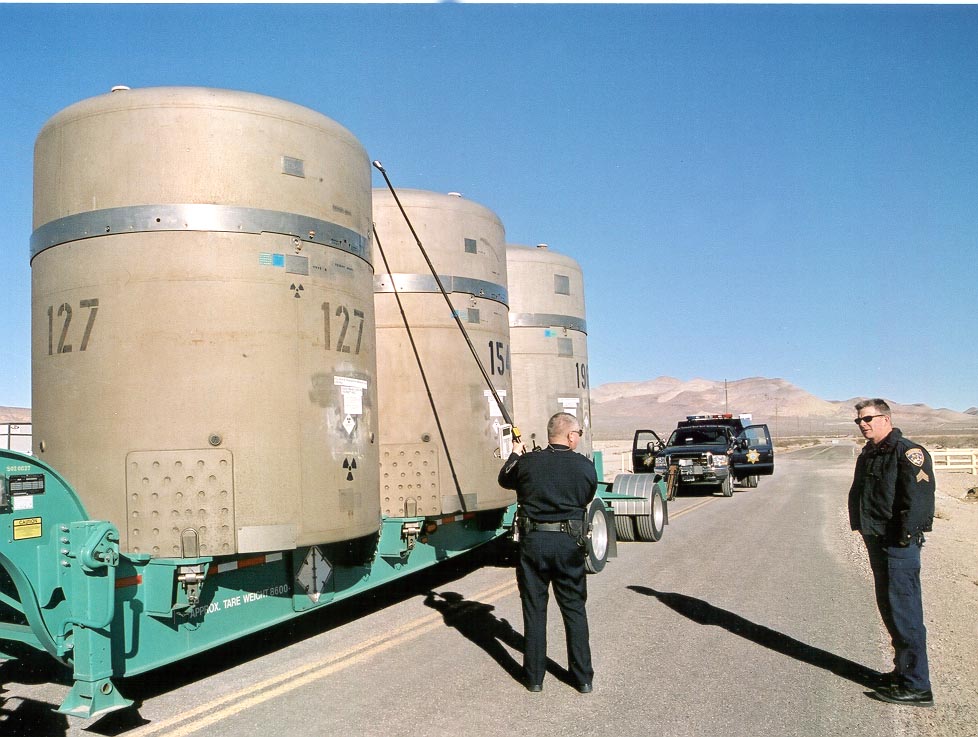
Nuclear waste is radioactive, but not so radioactive that it's unsafe to stand next to a container. Most waste is stored on site.
It actually doesn't make sense to move nuclear waste to permanent storage because some reactor designs can use this waste as fuel.
1. If your rocket has a failure during launch, you're likely to spread the nuclear waste over a large land area.
2. Even though we really haven't generated that much nuclear waste, it's still many many rocket-launches-worth. That gets expensive. Much more expensive than sticking it in a hole in the side of a mountain.
3. Launching something into the sun takes a huge amount of rocket fuel. It takes a Falcon-9 with a mass of ~550Mg to get a payload of ~22.8Mg into low earth orbit with a velocity of ~8km/s. The Earth is moving around the Sun at ~30km/s, so to launch into the Sun, you need to depart from the Earth at (at distance) ~30km/s. Earth's escape velocity is ~11km/s, which means that from low earth orbit, you need to get up to ~32km/s (sqrt(30^2 + 11^2)). So your ~22.8Mg payload in low earth orbit needs to include a rocket that can add ~24km/s to its velocity. If we assume a rocket with a fairly decent engine, with an Isp of 4km/s, then we can plug that into the Tsiolkovsky rocket equation. The remaining payload that can be flung into the Sun is a grand total of 57kg. All the rest of that ~22.8Mg is rocket fuel. Per SpaceX Falcon-9 launch. This is not an effective way to get rid of nuclear waste. (Note, it may be possible to increase efficiency by making use of gravity assists from other planets, but you still need to actually get to other planets first, so a pretty hard limit on the payload-into-the-Sun is the payload-to-Mars, which is ~4Mg. Still not very much.)
Then this technology has been, for all practical purposes, abandoned by nearly all countries that were researching and developing it. See https://en.wikipedia.org/wiki/Breeder_reactor#Future_plants
One of the most (if not the most) ambitious project was Superphénix, costed billions and failed flat. https://en.wikipedia.org/wiki/Superph%C3%A9nix
The sole officially actively pursued pertinent design, BREST-OD-300 ( https://en.wikipedia.org/wiki/BREST_(reactor) ), was planned to be built in 2020 ( https://www.world-nuclear-news.org/NN_Fast_moves_for_nuclear... ) and real work didn't even began ( https://www.world-nuclear-news.org/Articles/Russia-awards-co... ). Moreover it will only (when built, if ever, but not before 2026) be a demonstrator (low power).
This would fit in a 5m high storage facility the size of an American football field (which is even smaller than a European football field). As an additional comparison, the small Amazon fulfillment centers have about 40000m² of area [2] . Assuming the same 5m height, a small fullfillment center is nearly 10 times bigger than necessary to store all globally produced high-level nuclear waste.
Sure, the waste is hard to dispose and dangerous. But it really isn't much.
[1] https://www.world-nuclear.org/information-library/nuclear-fu...
[2] https://www.aboutamazon.com/amazon-fulfillment#how-big-are-f...
There are no methods that have 100% answers for every "what if 5 things go wrong at once?" question.
That's true for everything, but those questions only get asked for nuclear energy.