It's not a ridiculous thing to wonder about how susceptible mail in voting is to fraud, and it seems like some of us are putting blinders on simply due to our distaste for the current president.
If we were to hold a hackathon with a $100,000 prize for the most plausible path to exploit mail in voting in order to swing an election, are people implying that there would be no entries? Or maybe no viable entries? That's ridiculous.
Here's some spitballing: (eh, I removed this. I don't think brainstorming how to committ election fraud is a good idea. I'm assuming that readers of hacker news can probably figure out some relatively obvious ways of casting doubt into the outcome of a mail in election)
How are people looking at what recently happened with 100s of millions of dollars of fraud being committed against various US unemployment systems, and not thinking that other systems might be at risk as well?
Remember the Iowa caucus? That was a hastily put together vote reporting system, not even meant for tallying, and look at what a disaster it was. Now we're expecting that states will radically alter their voting system, in 5 months, and that it won't be vulnerable to interference?
To be clear: I LIKE mail in voting. I have permanent mail in voting status in my state (Arizona), and my wife and I usually get breakfast at our favorite restaurant and spend HOURS meticulously researching every candidate and BI on the form. Being able to take that amount of time is fantastic, and a luxury I wish everybody could have.
But it doesn't have to be so polar. I like mail in voting, obviously, but I'm not so stupid as to think that it cannot possibly be criticized. I am a hacker after all.
Boo to twitter for this. This is twitter obviously putting their finger on the scale of an election, and after all of the drama surrounding the idea that foreign actors might have purchased a few 10s of thousands of dollars of facebook ads, I'd hope that Americans would have a distrust a company where foreign entities have a major stake doing such a thing. Not acceptable in my opinion.
Just to highlight my point a little further: here is an article from the nytimes highlighting that mail in voting is far more vulnerable to fraud than in person voting: https://www.nytimes.com/2012/10/07/us/politics/as-more-vote-...
Here’s a quote from the article:
>Yet votes cast by mail are less likely to be counted, more likely to be compromised and more likely to be contested than those cast in a voting booth, statistics show.
and another:
> Election experts say the challenges created by mailed ballots could well affect outcomes this fall and beyond.
And another:
> The trend will probably result in more uncounted votes, and it increases the potential for fraud. While fraud in voting by mail is far less common than innocent errors, it is vastly more prevalent than the in-person voting
So who is to be believed here? Twitter? The New York Times? Why aren’t the experts from this article being listened to?
If he has an argument to make, let him advance it. If he fails to make a compelling case, it's not our job to look up citations and write paragraphs to fill in the gaps.
Also, please remember the context. The only reason so many states are considering mail-in voting now is because they are concerned that huge numbers of voters will stay away from physical polling places.
This is not a matter of "pick the theoretically best voting system." This is a matter of "how can we hold an election without accidentally killing thousands of old people by communicable disease."
I don't have to think that mail-in voting is perfect to prefer it over radically depressing turnout.
Pointing out that trump is lying isn't a bad thing.
but for it to happen in any meaningful way is super super unlikely as most other democracy's around the world can attest to.
he's technically right, but its not going to be in the order of even 1%. even if EVERY person in the US voted by mail, fraud on a level that would less than 1% of the entire vote.
Its a stupid blatant obvious ploy to try and gerrymander the vote.
There is also the question of differential susceptibility. Sure election fraud is possible with mail in ballots. I'd even stipulate that it's easier than casting fraudulent in person votes. But I think it remains to be answered how easily it can be scales, and whether the rewards are worth the risk this would pose to perpetrators' freedom.
> Now we're expecting that states will radically alter their voting system, in 5 months, and that it won't be vulnerable to interference?
Are mail in ballots for everyone really a "radical alteration" of their voting system? Local governments already have the capacity to send and receive thousands of pieces of mail, and the method of counting ballots is the exact same.
How would you set up this system if you were tasked with it?
You scoff at the reaction yet you've surgically extracted the political context of Trump's motivations for disparaging mail-in voting from your analysis. There isn't a new developing threat to mail-in votes, Trump has a clear political agenda. In Trump's own words a couple months back:
The things they had in there were crazy. They had things, levels of voting that if you’d ever agreed to it, you’d never have a Republican elected in this country again
Can you at least pretend to understand why some people might have a hard time accepting Trump's credibility on the issue?
It's not that weird. Mailed ballots can be coerced quite trivially at home, out of the view of authorities; no technology hacks or fake ID needed. That's why some of the "fact check" figures themselves are nonsense , such as the one claiming that only 0.00006% of mail votes are fraudulent. That's based on convictions. Nobody knows the real number.
In Northern Ireland postal voting is strictly controlled and monitored and permitted only in individually-reviewed case, because we had decades of coerced fraud by balaclaved men with baseball bats.
The reality is that most mail-in voting operates via what is effectively a two factor auth system or a handshake authentication system. Person A gets official mail being told they can register to vote. Person A goes to site and registers to vote. Then they receive a ballot sometime before election day, fill it out, certify that they are who they are, then it goes out.
The government can send a further correspondence indicating that you voted and where to check your vote to confirm. If someone attempts to vote multiple times using the same person this is easily verified. If the dead vote, you can cross-reference with obituary data to identify identity fraud. If someone votes for someone else (like their parents or their siblings) then that can be somewhat identified through the final check and letting people file a claim.
The reality is that actual fraud for mail-in votes is incredibly low and committing mass fraud requires the fraud to occur at the point of ballot counting. At which point you have a politician issue [1] not a voter issue. Which again, is pretty easily caught. The increase in mail-in fraud is likely offset by the disenfranchised voters that could gain the ability to vote as well as the voters in areas without easy access to voting booths.
[1] https://www.npr.org/2019/07/30/746800630/north-carolina-gop-...
And, of course, the discussion isn't actually about voting-by-mail, yes-or-now? Because that has been possible for a long time and isn't going to change. The discussion is about making it easier and/or the default to protect people from communicable diseases.
The issue, then, isn't even if voting by mail allows fraud. It's if the likelihood of fraud is significantly higher when, say, 50% instead of 30% choose that option.
This is yet another blatantly obvious attempt to stack the deck in Republican's favour. It's sickening to see people pretend to care about the integrity of democracy by engaging with all these phantom debates about voter fraud, in the complete absence of any actual fraud happening (except that Republican in South Caroline, of course).
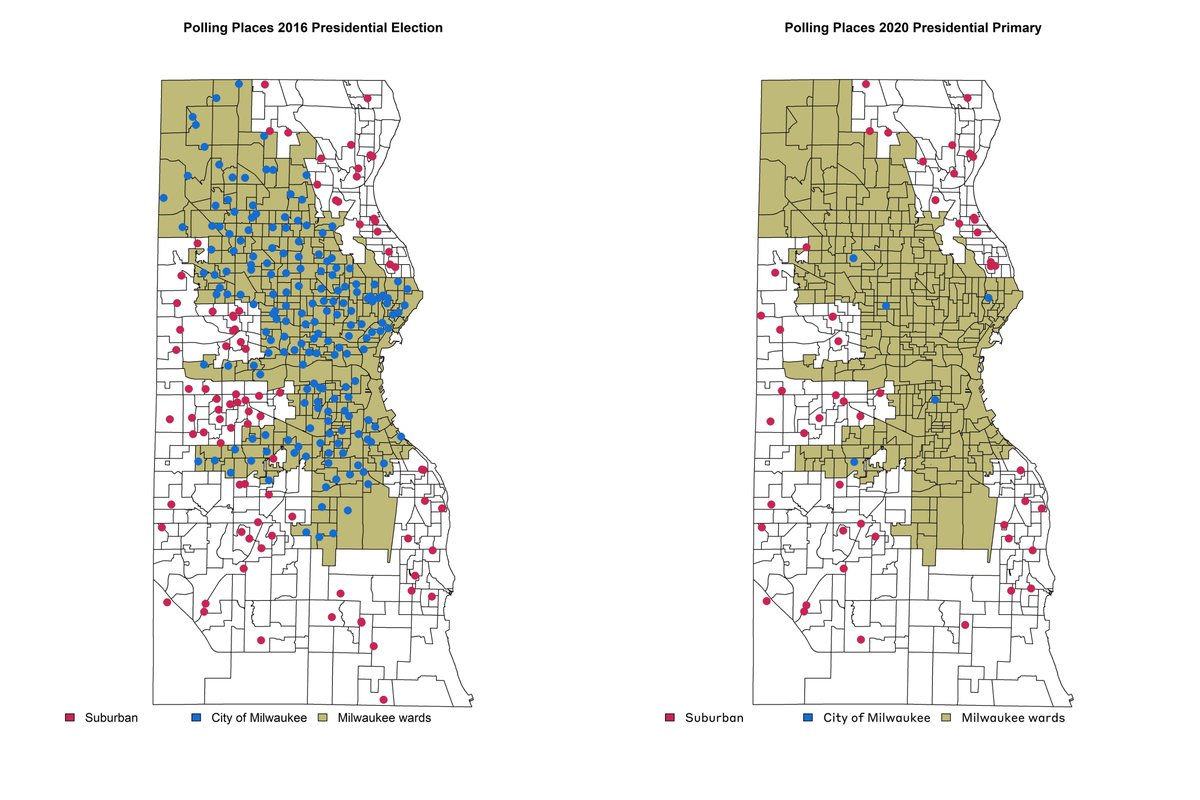
Meanwhile, real damage is done to democracy by the unrelenting attempts to selectively make it harder for people to vote. Take a look at these changes in polling locations in Milwaukee for a blatant example (the red, suburban spots are predominantly Republican locations, while the urban core leans democratic) : https://pbs.twimg.com/media/EYoIrdZXQAILKlB.jpg
Which of these examples of election fraud are...not examples of voter fraud?
https://www.heritage.org/election-integrity/commentary/datab...
Am I misunderstanding something? Are you saying they completely closed down all those polling stations? It seems like the less populated areas have
more* polling stations than denser ones, what is the justification for this?Someone should coin a word for the act of getting nerd sniped, but rather than getting distracted by a fun puzzle you're sitting down trying to account for all of the nuances of an argument clearly made in bad faith.
"The Democrats are trying to Rig the 2020 Election, plain and simple!"
https://twitter.com/realDonaldTrump/status/12647175457870069...
I think the rationale is that the existing incidence of local ballot fraud points at a widespread, under-reported problem that doesn't inspire confidence in the process.
Voting by mail is pretty normal to me, being in the military and outside of my home state for most of my adult life, but it's about as secure as WEP encryption for your Wi-Fi.
https://www.inquirer.com/news/voter-fraud-philadelphia-ward-...
https://www.dailybreeze.com/2016/11/03/how-more-than-80-elec...
https://www.heritage.org/election-integrity/commentary/datab...
> Trump falsely claimed that California will send mail-in ballots to "anyone living in the state, no matter who they are or how they got there." In fact, only registered voters will receive ballots.
This not "wondering about how susceptible mail in voting is to fraud," it's an outright lie.
How could you possibly know this, and how could twitter possibly know this? Surely that is the intent, but what do you make of stories like this one: https://losangeles.cbslocal.com/2018/11/05/goldstein-investi...
"Only registered voters will receive ballots", you cannot state a future event as a fact, since it hasn't actually happened yet. Stories like the one linked show that in the past, California has had problems with this.
Should twitter now fact check their fact checking? Perhaps the idea of future-telling is flawed to begin with and twitteer should not attempt to be a source of truth!
This is an unproven statement. Numerous elections experts disagree with it. Why is Twitter not within their rights to warn people of this?
"NO WAY (ZERO CHANCE) THE YANKEES ARE GOING TO WIN THE WORLD SERIES!"
Am I making a statement of fact, or stating an opinion here? Should twitter fact check this statement with some ambiguous "experts" who think that the yankees are the best team of them all and WILL win the world series?
So, let's consider if such fraud could possibly be substantial. Let's use California as an example. Registering to vote is easy, all you need is a web browser[1] and a mailing address where you reside or with a resident willing to give you ballots or ignorant that they are receiving them[2]. Also, the State of California faces an impractically large legal hurdle to reject suspected fraudulent ballots[3] so it can be assumed that most if not all will be accepted. It seems clear based on the observable facts that substantial fraud is certainly possible under the California regime. Please note I am not claiming such fraud actually happens, merely that it is easily practicable for an organization as well organized as, say, a political party. To be honest, I bet literally hundreds if not thousands of readers on this site could build "California vote fraud as as service" as a side gig. Let's disrupt the electoral process for a billion dollar valuation!
From this I conclude that while I personally disagree with the President, this particular statement is a (probably, I sure hope) incorrect opinion, not a factually incorrect statement.
[2] https://www.nbclosangeles.com/news/politics/more-than-80-bal...
[3] https://www.sacbee.com/news/politics-government/capitol-aler...
There is no reasonable interpretation of "There is NO WAY (ZERO!)" to mean "there may possibly be".
e: The President just helpfully tweeted out in support of my argument:
"They are saying my statement on Mail-In Ballots, which will lead to massive corruption and fraud, is incorrect"
> Yet votes cast by mail are less likely to be counted, more likely to be compromised and more likely to be contested than those cast in a voting booth, statistics show. Election officials reject almost 2 percent of ballots cast by mail, double the rate for in-person voting.
New York times article:
https://www.nytimes.com/2012/10/07/us/politics/as-more-vote-...
What evidence of fraud would you expect? How would anyone know? And given the sophistication of fraud these days (bypassing 2fa, number porting, etc) - - how could you possibly expect zero fraud in a system whose only controls are human?
Sweden where I live has several conditions on mail-in ballots. 1: it is only allowed as an exception for Swedish citizen currently residing in a other country. 2: A person must identify themselve through an embassy or the digital identity system which require a Swedish bank to perform identification. The first condition limits the scope of attacks and makes large scale attacks quite visible, while the second condition is very hard to perform. If you could break into hundred of thousands of peoples bank accounts, or take control over an embassy, voting fraud is unlikely your first priority.
This position makes no sense to me, because the original statement indicates certainty. Therefore, you need to test the opposite of what you suggest, i.e. the statement can only be true if the election must contain substantial fraud.
When you negate the double negative, the claim in the tweet is:
> mail-in ballots will certainly be substantially fraudulent
Therefore if there is any chance that they will not contain substantial fraud, it is clearly a false statement.
Though it would be naieve to assume it does not. Internet based crime goes through incredible hurdles today to bypass 2fa and anti fraud measures which are substantially more sophisticated than what the voting system has in place.
To suggest that criminals and nation-state actors would spend enormous effort to spread misinformation and steal credit cards, but completely ignore the far easier voting system, is absurd.
No what Mr. POTUS said was > There is NO WAY (ZERO!) that Mail-In Ballots will be anything less than substantially fraudulent
Translation: 100% certainty that Mail-In Ballots are substantially fraudulent
He specified a 100% certainty of substantial election fraud
The real problem here is calling what Twitter did a fact check. Because what Twitter did was just promote opposing opinions/predictions about the same future event. Neither side can make statements of fact about the future, they can only state their opinion and express their level of confidence in that opinion.
The issue here is that everything here is considered in the hard left of the media. I'm concerned that this will only help grow the divide between Americans, though I also don't have a better alternative to this. Clearly there is a lack of coverage of this from the right and in fact the opposite. A quick DDG search of "fox news mail in ballot" pulls up [0][1][2]. So when you see things like this I think it is easier to say that "the left" is trying to trick you. If Fox is your primary source of news, then it does look like Twitter is trying to silence a real issue. If Fox isn't your primary source of news then it looks like Twitter is trying to fight misinformation. Things are so crazy that it really is hard to find the truth and there is very good reason to believe that someone is lying. And no one wants to admit that someone they've trusted for a long time is lying to them, especially when there's nuggets of truth that you can hold onto.
So I'm a little worried about the repercussions of this, especially since the right already thinks Twitter is supporting the left.
Edit: By hard left I mean from the perspective of Fox viewers. My main point is about the perspective of the people this is specifically aimed at. While on the left we don't see it that way go talk to your friends on the right, they see it differently. My concern is because we need to unify and not divide.
[0] https://www.foxnews.com/politics/voter-fraud-california-man-...
[1] https://www.foxnews.com/politics/south-carolina-election-bal...
The Washington Examiner and Fox News have been burning their credibility on a daily basis.
Oh really? Name some things they lied about in the last 5 days.
>> The issue here is that everything here is considered the hard left of the media by Fox viewers.
Maybe the edit here makes the statement clearer because before it was implicit.
I agree with the parent commenter that this will only backfire, likely causing the opposite of intended effect on undecided voters. Tech companies like Twitter are not in a position to play arbiters on what is factual and what isn’t. And I think it’s really dangerous both for people to expect tech companies to assume this mantle and also to expect them to do a good (or honest) job of it.
While I don't disagree with the program, I'm also not sure what it solves.
It's a relative measure - left compared to Fox. Not left compared to SZ or Haaretz.
Maybe the edit here makes the statement clearer because before it was implicit.
I do wish the UI was a bit... angrier. The friendly light blue doesn't exactly scream "misinformation!"
But as they say, sunlight is the best disinfectant. Removing him from Twitter won't make him or his base any less hateful. It's a constant reminder that he needs to be removed. I think if Twitter and news organizations just started ignoring him, many people would forget how horrible he is.
[1] http://comp.social.gatech.edu/papers/cscw18-chand-hate.pdf
So regardless of whether banning him is good or bad in terms of exposure or whatever, he's a user on the platform and he ought to be treated as such. If Trump wants to speak as the president with authority I assume he has the white house press department at his disposal.
EDIT>> I dug up the clip: https://www.youtube.com/watch?v=K571_jqnCpM
But the relationship is symbiotic. While Trump loves him some free platform, he's a big traffic draw.
So, if Twitter wants to be too uppity, Trump could, for example shift operations to Gab.
I submit that a key point here is THERE IS NO CORRECT ANSWER to the policy question.
If one engages in social media, one's feelings will be hurt.
This is no blank check to be a dick. Criticisms of Trump cheapening the office are trivially shown correct. Vote accordingly this November.
[1]:https://twitter.com/realDonaldTrump/status/12654275381401886...
Saying that what twitter is doing is "stifling free speech" is a matter of opinion, and while you can certainly argue against the statement there's no need for the amendments to the us constitution to come into it.
Does he have to be on Twitter? I mean, if Hillary can set up a mail server, surely Donald can host a Mastodon instance.
<shakes head>
There is no way to be sure if mail-in ballots will be anything less than substantially fraudulent.
Remind me again how rigorously testing under a scientific method has quelled any misinformation these days??
This is something that's been statistically proven to work and yet the amount of people I see leaping to his very ignorant claims of this topic here is disappointing. Can you back up the claims that mail-in ballots will be substantially fraudulent at any level beyond baseless speculation?
https://www.inquirer.com/news/voter-fraud-philadelphia-ward-...
It's a sort of article (I didn't know Twitter had this type of format, I really like it, weirdly enough) that contains an introduction text and a 'What you need to know' paragraph, followed by fact-checking tweets from press organizations.
I know where the tweets come from, but who has written the introduction and summary paragraphs, and who has compiled those tweets and photos in that order?
[1] https://arstechnica.com/tech-policy/2020/05/twitters-first-f...
https://help.twitter.com/en/using-twitter/twitter-trending-f...
- Crowd sourced
- If 80%+ agreement it's true or false, report it as such with top sources provided
- If less than 80%, report it as "controversial leaning (strongly)..." with sources provided, inviting actual research
In the US, the question of mail voting encouraging fraudulence would get far less than a 80% consensus.
Watch as I essentially take the contrapositive of your statement and say << Democrats fight hard to make voting as easy as possible because they are supported by people who are not engaged politically and by people who aren’t invested enough to vote if it takes any effort at all. >>
See? Not pleasant. I’d wager a lot of people have problems with that statement and I’d also wager that I could use each of their counter arguments to my statements as counter arguments to yours.
I see this pattern a lot. Its strange to me.
https://techcrunch.com/2020/05/27/after-twitter-fact-check-t...
The demo was a bright orange notice.
https://www.nbcnews.com/tech/tech-news/twitter-testing-new-w...
It’s interesting that in the article they write: “A leaked demo features bright red and orange badges for tweets that are deemed "harmfully misleading."”
But currently, they didn’t use that approach. Right now the warning tag is an exclamation point circled badge with blue text.
It could be the most profitable 5-minutes of pay-per-view streaming in history and also simultaneously the most amazing test of Internet resiliency, ever.
I would be very curious to hear an explanation of this decision. Why do Tweets about mail in ballots receive a warning but tweets accusing a journalist of murder don't?
>Yet votes cast by mail are less likely to be counted, more likely to be compromised and more likely to be contested than those cast in a voting booth, statistics show. Election officials reject almost 2 percent of ballots cast by mail, double the rate for in-person voting.
I'm sorry, but that so-called "fact checking" looks like a classic case of "Trump said something is bad, so we must defend that thing at all costs".
[1] - https://www.nytimes.com/2012/10/07/us/politics/as-more-vote-...
No need to censor, only offer a second opinion
Someone: I don't trust the establishment
Establishment fact checker: FALSE. The establishment is perfectly trustworthy.
Maybe we need to start talking about The Right to be Suspicious or something.
> ....Twitter is completely stifling FREE SPEECH, and I, as President, will not allow it to happen!
Whelp, it was fun while it lasted.
https://twitter.com/realDonaldTrump/status/12654275381401886...
This morning? He doesn't seem to be on the front page at all... the first result is for a search done on twitter.con for 'donald trump twitter', the next result is for the POTUS account. I would say this fact checking thing has had a knock on effect to search results.
Same for his Hydroxychloriquine argument, which he promoted as good prevention (which is good information with scientific studies proving it), and this was labeled as false and dangerous information. Probably because Chloroquine phosphat is somewhat dangerous (different drug), and it has no proven treatment effects.
Please fact check the fact check warnings, and beware of dependent media.
Donny, love him or hate him, does say a fair few things that are ... questionable. Jack has talked about this a bit, and their conclusion thus far has been that anything he says, by virtue of the office, is newsworthy enough. Policies for thee, but not for he. It's been a battle with users, but everyone seems to just grumble along.
That policy has worked up until today.
A lot of work went into this decision. They A/B tested the color of the note, likely the font, the positioning, the exact words, the fact check itself, etc. This thing went through meeting after meeting and was run past some good legal counsel. Twitter isn't the sharpest tool in the shed, but it's also not a rusty shovel. They red-teamed this a fair bit, I'd imagine. They must have known that Donny would not view it favorably and would do exactly what he is doing currently.
All the same they went ahead and decided to make the move at the end of May, ~6 months before the 'fit hits the shan'.
Why?
Their stock is, well, fairly ok. Jack seems to be doing alright. Monthly users are flat-ish since 2015, but compared to FB, it's a bit of a wash.