When a device that most will spend $449 on is "cheap" you have to admire Apple's price anchoring[0], they release a $1249 flagship and suddenly what the largest iPhone 5S flagshp cost ($442.09 inflation adjusted to 2020) at launch is considered "cheap."
It is undeniably a nice phone, but we've all lost sight of how much any of us should be spending on smartphones when $449 is celebrated for being a bargain. We've lost perspective.
PS - This isn't exclusively an Apple thing. Google's "bargain" Pixel 3a is essentially the same price.
[0] https://en.wikipedia.org/wiki/Anchoring_(cognitive_bias)
[1] https://www.apple.com/newsroom/2013/09/16iPhone-5s-iPhone-5c...
> an unlocked, contract free iPhone 5c will be available through T-Mobile for $549 (16GB) and $649 (32GB). T-Mobile will also have the unlocked iPhone 5s for $649, $749 and $849, for 16GB, 32GB and 64GB respectively.
https://www.engadget.com/2013-09-10-iphone-5c-and-5s-go-on-p...
Consider the case of someone who is upgrading from the iPhone SE they bought four years ago. $100/year seems like a pretty good deal for their next phone.
Maybe Apple's better pricing will give Google the kick in the ass they need to bring back an inexpensive phablet like the Nexus 7.
That's 75% of a minimum wage in Montana.
The value that you get from that device is extraordinary compared to the cost.
The cheapest smartphone in the US costs at least $25/month ($300 a year) in wireless charges, and its owner will typically use it for thirty hours a month or more. Trying to save less than $10 a month (maybe a quarter per usage hour) by having a significantly worse camera and a much worse phone experience seems like ignoring the forest for the trees.
If you aren’t going to pay up slightly for a much better phone experience in today’s world, what are you spending your money on?
I'm generally a fan of Apple hardware, but the 3a was the best phone I've owned in a long time. It doesn't have anti-features like slippery glass back or notch and has a headphone jack. And the best thing about it is the battery life - 3-4 days with 6 hours of total screen time.
Edit: Wanted to share a tip. If you are planning to buy an iPhone anyway, be sure to get Apple Card. You'll get a 3% discount on your purchase, and they will let you pay 24 equal monthly payments with no interest.
You can say that about anything considered the “cheapest” in a group
- the cheapest new car - the cheapest new laptop - the cheapest new house
> When a device that most will spend $449 on is "cheap"
“cheapest” is not the same as “cheap”
I do agree though that even with potential battery savings from the newer CPU architecture, it could be a problem in the latter half of the SE 2's life.
hopefully mAh
At least the browsers can freeze, crash and hit more bugs per hour with a faster CPU, so at least it got that going for it.
And then what? Can one grab the source and compile chromium or firefox in such a way that it can use JIT and all the other things? Would that even be "supported" as a compile option or up-to-date branch? I thought PROT_EXEC was limited to Webkit.
Curious what the next steps may be / what details I'm unaware of
what i care about is that the cheapest iPhone has a longer support period than the most expensive Android. it's actually insane and infuriating because I don't even like Apple but there literally is no other choice if you don't want to switch your phone every two years.
https://appleinsider.com/articles/19/07/22/apple-issues-ios-...
Bad battery = battery replacement
Those only have 3 years of "guaranteed" monthly security updates since first release of phone.
In practice, though, Nokia's delivery is delayed and much less frequent than monthly (I've got a Nokia 7.1).
OnePlus delivers security updates 3-9 months after the pixel, at least on the 7 pro (their flagship from last year).
These promises are simply not being kept.
FWIW, the original iPhone SE is still getting updates, and was released 4 years ago.
Chasing statistics (Fastest processor! Most megapixels! Longest battery life!) becomes useless after a certain point. Processors and megapixels are long past being a deciding criteria, while battery life (and picture quality, for that matter) still are important.
Even with movies for flights, I haven’t filled a phone up in years.
Edit: for fun I did a quick cost comparison. I drive a lot and listen to music and podcasts. 40,000km a year. If I streamed, I would have to upgrade my plan (+$10 a month minimum) and my phone (+$150/2yrs). Purchase price at the time was $100. So over the 3.5 years I've had this sd card, I've saved a net $620.
I just picked up the new iphone se for her and explained twice “there is no headphone jack”.
She replied: “Cool, so I can keep my headphones plugged in to the laptop and use the other headphones for the phone. In worse case, I have bt headphones”.
With the SD card... I mean, it seems not possible to configure any app to store data on it. She has signal, whatsapp, broswer, spotify and a few photos and the phone is constantly complaining that it is low on storage.
Androind is working well for my mother though. She is 70+. She doesn’t use any apps, simple text messages, phone calls and that’s it. She just has to buy a new battery like every 6 months...
My car has an aux port. It has terrible Bluetooth that cuts out every couple minutes. I also use the same headphones at my home plugged into my phone and my desktop. This could by avoided with a dongle or two (or three), but honestly, I hate dongles, so I have thus far been able to buy phones that haven't made the decision to remove a (very useful) port.
I love the idea of budget iPhone, but I hated iOS.
Does it work as smooth as Pixel?
To ask the question: why would Google make better processors than Qualcomm?
Apple has immense economies of scale at the high-end because that's the only thing they sell. Google's processor would be more niche than Qualcomm's (since manufacturers would need a Qualcomm modem to go with it rather than just grabbing an integrated Snapdragon modem/CPU) and it would be smaller than Apple's in sales since high-end Android phones aren't the main part of that market. This seems like one of those instances where people believe that Google can do better in any market. Google is a great, smart company, but we've seen them fail a lot too. Android Wear didn't take off with Tizen becoming Samsung's wearable OS and Google eventually buying Fitbit. We saw Google buy Motorola just to sell them off as a failed experiment. We've seen Google Fiber stall out as Google couldn't make it work. The Nexus/Pixel line has been ok, but it hasn't changed the industry. Chromebooks seem to be fading.
Why should Google be able to enter the mobile CPU game and do better?
Not only that, but would manufacturers even want something better? Manufacturers want customers to keep buying new phones as often as possible. If Google comes out with a CPU that's 70% better and could last a customer for 4-5 years, would they want to buy it? Apple is really unique in that they're the only company really giving you a good experience for an extended period of time. But part of that is that Apple knows that a good device from them creates loyalty because there's no iOS alternative. If you're an Android manufacturer, you know that a customer's choice for their next device could be any number of different brands offering nearly identical Android experiences.
Does this even matter for Google? What part of Google's bottom line would this help? More people using Android devices certainly helps, but would a better processor convince iPhone users to move to Android?
I guess I'm failing to see how a better processor helps Google enough to justify spending all the R&D on it and why Google would be better at building this processor than the companies already creating mobile processors. For Apple, it gives them a differentiator and the ability to control their platform and their destiny - and likely control their laptop platform in the near future. They can specifically target the CPU and build what makes sense. For Android, this CPU might be 10% of Android devices, but it wouldn't become an assumption. It wouldn't create loyalty for a manufacturer since the same CPU/OS combo could be had via other options. We're just talking about increasing the price and complexity of a device they don't want to continue supporting anyway.
And I still haven't seen why Google would be able to beat Qualcomm, Samsung, HiSilicon, etc.
Eventually Google will stand up to them or else lose the phone war in wealthy developed nations.
Author conveniently forgets to mention that the 865 has hands down better AI performance which is considered a key benchmark for high end devices. Multi-core perf is neck and neck.
https://techyorker.com/qualcomm-snapdragon-865-vs-apple-a13-...
You’d never read that anywhere, but it’s true.
Why people on HN care about phones so much is beyond me. Between fanboys and envy, it’s a weird world. I mean, tech is great, but this “mine is bigger than yours” is kinda old. (Or maybe I’m old....ok, I’m definitely old.)
Buy the phone that works for you and be happy with it.
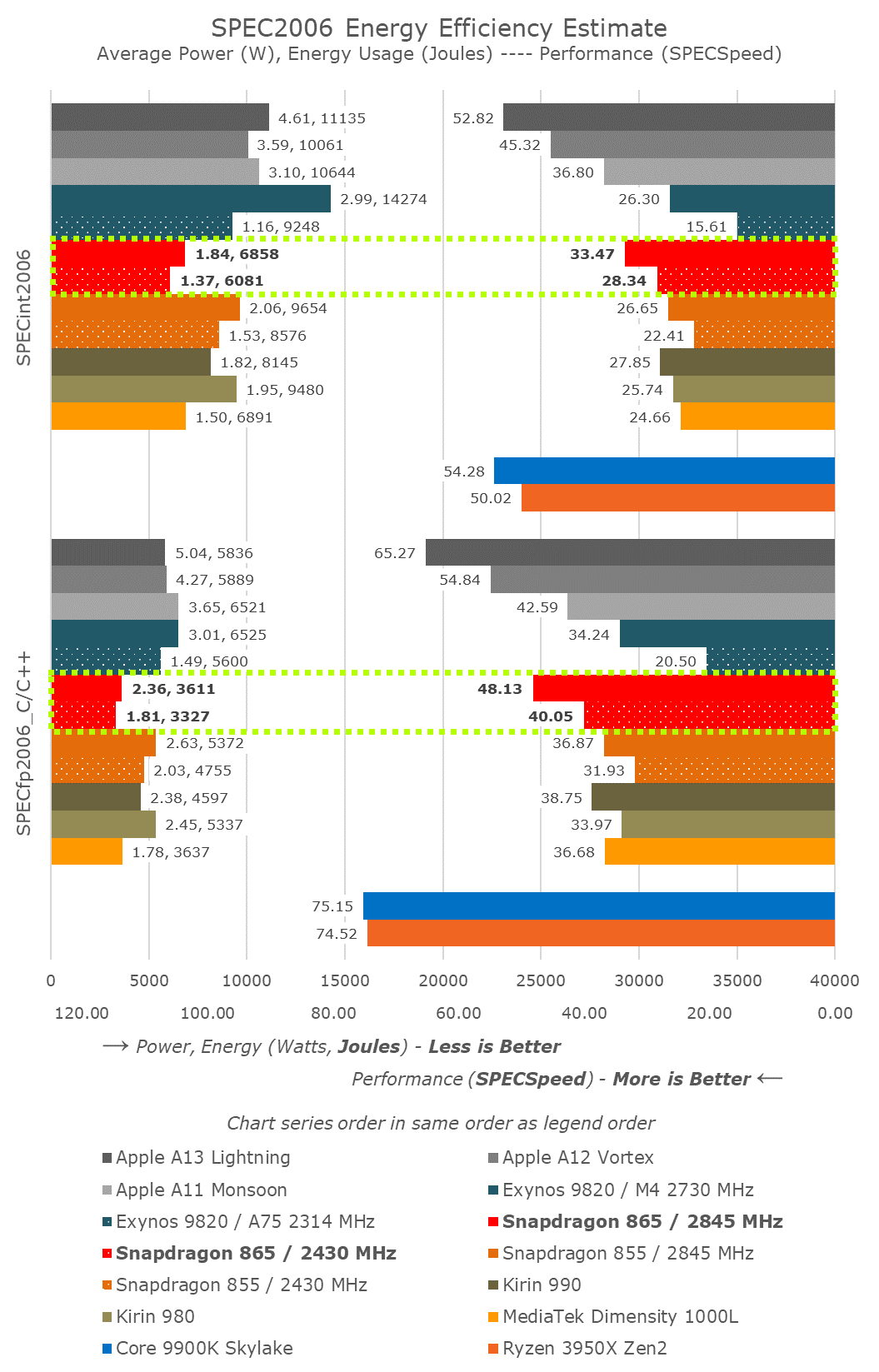
The A13 is a huge core with better-than-Skylake IPC, that trades blows with Skylake++ 9900K or Zen 2 3950X in many real-world benchmarks, despite the much lower TDP and clock speed:
I wanna upgrade my in-laws from cheap, spyware ridden Androids that can't even withstand a video chat. It will be quite hard with the screen that looks like it's half a decade old.