How come that there are nevertheless only between 40 and 50 new cases per day?
https://www.youtube.com/watch?v=YfsdJGj3-jM
https://www.youtube.com/watch?v=ehCnbW4FAhg
Brief:
- Your temperature is checked before entering any store/restaurant/tourist attraction/(sometimes) leaving your neighborhood/(sometimes) at a road block. You must scan a QR code so your location is logged.
- Restaurant workers and public servants are suited up in light haz mat gear.
- Entire neighborhoods have literally been walled off with just one entrance where your temperature must be checked to enter/exit.
- Hotels have shut off central air to prevent the spread
- Ordering food is touch free
- Elevators have tissue paper so there's no direct contact with the buttons
- Offices can only reopen once they have a Covid-19 plan, hand sanitizer, gloves, touch free thermometer, masks, etc. Each employee must log how they got to work.
- much more in the links
[1] https://www.vox.com/future-perfect/2020/3/12/21172040/corona...
https://www.youtube.com/watch?v=YfsdJGj3-jM&feature=youtu.be
Procedures at Zhejiang Hospital (zero fatalities)
https://video-intl.alicdn.com/Handbook%20of%20COVID-19%20Pre...
A week ago there were videos released of the makeshift hospital in Wuhan, where all beds were empty and the doctors were standing in front of the empty hospital taking off their face masks, smiling. Soon after, videos were uploaded by locals showing a very different situation.
Disclaimer: This is my own opinion. The only sources I have for this are the same as yours: social media. So, take stuff with a grain of salt, do your own research and make your own conclusion.
Speaking frequently with people living there things do seem to have recovered and life is starting to return to normal.
Other than incorrect numbers, the second most likely possibility is that they found some effective treatment.
Here's my thinking. We know the following (maybe my information is not entirely correct, but the reasoning is still valid): 1) a host is infectious for about 14d; 2) the virus survives on surfaces/objects for 9d (this is based on other coronaviruses, but a more recent study suggests it's shorter).
If you want to stop the spread, or reduce it significantly, you need to quarantine people for at least 2 x 14d + 9d.
Why is that? Because, the first infected in each household will stay so for the 14d, and assuming all the other members of the household are infected by the first person, and assuming the infection happens towards the end of the first 14d, for safety, you need another 14d. Plus, you want to make sure the virus is not still active via surfaces/objects, so plus up to 9d.
If you go further and assume that not everyone is infected by the first person to have the virus in the household - so you will have multiple generations of infections - then you need to add maybe another 14d. And so on.
China did some 2 months of quarantine. Chances are very high they actually succeeded in reducing significantly the number of active cases. No need to appeal to conspiracy theories at this point.
Why do we see a resurgence of cases? Because the 14d is just the avg. Some people reportedly can be sick for longer, many can be sick without having serious symptoms, some people don't respect fully the quarantine etc. Because of this, stopping it permanently is going to be very difficult via quarantine alone.
On the other hand, ICU cases, and deaths cases seem more relevant.
By contrast, three weeks after the first known case of the disease now known as COVID-19, China had notified the WHO of a spike in cases of a pneumonia-like disease. Two weeks after that, the coronavirus had been isolated, genetically sequenced, and a diagnostic test developed, giving China the tools it needed to launch one of the greatest infectious-disease containment efforts the world has ever seen.
If "one of the greatest infectious-disease containment efforts the world has ever seen" has not resulted in contaiment and the virus has continued spreading, as your comment suggests, we will soon find out -and in a very unpleasant manner.
Or, to not put too fine a point on it: in that case we're in deep shit.
However, number of deaths is likely more accurate. Some places like Vietnam, and even Washington state have somehow managed to have a very slow growing number of deaths despite likely having community spread before Italy did.
Is it likely that the Chinese are giving false data / simply not testing as thoroughly anymore?
I'd expect pockets to crop up here and there, but they know how to shut them down once detected, and have the oppressive infrastructure in place to do so.
If you are skeptic about China's data (which is a fair objection), you can also look at the Japan process.
However, I have no idea about the accuracy of their measurements or degree of correct reporting.
A lower fatality rate in a higher population can cause more deaths. 10% of 1000 is smaller than 5% of 1000000.
But more importantly, something that is more obvious and more quickly restricted will spread less. SARS had an R0 of 2-4 but with control measures in place that dropped to 0.4 (figures from Wikipedia).
With covid19 many patients are able to continue their lives and infect others without being obviously sick themselves. This limited the ability to contain outbreaks without extensive testing.
That gives your virus time and opportunity to spread.
Fast lethality means the host dies before you spread. Strong symptoms means the host stays home and you don’t spread.
Covid19 hit the sweet spot. Asymptomatic for many days, barely noticeable symptoms in 70%+ of the population, then suddenly very deadly in the few percent that get bad enough.
With better testing, this could've been nipped in the bud worldwide. Also, with proper pandemic preparations and alertness, countries wouldn't need to shut down. Shutting down proactive measures to save small amounts of money, costs much, much more in the longer run.
You will witness every decent country hit by unconstrained exponential contagion, shutting down.
When it's too late, or people can't be bothered, they become Italy, Spain and Worse.
The total number of fatalities caused by a disease on the other hand depends on the spread across the population which is influenced both by the communicability and by the effect of the symptoms on its spread—how long are people infected, how long do the infected live, how identifiable are the infected.
If you choose to plot things on a logarithmic scale, you open a whole can of worms with expecting your target audience to be educated numerically and understand the implications of a line on a log-scale (which looks far less dire than an exponential on a linear scale).
https://www.abc.net.au/news/2020-03-26/coronavirus-covid19-g...
As a group of scientists wrote in 2007 [1]:
“The presence of a large reservoir of SARS-CoV-like viruses in horseshoe bats, together with the culture of eating exotic mammals in southern China, is a time bomb. The possibility of the reemergence of SARS and other novel viruses from animals or laboratories and therefore the need for preparedness should not be ignored”
I'd love to know if we see any sort of "rebound" in the quarantine period.
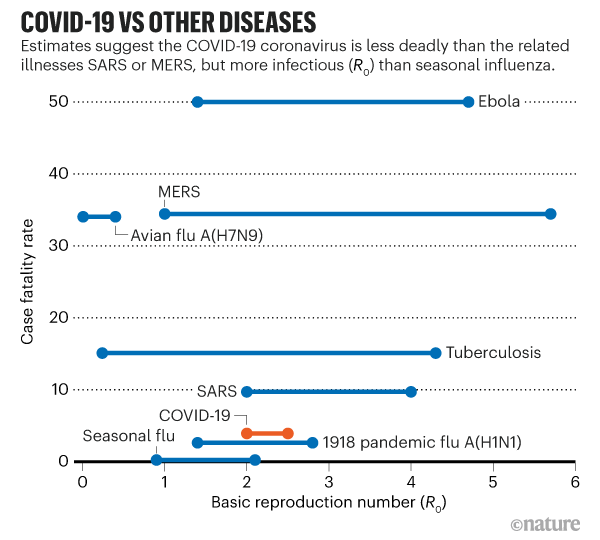
My understanding is that R_0 just depends somehow only on the virus itself, while there is another factor R = a R_0, which determines the actual reproduction number "in practice", taking into account isolation measures and such. So for Ebola R was much lower than R_0, so a lot fewer people died compared to COVID-19. Is this correct?
[1] https://media.nature.com/lw800/magazine-assets/d41586-020-00...
Let me clarify the paradox: Say Ebola has a R_0=4. That means one person infects 4 people under some circumstances. It doesn't matter if Ebola kills someone in 3 weeks or in 5 seconds, under some circumstances one person must be infecting 4. What are those circumstances, and how are they different from the actual circumstances which led to the Ebola epidemic stopping.
R0 being different in different places is expected. It's especially expected to change as measures are taken to control spread. Even in the absence of such measures, different cultures, even at the same population density, will often have different R0.
* Wuhan throw a party to celebrate the lunar year
* Almost the entirety of China goes on holiday for the lunar year
* New Year holiday
* Border lock downs of various Countries within that timeline
Those charts don't look that powerful to me.