I spent the first several years of my career working in academia for a poverty level wage.
I can confirm from my own experience that when you worry about not being able to pay rent and all the bills, it's very difficult to be productive, much less in a job that requires any kind of focus or creative thinking.
It's interesting but sad watching that creativity vanish as the rents rise. There's more money here now, but less creativity.
I think this apparent contradiction is resolved by asking "who had the time to be creative?". When rents were low, artists could make ends meet and still have time to create. As rents are rising, the artists are pushed out, or forced to spend more time making money. The new tenants are people earning decent money, who again are either working too hard to create, or are not "artistic" in that sense (me included).
The old squats and communal housing are being redeveloped, the graffiti-covered walls are being repainted so the houses they cover keep their value. The focus moves from "poor but sexy" to "let's make lots of money". Everyone is richer, except the culture.
It's a concern that spans decades.
https://www.cbc.ca/archives/the-last-days-of-toronto-s-low-r... — This article dates to the 80's and its tone is the very same.
(Canada's lost sweetheart PM hopeful is interviewed in one of the videos when he was a Toronto city councilor. Such a loss. He really had his finger on the pulse)
Seems like we are regressing from artists back to "mathematicks". Hopefully we don't regress further into "Politicks and War".
― Virginia Woolf, A Room of One's Own
>Shafts were driven down into the ground and galleries opened where slaves, chained, naked, and branded, worked the seams illuminated only by guttering oil lamps. An unrecorded number were children. It was a miserable, dangerous, and brief life. [0]
It is always the most comfortable that consume the most vivid persecution porn. Feminists seem to have been doing this for a century longer than the The Handmaid's Tale, which was my introduction to that brand of mental illness.
[0] The Rise of Athens: The Story of the World’s Greatest Civilisation
Not only do you worry about your own small income; but grants, scholarships, registration fees and a myriad of other things have in recent times become volatile and can be taken away from year to year.
Most of the issues is due to 1) our government being corrupt and 2) promises the government made about free education.
I am not against free education, but I am against impoverished professors.
This is why I decided to side-step academia. It is delaying my PhD by probably 3–7 years (I am at year 2's start now) but it's better than having in theory 100% time spent on a PhD but actually worrying about the University and your peers, your own future, etc. in reality.
Welcome to the sad reality of academia almost everywhere in the world. (sigh)
Basically in order to be productive under those circumstances you have to ignore reality, which can be problematic for the people around you.
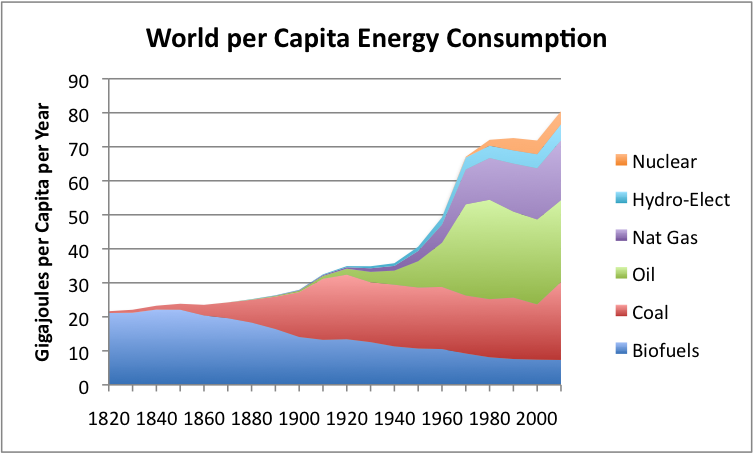
But at the same time everything is relative on your perception of reality. We spend today 50-100 times more energy per person that people 100 years ago, and most of those people were happy.
We upgraded our expectations, specially because of mass media and advertisements and feel always dissatisfied because they will compare us with people that have more than we have.
Obviously, the more materially rich your society is, the better the latter deal is, but happiness comes from feelings of safety, not being overworked, and solid social ties.
https://www.eia.gov/totalenergy/data/annual/showtext.php?t=p...
https://en.wikipedia.org/wiki/1920_United_States_Census
In 2018 the United States consumed 101.2 quadrillion BTU of primary energy, with a population of 327 million.
https://flowcharts.llnl.gov/content/assets/images/charts/Ene...
https://www.worldometers.info/world-population/us-population...
Primary energy consumption per capita in the United States increased about 54% in the last 100 years, not 5000%.
Global energy consumption per capita has grown by nearly 300% since 1920:
http://theoildrum.com/files/per-capita-world-energy-by-sourc...
This is still much less than 5000%.
I’m asking out of general curiosity and not snark, but is there a reliable source to this?
A cursory search on my end didn’t return anything. I often wonder if the obsession with “happiness” is a relatively recent phenomenon borne of our own privilege.
my mum has not been financially stable for over a decade. in this time she has been starting to "reset" what she finds acceptable. just recently she had to downsize her house and she has already focused on only what I can describe are ways to spend money to avoid reality. she recently listed a train of things she wants to do to her new house that sounds like she wants to stay there for the rest of her life. when asked about the conflict between staying and her next year goals is met with internal strife. she couldn't accept the fact that she needed to use what little money she had to lift herself out of her situation. instead she put priority on installing a dishwasher in her 600sqft apt to help the next person.
your brain is the greatest troll ever to exist
100 years ago was 1920. That is two years after WWI. That is destroyed countries moving from crisis to crisis, veterans struggling to become part of society ...
citation?
I am scared of losing my job though, because of a lapse in mental health or whatever. Not because my expectations are high, but because I'm afraid of having to sell my house in a hurry and move into a small apartment with my wife and my 3 children, as well as the feelings of failure and shame.
Is that known?
Expectations are also imposed. We have to commute to our jobs and pay for our apartments that conform to building codes.
Lacking money occupies your mind, you just tend to forget if money isn't a problem anymore.
To me that's the main benefit of earning more. Sure, it's nice to be able to buy more expensive things overall, and e.g. be able to travel more, but I find more value in the many tiny day to day improvements that individually sound trivial, such as not having to budget when at the grocery store. It's a few minutes here and a few minutes there extra where my mind is free to relax or focus on more interesting things, and it really adds up.
There was a year in my youth when I had a big economic setback, and suddenly had to budget my day to day expenses again, and frankly, the time I lost that I had to spend thinking about money, from the small things like how much I could afford to spend for lunch to how to cover rent, was exhausting, and a very stark reminder of how easy my life had become prior to that. And I've never experienced true poverty - I always had multiple safety nets; I'd never have starved, for example.
I think the mental exhaustion from dealing with a strained economy is one of those things people who haven't experienced it tend to don't get when trying to imagine what life is like for people who have little money.
Not disagreeing, just trying to add some complexion.
Poverty may even trigger creativity at times. But stress is the major impediment, and therefore living in long-term poverty does not favor sustained creativity.
"I must study politics and war, that our sons may have liberty to study mathematics and philosophy. Our sons ought to study mathematics and philosophy, geography, natural history and naval architecture, navigation, commerce and agriculture in order to give their children a right to study painting, poetry, music, architecture, statuary, tapestry and porcelain.”
Like Maslow's hierarchy of needs... generally people have to expend their creative thought on how to provide for themselves before they have the opportunity to use that thought in more expansive ways.
Do a Dan Price and you jump start people's ability to settle the lower levels of needs and be able to make more choices.
water / food / electricity doesn't total high for my needs, rent on the other hand
I guess that's why artists lives in old buildings sometimes..
ps: also, call me crazy, but I think in a hunter settings you'd have more time to wander and create than todays city life. As long as there's enough rabbits around to grab ..
https://en.wikipedia.org/wiki/Henry_Cavendish
This guy managed to get a measurement of G (the one from high school physics) in his basement IIRC.
It's a shame that so often that thing seems to be how to pay rent on time, or being able to provide for your familiy financially.
Who was paying you and could you not go do something else for money?
0:
I also "lost" a lot of money this week, but I'm not leveraged and I have positive monthly cashflow, so it's no big deal. I just bought a little more of my favorite broad market etf than usual and went back to my life.
Although we are the exception not the rule. My last job had me running around exhausted and I thought being super productive would increase my bonus (narrator: it didn't)
Dan Price really is like what is presented in this article. He actually cares about his employees and is being genuine here. He's a good person, making a private business decision to increase the pay of frankly his lowest paid workers.
In a city where the average tech worker earns $275k a year, he believes its the right thing to do to make sure everyone that works for him at Gravity can earn enough to afford rent, food, and some fun.
Say what you will about the merits of decision, but it takes real leadership to make it and stand by it. I happen to think he's doing the right thing and I hope other companies choose to follow suit.
He really does come across as great guy. If I was more local I would probably look to work for him.
Like, I could see somebody not feeling like that's fair so I'm wondering how the morale was impacted by that.
I need to move to bay area this year. thats my sole mission this year.
I think I remember reading that Americans, on average, have $700k saved up for retirement. When I dug further into the data, the median was many multiples less than that.
I’d add Portland, Austin, Minneapolis, etc. to your consideration. Comp is 25% lower, but cost of living is even lower than that.
"There is one rule for the industrialist and that is: make the best quality goods possible at the lowest cost possible, paying the highest wages possible."
-Henry Ford
I chat with 2 russian chaps working on the technicalities of that challange (coding the model in sofware) they had an interesting thing in common. They both had parents who tried to work the paper administration in soviet days. They told their kids countless horror stories about misplacing a bit of paper excluding entire regions from goods, like no shots. The parents were extreamely entugiastic about computers when they came onto stage. That! That is what we needeed!
I'm with you for the second part, I think the results can be looked at independently. However, I don't think one good deed should excuse past bad behavior and one should be careful about glorifying someone to the extent that we ignore their misdeeds.
I really hope that was intentional.
The article specified that "two senior Gravity employees also resigned in protest". Do you have a source for "a lot of the high performers" outside of those two?
It sounds to me like it worked out for the company, regardless of the CEO's personal goings-on. It's a win for the idea that if you pay all your employees reasonably, they won't just fall back and let the company crumble. I think it's really important to point and show that this initiative, which so many people derided as ridiculous and guaranteed to fail, actually worked.
I'm not sure what value the "high performer" qualification has in this instance. They were the highest paid, but I don't think we have any guarantees to their actual output. If the CEO is an untrustworthy agent (as some of the stories make him out to be) how can we trust any of the valuations of his employees?
https://www.bloomberg.com/features/2015-gravity-ceo-dan-pric.... https://www.hundredeightydegrees.com/investigation/2018/2/27....
https://www.bloomberg.com/features/2015-gravity-ceo-dan-pric...
https://www.hundredeightydegrees.com/investigation/2018/2/27...
https://www.bloomberg.com/features/2015-gravity-ceo-dan-pric...
source: https://www.geekwire.com/2016/dan-price-70k-ceo-prevails-sui...
> Lucas Price served the suit on his brother prior to the $70,000 announcement, and the core allegations related to the preceding years. The suit alleged that Dan Price used his majority control of the company to pay himself excessive compensation, manipulate valuations of the company to his financial benefit, and charge hundreds of thousands of dollars in personal expenses to the company.
FWIW, Dan Price (owner of Gravity) is the real deal.
While I no longer work there, I am proud of what he is doing. He is a capitalist, making a decision as a private business owner to help improve the lives of his employees earning < $70k (in the expensive Seattle area mind you) by reducing his own compensation.
I'm not sure which is more applicable:
1. Hurray, decency.
2. Shouldn't getting excited about what would've been middle-class income 70 years ago be a sign how far workers' pay has fallen?
The standard of living that 70k USD buys today is vastly better than what the median income bought in 1950.
(Of course, Seattle is rather expensive. The 70k USD would go much further in a city that didn't restrict residential construction so much.)
At any rate, the claim that "stuff" is more expensive because it is better implies that decades of technical improvements have resulted in no efficiency gains. At best, it implies the value per man hour has essentially remained flat. And since the option of buying lower priced versions of items has dispersed, we can never know if the higher quality item is fairly priced.
Edit: I did the calculation backwards. Thanks to everyone who pointed that out.
Now compare with median annual incomes in 1950. Asking Google about '1950 median american income' gives 'Average family income in 1950 was $3,300.' Not quite what I wanted to know, but close enough. (We are looking at per worker income, and would probably be more interested in median than average.)
GP is probably also relating to what you can buy using 70k.
Now, without exact numbers, I can't say economically this or that.
But effectively this was not a zero sum game. The company was not paying more for the same outcome, they were paying more for more output.
The output of the company increased. This is how investments are usually supposed to work, you put money in, and reap profits.
What makes this a bit more difficult to gauge that it's likely the increased performance does not come from individual output, but from a better cohesion of the team which generally makes things always easier and efficient.
What people often get wrong is that they think about wages atomically - I pay this guy this much and he delivers this. Whereas when you are having a team of workers (whose job is not to be a mindless drone) and whose output depends on the co-operationnof the individuals, often the second order effects are more important.
For example: rewards. You give a huge reward to the single top performer in your company. What happens? Everybody becomes jealous of him, and some will feel cheated since they contributed heavily to the projects the individual participated in. Future collaboration will likely suffer.
In fields were output is purely of individual performance (some sales jobs, logging, etc) this calculus is of course different. In these situations the atomic cost analysis probably works.
Everything else being equal, an average business would be outcompeted if they did something like that.
If you still think what they are doing is efficient, take it further and further. Start increasing the salaries more and more. Very soon you will be able to afford one worker. A very expensive janitor maybe?
For Facebook, Google, Apple and Microsoft, not much would change, they don't employ that many people below the threshold, I think, unless you count the outsourced contractors that do moderation, annotation etc. This company's policy doesn't extend to the company they outsource the cleaning of their office to either, so that wouldn't be a fair comparison.
> in Seattle that wasn't enough to afford a decent home.
Because the population in Seattle has grown by leaps and bounds, if everyone could afford one of the supply of homes, the prices would go up until demand equals supply.
>make building affordable units a higher roi than building luxury units, etc.
Every luxury unit that is built lessens the pressure on housing demand.
So the key is: just build more housing.
The mentality of these people...!
Not people you want in your company
As senior employees, maybe they had stakes in the company. Maybe they didn't want to go through the above.
I have hard time believing this.
It’s in the title. ‘Everyone on 70k’ is a pay cut if you were in more than 70k, as any professional would be. It’s clearly wrong as it doesn’t make any sense, but that’s the source they were referring to.
Some articles that talk about the other side:
https://www.bloomberg.com/features/2015-gravity-ceo-dan-pric...
https://www.hundredeightydegrees.com/investigation/2018/2/27...
“Gravity’s 2014 profit was $2.2 million, Price adds. At private companies with sales like Gravity’s total revenue, salary and bonus for the top quartile of CEOs is $710,000, according to Chief Executive magazine’s annual compensation survey. At companies with sales like Gravity’s net revenue, the top quartile pay falls to about $373,000. At companies with a similar number of employees as Gravity, the top quartile of CEOs makes $470,000 in salary and bonus. The CEO of JetPay, a publicly traded competitor that processes a similar volume as Gravity, received $355,000 in 2014.“
Yet his comp was $1.1MM?
“Price signed with the talent agency William Morris Endeavor Entertainment and now charges as much as $20,000 per speech, Pirkle says.”
Or his obvious avoidance to answering the direct questions. It’s cool what he did, but I don’t trust the guy. Or at least I doubt his motives are so honorable. Perhaps I’m too cynical.
It’s been 5 years, or $150k each, and there’s been no apparent bad news. What more do you need?
Have you changed in the last 5 years?
But what works in a group smaller than Dunbar's Number[1] may not quite scale up.
Don't let that Politician Obfuscating Near You (PONY) con you into believing otherwise.
Real systems usually are mixes. E.g. Soviet system is largely slavery plus some bits of capitalism and a lot of propaganda to cover the monastery aspect. Or a capitalist company with a visionary leader may be quite a monastery too.
Now, the most pleasant way to work is indeed a monastery, but the one that scales well is capitalism :) Slavery is inferior on both counts, but may work when there's no way to add economic interest.
Scaling above that starts to require some external management structure (your corporation).
Then there is the military (retired Navy here) where there is an explicit hierarchy and a Uniform Code of Military Justice to as an external driver.
Hence the authoritarian fascination with military terms. If that's your thing, then organizing society like some vast bipedal ant colony seems attractive.
Journalism shouldn’t give coverage intended to benefit a company. But it’s just as important they don’t forgo telling a story they consider interesting just because it might incidentally benefit the subject.
Workers who feel they aren't being fairly compensated for their labor don't work as hard. They don't show as much attention to detail. They don't have any loyalty to their employers, who they perceive as exploiting them. They are much more likely to quit or leave at the first opportunity for any job that seems better. They aren't invested in good customer service. They grow to resent their employers when they work full time and still don't make enough to afford basic necessities.
Its no surprise to me that paying workers a living wage (or even something close) results in measurable benefits for a business, in a variety of ways (not to mention immeasurably improving the lives of employees).
Further (since this seems like such an alien concept to most high-wage, HN members) getting paid a decent wage also allows massive benefits to the economy and society at large. We're currently looking at a global pandemic with the coronavirus. Given the apparent virility, it seems inevitable that this virus will spread to every country in short order. Most low wage workers don't get sick leave. Many get fired even for taking unpaid sick days. These are your cashiers, your grocery store workers, the people who make your coffee - the service industry workers who make up the bulk of American labor. Even those workers who won't get fired for taking sick days, often can't afford it. We've all seen the stats about the huge number of Americans who cannot afford an emergency expense of a few hundred dollars. Staying home sick qualifies. The containment efforts we've seen in South Korea and Italy have (so far) largely failed - and these are countries with universal healthcare and worker protections that we don't have. Right now it costs $3,200 to get tested for the coronavirus in the United States. Not treated - just tested! Working people cannot afford this and will not get tested, or treated - which will make the crisis worse. How much will this crisis end up "costing" us in the long run? If not this one, how much will the next, inevitable one cost us, because working people don't have the income or benefits to take care of themselves?
Massive kudos to this guy for paying his workers a fair wage. Hopefully other employers are enlightened enough to follow his lead and do the same, with the understanding that paying adequate wages benefits not only their business, but society and the economy at large.
Not if their work doesn’t really differentiate the product. I have all the research I need about products from the internet, so I don’t need a store employee to sell me anything. Same with many other low paying positions. They are low paying because customers aren’t valuing the extra benefits of a non plug and play staff.
There are low-paying jobs for a variety of reasons, including in large part, corporate welfare for the largest employers, like Wal-Mart, which the government subsidies at taxpayer expense to facilitate the payment of starvation wages.
https://www.forbes.com/sites/clareoconnor/2014/04/15/report-...
As far having everything you need for your products due your internet research, I hope you will enjoy the coronavirus (or whatever other communicable disease you acquire) as an added bonus from low-wage workers who are unable to call in sick. The people who brew your coffee, make your sandwich, park your car or do a million other things that allow our society to function. Perhaps when your mother, your aunt or child dies because they were needlessly infected by a low-wage worker who couldn't afford to seek treatment or call in sick to work you will factor that "worth" into their perceived value.
As someone who worked retail in a music store, there's a whole lot of people who have no idea how to even begin finding what they like. Efficient customers like you are a minority.
However- it still needs to be said that we really ought to fight to create an economic system in which everyone has the means to have a comfortable life, even if individuals that make it up are not virtuous. Because this kind of story is a rarity, and the market will certainly punish him for his generosity.
Why do you think everyone should have the means to have a "comfortable" life? Perhaps you mean means to meet necessities? If not, what does "comfortable" mean to you? Additionally, why do you think that the means are not there today?
"Crunching the numbers" does not give details as to how he arrived to 70K. The article made a reference to report by Daniel Kahneman and Angus Deaton, but it is not clear.
Have I missed something?
The hiring quality will also increased. For example, with a 40k salary, the company could hire someone with 5 years of experience, with 70k, they can find someone with 10 years of experience.
So in a few years the company will get rid of low performance and hired more skilled workers and the salary vs skill will match the market rate again. (with a few exceptions)
When they stop growing and increased competition will cut into their margins, and especially if they start losing money. At that point, they'll be looking at efficiencies everywhere - and those expensive employees will probably be laid off.
Not sure if this means ALL of his stock, but this doesn't seem to be the same thing.
1) Him making $1million salary at a small-medium company is quite a bit, but that may be because ...
2) ... the company is clearly making a lot of money (as in a lot of profit) and/or growing quickly. When you're growing and making huge profits at a software company, you can afford to pay above the market rate because you have spare cash. At some point that will change. The growth rate will plateau and they will cut salaries (maybe not for existing employees, but for new hires), or layoff expensive staff.
But props to Dan to get this done when he had the chance to.
37signals would be proud.
If you decentivize the most productive people, then you might hurt the rest of the company.