"Well, there is a port of glibc to UEFI, so one could very easily "boot into Emacs". Strangely I've not seen anyone do this."
Can you hook me up with that link :) Cheers.
Today's world seems broken, fragile, noisy and unmaintained. May be that humanity needs to unwind, rewind back a couple of decades and try again. If you play the scenario of human evolution multiple times, I am sure a large scale system such as global society would end up in a different state... every time.
Reminds me of the story that Kyoto, Japan didn't get ruined because one of the military commanders in charge of the nuclear bomb drop locations, had a soft spot for Kyoto... and instead chose Nagasaki and Hiroshima. [1]
If we were to replay human progress, I want us to go back to that era and relive the engineering life. Must have been amazing to work in a technical field in the 70's and 80's. Now we have AI and Quantum and all these fucking buzzwords, largely perpetuated by people who have no clue - marketing and PR folks.
[1] https://www.theatlantic.com/international/archive/2015/08/hi...
0: https://en.wikipedia.org/wiki/Bell_Gothic
“Quantum” is from the 1920s. It’s not really a buzzword but more an adjective describing our most accurate model of reality yet that physics can provide.
Yeah, the modernist ethos. Today those would sound featureless, single-minded, featureless (yea, again), oversimplified, lasting beyond its usefulness, unoptimised, repetitive.
As any engineer, I also like the modernist thinking better, but it's not realistic, life is messy and complicated.
The closest guesses I can come up with is the Commodore 64 Programmers Reference Guide, or maybe an old terminal or computer magazine. But I could easily be wrong.
Either way, I love it.
https://hackaday.com/2017/01/18/forrest-mims-radio-shack-and...
https://www.fileformat.info/info/unicode/char/0ca0/index.htm
How does this work from a copyright/legal perspective?
Other jurisdictions do provide protection for the abstract shapes represented by typefaces.
The thing is called "tracing" and quite common.
The actual code (which means the ttf/otf) is protected under copyright. The shape of a letter isn't and can't be by any form of IP.
So: You're not allowed to redistribute the font file but creating your own font which just happens to look alike is perfectly fine.
So, a given "specification" (how a font looks to the human eye) can have many different "implementations" (ie. TTF files). The specific "implementations" themselves can be copyrighted, but somehow not the "specifications"?
If so... assume one TTF file which is copyrighted, pay-per-use license. Assume another TTF file, which is open-source, free to use and redistribute. The files both implement the "Helvetica" specification, rendering the same letters to the human eye. How "different" must the free implementation be from the paid one, for it to not be considered an infringement?
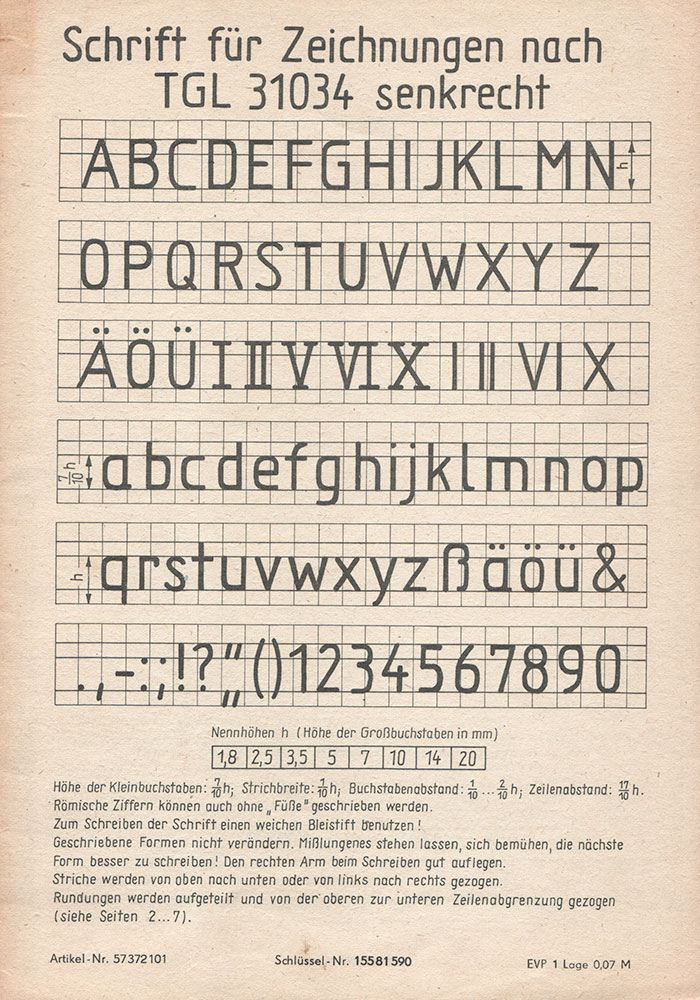
https://de.wikipedia.org/wiki/Normschrift
https://www.typografie.info/3/uploads/99b804cee64ef8c64ad900...
I had to learn that one in drafting class in middle school.
There are few widely used "Technical lettering"[0] standards: «ISO 3098»(EU/International), «ASME Y14.5»(US) and «GOST 2.304»(ex-USSR).
There are few FLOSS fonts which cover «ISO 3098»[1,2,3], «ASME Y14.5»[3,4,5] and «GOST 2.304»[6,7,8] technical lettering standards.
[0] https://en.wikipedia.org/wiki/Technical_lettering
[1] https://github.com/hikikomori82/osifont
[2] http://peter-wiegel.de/TGL.html
[3] http://peter-wiegel.de/TGL_0-16.html
[4] https://www.fontspace.com/micronus
[5] https://cstools.asme.org/csconnect/CommitteePages.cfm?Commit...
[6] https://bitbucket.org/fat_angel/opengostfont/
Trivial factoid: my understanding is that the Gorton pantograph fonts came first, and that the Leroy lettering sets were manufactured using the Gorton fonts. But I don't have a good source for that, so I could be completely wrong.
This font was also used by EC Comics (their comics included Tales From the Crypt). Here is another font based on that which is more fuzzy: https://caseyburns.com/artwork/font-design/
I too find the high concentration of upper case fonts, especially Courier New, in engineering and especially EE, to be kind of relaxing and pretty.