1) have centralisation
2) assume storage space will expand exponentially since the entire point of bitcoin is many many copies of its ledger
3) come up with a new method more secure than PoW but still decentralised
Good luck with (3). (1) and (2) are not good choices. So they moved it off the chain into lightning network.
Would you say that the credit card network, or PayPal, has exponentially increasing storage requirements? It's possible for Bitcoin (for example) to be decentralised and useful to the world and only require linearly increasing storage space.
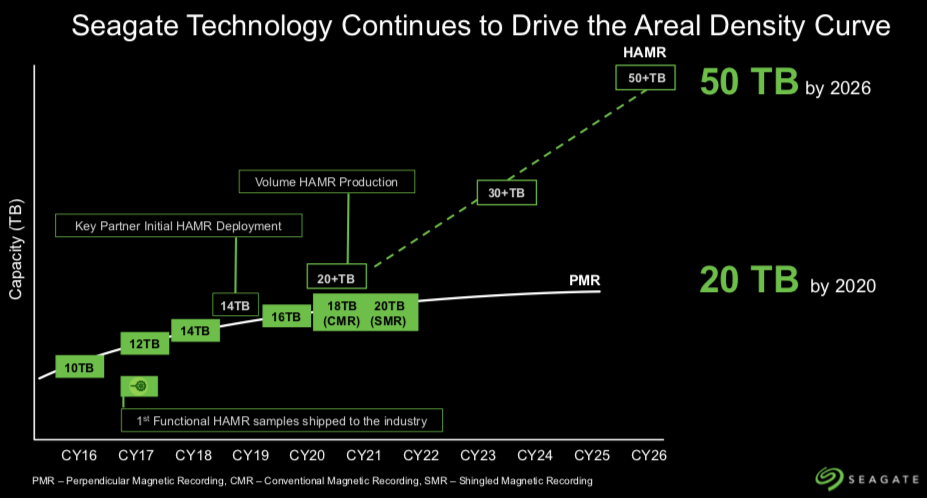
Fortunately it seems that storage technology will continue to scale linearly over the coming years too:
> (ignoring things like High Frequency Trading)
HFT is not a blockchain transaction. They are off blockchain transactions entirely because they trade money between bitcoin / other cryptos and dollars.
> there is only a limited number of potential active crypto-currency users
My entire point is that this limits them from growing. If the blockchain is kept from exploding, it helps to onboard more users.
> Would you say that the credit card network, or PayPal, has exponentially increasing storage requirements?
Indeed not. But their user base is now standardised. So they have a predictable number of transactions every second. However, their storage requirements are still obviously industrial grade server farms. The point of bitcoin is that everyone should have a copy of every transaction (excluding lightning network transactions). You see the connection? Not all of us can have our own server farms. If we all wants to store every transaction in the way the parent of my previous comment alluded to (increase block size), each of us will need our own mini server farm i.e. exponential storage growth.
> It's possible for Bitcoin (for example) to be decentralised and useful to the world and only require linearly increasing storage space.
Yes. It'll level off at some point. But we are far, faaar away from that point. So it'll take quite a while before it levels off.
Is that the point of bitcoin? Satoshi said:
> Long before the network gets anywhere near as large as that, it would be safe for users to use Simplified Payment Verification (section 8) to check for double spending, which only requires having the chain of block headers, or about 12KB per day. Only people trying to create new coins would need to run network nodes.
https://satoshi.nakamotoinstitute.org/emails/cryptography/2/
(He also didn't say anything about "lightning network transactions".)
> If we all wants to store every transaction in the way the parent of my previous comment alluded to (increase block size), each of us will need our own mini server farm i.e. exponential storage growth.
The BTC blockchain is currently 250 GB. If blocks had been 10 times bigger, the blockchain would still be less than 3 TB, and blocks would almost never be full, which would reduce transaction fees and help to onboard more users. I don't think that storing 3 TB of data requires a server farm.
Quite cool approaches. The problem is that you can't attach data to transactions, so only useful for a subset of applications, those unlikely to create much bloat in the first place.
https://www.youtube.com/watch?v=agppUdX9YvI&feature=youtu.be...
An actual market-powered mechanism for data-pruning. As the price of new transactions rise, the amount paid by old (rebroadcast) transactions rise more. Network hits equilibrium where data in == data out.
"Decentralization" is a means to an end. Not everyone have to run a full node, as long as there's enough.
It's amusing that LN is touted as a solution, since decentralized routing is an unsolved problem, meaning that LN will be more centralized than what it's supposed to solve.