For example if you set a budget of 100 dollars per day, Google can, and most likely, will, spend 200 dollars in short campaign per day.
Another thing: in display campaign, on default, most of the budget will be drained by mobile fraud applications that generate fake clicks. And also by video clicks made by babies on YouTube. And Google removed an option to disable mobile apps altogether lately.
Keyword targeting - on default Google uses broad matching including variants etc. Eventually you can pay for clicks for non relevant keywords that will also drain most of the budget.
Another thing: Google advises to put ads on your company name. It is a neat strategy, because you pay for something you had for free. And campaign seems to have better statistics.
Another thing. You wont believe it, untill you see it. Aprox up to 80% of ad traffic are bots. And advertising platforms does not recognize it or refund.
And so on... I am working on Google Ads campaigns for several years now. Always say to my client two things:
1) Google and Facebook will spent every penny you want to spend
2) Spend on ads only such amount on money, you can live without, and keep it running for a longer time without interruption.
3) Optimise often
By time though you'll build up a nice list that you can exclude, but it's going to cost you in the start.
A friend's toddler was watching a cartoon with songs on YouTube, and they were deeply focused on it when an ad popped in their face. They didn't stop crying for an hour.
By excluding channels for kids from your ad campaign you can both save money and avoid scaring children, so go for it. :)
How is this possible? It sounds like a bug, but it's probably not, so what's their justification?
Launching an ad campaign feels like rocket science now mixed with a good amount of woodoo magic. 80% down the drain by default? That's a number I could believe, but freaks me out how to market my side project to get actual people on my service. And I'm on a ridiculous budget, I can't afford the "throw money on the wall and see what sticks" method with 500$.
Therefore, the budget is only "eventually consistent" - i.e. at the end of the campaign or after a day or so, the number you're being charged is accurate. However during the campaign itself it's not possible to guarantee that things won't go slightly over budget as each individual ad auction cannot feasibly check the central budget.
That said, it definitely feels like there should be a way to implement this such that it backs off as the budget is approached, so that overshoots are likely to be minor, rather than 100% of the budget as apparently happens on a regular basis.
Eg. Your daily budget is $200 and they spend $420, you’ll get a $20 credit.
Then there is the monthly limit, which is your daily budget x 30.4. Also here you'll be credited any amount they exceed.
So there is a reason behind it. But its something well hidden. You have 500 dollars for a one week campaign, and it occurs you pay 1000 dollars for it. It does not seem to be right.
The only assurance is that your monthly budget won't exceed $3000
can you adjust bid to -100% for mobile?
And as you can expect, Google has 10 times stricter requirements for websites showing their ads, than for Android apps...
Facebook is the same way with all of this crap too. I’ve seen more success with the hard way, networking and getting content made about me and distributed in magazines or online blogs from people who get to use my service for free.
Sales aren't some abstract thing that can't be quantified.
Site gets no traffic -> Spend $X on google or facebook pointing traffic to site -> Y Amount of traffic -> $Z amount of sales.
You now know how much revenue $X worth of ads buys you. You also know how much each amount of revenue is worth to you in profit. As long as spending that $X makes profit, you're gonna do it. No matter what crap is mixed in by the ad company.
If something you want is bundled with something you don't want and is priced such that you're willing to buy the thing you want at that price, you don't turn it down. You buy it and ignore the thing you don't want.
Keep the budget low, so you wont bother about it, and use money for anything else than Google Ads.
And its not like i am against Google or something. Actually i have a company that runs Google Ads for clients. So i dont have any hidden interest to criticize Google Ads, contrary. But its the truth and its just something i think everyone should be aware of.
Did you read the fine print? Doesn’t matter, you can’t redline it anyway so it’s take it or leave it.
https://marketingland.com/class-action-lawsuit-accuses-googl...
Are ads really effective? I don't buy advertised products.
Do we really trust ad tech accounting? They've been caught inflating numbers over and over again.
The whole house of cards seems like it could fall over if actually investigated. Google, Facebook, Twitter - every single one of them.
Influencer and direct social referral advertising seem much more "legitimate" than injected ad impressions.
How can we get the thing to implode? Google has destroyed the web to prop up its ad business. I'd be happy if they couldn't cause any more trouble.
without competition, it's only going to get worse
When it says "location of interest" someone in Turkey can be interested products or services in the US.
The article even says itself that he didn't click on the advanced features until he asked his friend, after the clicks from Turkey. This is totally the user not reading the docs... and he used to work there... in that group for 2 years?
Also, Google and Google Adwords is heavily biased to be about relevancy, not mechanical-like billboard. Shouldn't be a surprise.
I've seen funded dating startup from US, which released their ad campaign on Facebook targeting 'Worldwide' for maximum clicks (thinking the clicks would be distributed), 90% of their users were from Philippines and they had to eventually change their product to Philippines only (no offence to Philippines, it's just not what the startup intended to do).
Also, how do you spend so much cash and ignore the stats for so long that you have to change the target demographic for the app?
imagine if they said "lets pay double as much to try to target US users"
The fact that prices are set by an auction makes the system inherently sustainable unless you think many of the bidders are irrational.
Seems like it encourages companies to get in a bidding war against each other in a race to zero profit margins, while Google pockets what could have been their revenue.
I really wish there was a competitor to Google. They're one of the most opaque organizations around as far as their primary revenue stream - AdSense - is concerned.
I understand it's not the same thing, but it sure smells the same
I believe it’s clear in the Google publisher dashboard that you are targeting your ads to appear to people in the US, not that your product itself is relevant to the topic of the United States.
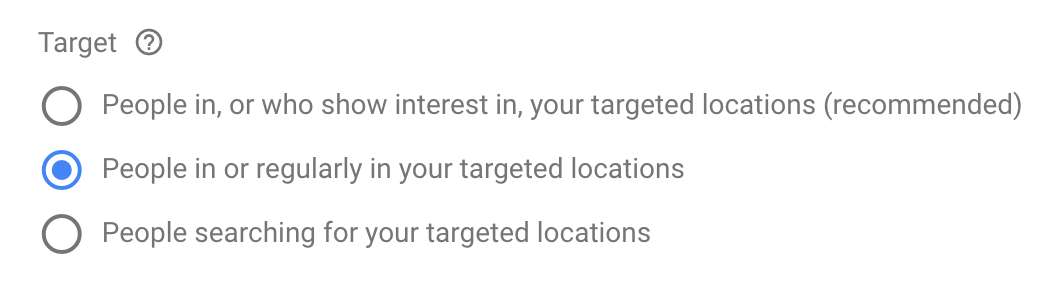
Clicks outside the US are not necessarily meaningless -- the screenshot in the article shows that they are targeting people "regularly in the US". Just because I left for a couple of weeks does not mean I abandoned everything related to where I live. There's still value in targeting US ads to me, independent of my current location.
Not necessarily applicable to the advertiser, though. If there's a US restaurant chain hoping for regular customers, they would be wasting their ad spend if you're on the receiving end of the ads.
It is worse than that, the country targeting setting was already at maximum tightness. This is a very bad dark pattern by Google, there is no setting to strictly target a country.
https://miro.medium.com/max/1048/1*5I7qjuarkWtiNltBdR1Quw.pn...
What happens is a "publisher" combines CSE with Adsense then drives (often robotic) traffic to the ads that come back in the feed. They then identify high-paying keywords and make money.
Sophisticated attackers will observe that Google cares if the IP address matches the CSE request, but they don't care if the cookie and IP make sense (or if that cookie is being used elsewhere in the world). This means a sneaky extension can lift the (advertising) cookies of Google users elsewhere in the world and deliver them to places (e.g. Turkey) where it is convenient to run the click farm.
1. Buy AdWords ads in countries out of Bing’s coverage,
2. Send these clicks to a page serving your Bing feed’s ads for same/similar keyword search,
3. Realize Bing US CPCs on international AdWords ad buys
For those who are outside of the service area it's less than <1%. While it may only receive a handful of clicks from outside the area a month, it eats into the already minuscule budget for the long shot of a person who decides to look up the service while on vacation or visiting relatives. It's not efficient ad spend for a business like this.
A SaaS business is a different case, but this issue is persistent and getting worse.
People don’t pay for clicks, they pay for results. Clicks are an intermediate measure. If I make $100 from $50 spend via 1000 or 100 clicks it’s pretty much the same thing.
Google does provide a CSV with all the AdWords recognized countries: https://developers.google.com/adwords/api/docs/appendix/geot...
You should be able to copy the list to the clipboard and paste into the exclusion list.
I can’t tell you the times I have had to tell clients and other search marketing professionals that they need to have a negative list.
Budgets are not infinite and they need to be managed to get the most out of them.
It's probably fair to assume setting a target location is it, not that you additionally have to exclude the rest of the world. And it's buried in the advanced settings, so anyone looking for a quick default setup just do the minimum required setting presented to them.
After spending ~100k, our ads randomly stopped working last month without changing anything. Support took 10 days to reply saying the account was up for a review (no notifications sent, no indicators). Yet, it still wasn't working.
Booked a consultation with one of their so-called "Experts", he couldn't find anything wrong and suggested to contact support again.
After the initial 10 days response, still waiting for a reply from so-called support 20 days later. I'd assume support only exists for companies that spend millions a year.
Given your vested interest in Ads and Google in specific, I am sure you know this already.
Your browser by default leak your OS version (Chinese using older versions very often), locale (of course there is tons of users with Thai or Turkish locale outside of their home country, right?), fonts, etc, etc. Basically everything is can be used and actually actively used for fingerprinting. In cases of some proxies WebRTC can just leak your real IP. I wont even start on the fact that Google controls web browser that is used by 50% internet users and it's sent a lot of data to the mothership.
And yeah if you try to mess with Google itself by let's say mass registering accounts you'll understand how good they are at protecting their own infrastructure and money. At the same time why should they care about someone else lost money? So they don try to fix it.
Don't get me started about Twitter advertsing. Want some followers for your business? Twitter will gladly send you tons of obviously fake profiles as soon as you get too many impressions without a click. Like profiles without real pictures and timelines consisting only of retweets.
You have to tolerate an accepted amount of cruft with any PPC campaign.
And in addition they no longer show average position metric (1) which increases barrier to entry, they now only show impression share.
(1) https://www.practicalecommerce.com/say-goodbye-to-average-po...
But other questions came up.
Why do so many quit google after less than five years?
How does a company who's product is a push notification when someone clicks get funding?
Usually initial stock grants are for four years. If the price goes up enough and then relatively flattens out, it can happen that one’s total compensation begins decreasing after the fourth year. That, and 4-5 years is enough time to build a sufficiently large safety net that one can attempt to strike out on one’s own.
Or he's just unemployed working on an app?
That sounds incompatible.
You worked for Google. You should have known this before today.
If you call them on it, the Google phone reps will say with a straight face, “Let's say people with family in Moldova want to look for something to tell their relatives in the U.S.”
The ethical way for Google to handle this would be to make all U.S. campaigns by default target users in the U.S., Indian campaigns target users in India, Moldovan campaigns target users in Moldova, etc. If businesses want to expand their campaigns to people living in other countries for whatever reason, give them the option but don't make it the default.
I feel especially sorry for the local small business owners trying to counter the SEO garbage and Yelp reviews that clutter the results. They try to set up the campaigns trusting Google's guidance, and they're lucky if 10% of clicks end up being target customers living in the same area. Often they have no clue about what's going on, and wonder why their campaigns are costing so much for only a trickle of real customers.
Seemed to eliminate most of the junk clicks.
My site is focused only on relevant content in a particular infosec niche, and is well written - yet quality scores across the site are 2-4, and have been for the entire site history, which spans almost 20 years. Which means we pay more for ads.
I've been through the usual guides, and I can't find anything actionable - they all basically boil down to "have relevant content" - but I do, dammit!
I've also taken up Google's frequent offers of free help from an expert on 2 occasions. Both times all they did was try to get me to increase my spend (e.g. enabling the search network etc), and parroted about "writing relevant content", even though both agreed that the content seemed very relevant to them.
The site has been rewritten from scratch a couple of times over the years - no change.
I even paid a copywriter a couple of years back, but the tweaked content still resulted in the same 2-4 quality scores.
I'm considering switching to a different domain, closing the AdWords account and opening a new one, but I've no idea if that would actually change anything.
You need to try things that are as different as possible. Don't rewrite it -- explicitly take different approaches with the goal of making them very different from each other. Then run an experiment.
I've never watched a non-English video or ever interacted with the non-English speaking web. How on Earth can Alphabet screw up so much? The only thing I can fathom is that Alphabet is optimizing for getting more advertising revenue, long-term effectiveness of their ads be damned.
I’m not sure where you are, but I imagine that folks like you are a very tiny percentage of the market.
Honestly I think this highlights how divorced eng is from real world usage, otherwise he'd know this shit happens. every.damn.day.
ad tech is a house of cards and makes me reconsider working at Google every day.
I actually disagree, primarily because of the auction. It's an incredibly clever way to ensure Google's incentives are aligned with the advertisers'. Assuming rational bidders, Google can only charge more per click if the clicks deliver more value to the advertisers. If Google just sends a bunch of garbage clicks to the advertisers, they will just lower their bids.
It appears arguably reasonable that geotargeting isn't exact, nor is it clear that these clicks weren't actually real and valuable. If he's trying to make the point that the trend is disturbing, well, then: make that point with something akin to a real sample (at least 1000 clicks, spread over more than a week?)
For example, Adwords defaults into advertising on every device which now includes TVs. This channel would never work for our business (an app that integrates with GitHub), and I'm sure this would work badly for many other businesses. We only found it by digging into the campaign stats once it had launched.
It also strikes me how long the approval takes for new ads - 48 hours. How many advertisers drop off in that time? That feels like a real value add thing to focus on.