I also worked on sites where you don't have a conventional work space such as construction sites and it seemed to be pretty casual with being under the load if you were working in the area or holding the guide rope. In my case we didn't really have an option most times to not be in the way because it was a confined space, that's fun to think about.
I think because depending on the job crane safety and awareness are not primary concerns for a lot of construction workers and those safety practices never get taught unfortunately.
In the same factory with good crane safety, I also almost got killed by an oversight in loto when I guy through a sheet of plastic and there was 240v line running behind it, not in conduit, and I was standing on the top of a ladder. Burned through the entire razor blade in my hand. Thank fuck the blade holder was plastic.
You can and should use a test light or DVOM to verify the power is out.
You can and should treat the wires as if they were "hot" anyhow. You should keep a wire nut on the hot wire. Don't actually put any of the wires in your teeth.
Now. You could do all that, but what I do at home is carry a lot of insurance and work "hot". I don't care about 120V or even 240V. I make sure what I'm touching one arm at a time with no ground path through my heart. Don't stand in water. Simply just don't touch the hot wire. I learned to work hot on a piecework job that payed by units completed and that was about 1000% more if you could work hot. And, you can, if you manage the risk. If you mess up 99% chance you'll say "OW" and NOT do that again. I wouldn't play Russian roulette with 1:6 odds. But 1:100 (die from) x 1:100 (mistake) x 10 hours per year (occasional fixes), fine not worth the bother. Far more chance of dying falling off the ladder than electrocution. DON'T stand on rolly chairs.
Now at an uncontrolled job-site, where I'm payed by the hour, 2000 hours/year? NEVER. It's a lot different when you are a company of one vs. many. I know what I'm doing, and while I make mistakes, I can guess how often. If you have more than 0 co-workers, you cannot trust or predict their mistakes.
https://www.amazon.com/dp/B004J173I8/ref=twister_B007NAGJJG?...
Personally, I just lock the panel.
If your panel can't be locked a big piece of masking tape across the door, holding it shut, with "NOPE. call <you>" written with a sharpie should do the job. :)
FWIW, the first photograph in that WP article with the tagged panel is one of mine... from close to 15 years ago.
If you want to get fancier or if others are going to need to access the fuse box while you're working, you can get "lock dogs" which let you lock individual circuit breakers. Then you just lock off the one for the circuit you're working on.
- Switch off (at circuit breaker)
- Prevent switching on (lock the breaker)
- Check voltage free (multimeter cleared for 230V/120V operation with long, isolated test leads)
- Ground and short (put a plug into the socket connecting earth, live and neutral, you can DIY that at home safely by cutting open an unused cord and soldering all three wires together)
- Cover nearby powered equipment
In the Real World, you’ll just tell your wife/kids/roommates “Hey don’t touch the fuse panel until I’m done doing this thing” and it’s not an issue.
Tell the other inhabitants what you're doing and tape over the breaker with a note saying to see you before it's turned on.
Sure you could stick a padlock clasp on the breaker box but when your job-site has a number of people you can count on one hand a note will have 99.99999% of the same benefit and if they're trying to recklessly kill you all a lock does is buy a little time.
Just because that breaker is labelled to run a specific motor, unless its been verified, it might be wired to the wrong motor, or the labelling is wrong or any other host of oversights.
Had a manager come in, and run his motor. The electrician who was elsewhere in the facility straddling a auger watched it suddenly spin beneath his feet because the lock he put on a breaker was not physically wired to that motor (had not yet been tested).
Lots of horror stories from that particular site. Always verify YOURSELF. Don't trust other people's word
You come back, and someone has somehow messed with your equipment. Obviously no one is using anything, everything must be available! They could have done anything from disconnect a cable to outright taking everything over for their own pet curiosity project -- all non-priority, of course. Total break of configuration to say the least, to speak nothing of potential safety issues to people or equipment.
I have had multiple people ignore multiple "test in progress", "do not touch" signs and indicators multiple times for [honestly] no good reason, LO-TO or not. If I had the authority to ban them from the area unless escorted I would have.
High priority emergency? Yes boss, I'll wait to finish or redo from scratch whatever I was doing for you. But if you're low on battery and want more Stardew Valley? You can wait or go somewhere else.
/rant
(Would help to have a use-case example. And how the pattern helped Vs. what was being done before)
Failure to isolate (lock-out) puppet from switching things back on during a migration.
I've never seen it used, and the only references I can think of was where it was just annoying, if not a risk (someone locking a file then leaving over the weekend or the company entirely).
For normal master lock key padlocks, it is not a big deal if it accidentally unlocks with somebody else's key.
Their normal cores are shitty enough that even a regular key has a reasonable chance of acting like a bump key, so if you insert the wrong key quickly and turn, it might just open.
With LOTO locks, Bob could die if Alice's key works on Bob's lock. (e.g. both on working on equipment powered by different circuit breaks, and Alice confuses the breakers, and removes the lock from BOB's breaker, because her key happened to work on it).
A few reports of that happening, and their LOTO locks could be banned from many worksites due to unions insisting on it.
Now to be clear, the master LOTO locks offer basically zero physical security, since they can be very easily destroyed or bypassed. But to my knowledge, no master branded lock offers any real security, so that is hardly surprising.
Specifically, in many rail signalling network systems, a signal will turn red when it detects a short between the two rails in its section (i.e. an axle rolls into it). It will then turn back green when that short disappears. Workers can therefore clip something between both rails, which triggers the signal relay and makes the signal light green.
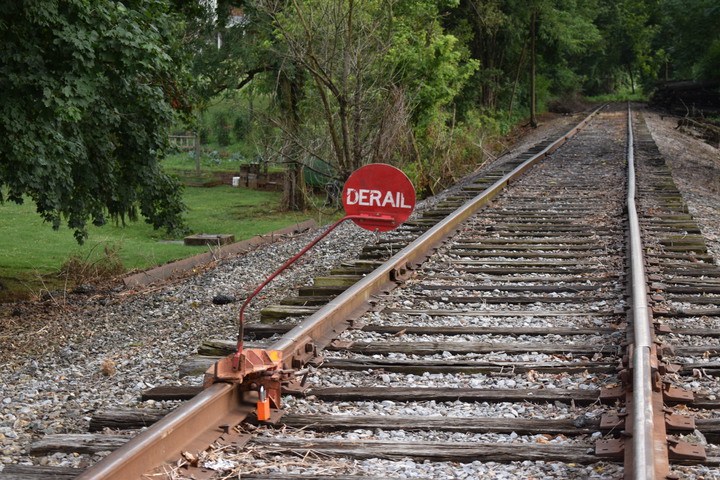
This is absolutely not isolation & lockout though, because it doesn't actually remove the energy source. That's not to say it's not a valuable process though, but an isolation & lockout for this sort of circumstance either involves locking the track switches to direct traffic away from the worksite, or installing a derailer [1] on the track that phyiscally throws the train off the rail into the dirt so it stops well clear of the work site.
The above obviously doesn't work if you're working on a running system, though (which does happen, occasionally). In that instance, the track clip lets trains stop at the red light, radio to the worksite, have the worksite clear, then remove the clip, let the train through, then resume work. It's different levels of safety for different perceived risks.
The big metal bar is different, as the poster explained it will short the (supposedly dead) power circuit in a third rail system, taking several hundred volts at quite a lot of amps until the short is detected, hence it can't just be a couple of metal clips and a cheap cable like TCOC. If some idiot re-enables power to the circuit or a fault elsewhere re-energises it despite it notionally being switched off, the bar will turn that into a full short and everybody will know there's a problem, although I'm not sure that would save anybody who happens to actually be touching the now surprisingly live rail at the time it's energised.
On overhead systems there is similarly an arrangement where a worker - after confirming that the power is supposedly dead - ensures this is true by physically grounding it. Again it's a failsafe.
It definitely saved a few peoples limbs at that company alone.
EDIT: This is obviously mentioned in the article! Mea culpa ;-)
#edit: Oxford comma ocd
Pretty recent death caused partially by not following this procedure.
SRE's and operations people can pick up good habits from manufacturing gigs. A lot of the same concepts like uptime, good documentation, procedure, discipline are really important to the business at all levels. When lives are at risk good companies put a large sum of time and money in making sure everyone is on the same page.
There's a concept called the hierarchy of hazard control [2]. At the top is eliminating the hazard - just removing it completely. It goes down through substitution, engineering controls, admin controls and then protective equipment is right at the bottom as the least effective method of protection. I&L aims to address the hazards right at the top by eliminating them, which is by far the most effective means of ensuring safety.
It does this by following a process: First, isolate the energy source. Secondly, lock that isolation out so it cannot be reactivated. Third, test for dead by showing that a) the isolation cannot be removed, and b) that there is no residual energy source remaining.
For example, an electrical isolation point might be a switch, which when thrown firstly breaks the circuit, but then also drains out any capacitors or other residual energy storage. The isolating person throws the switch, locks it out, tries to throw the switch back against the lock to show it's secure, then tests the system for dead by trying to power it up or by testing terminals for a voltage to prove that the energy sources have been drained. Once that's all done, they'll then complete the rest of the process and let others lock on to the system.
When someone locks on to an isolated system, there should be sufficient documentation and indication to show that the system is isolated and safe. It might mean that if a mechanical latch is rotated to the 'safe' position, there's a sign that rotates into view from the isolation point so the protected person who is locking on to the isolation can see it, whereas when it's not locked out they cannot. The protected person can in theory go and test the lockout to ensure it's in place, but usually (where I'm at) it's controlled by a dual sign-off process when the above can't be achieved. Then the protected person throws their lock on the isolation point, and that ensures that none of the isolations can be released until they remove their lock. Critically, those who place the isolation are generally a controlled set of people who are trained more highly than the protected person level who just has to know how to verify isolations are in place and then lock on. In general, the people working on the isolated system don't place their own isolations unless it's a simple system/process.
The whole process essentially provides a method of accounting for every person working on a system, and letting them be confident that it can't be powered up whilst working on it. It's not supposed to be secure locks. Mine, for example, have plastic casings, and ones designed for electrical work have a plastic bolt which I could probably easily remove with a bit of percussive persuasion. However, you also realistically generally can't stop a malicious person bypassing those safety measures, e.g. by wiring around a circuit-breaker or by undoing some bolts to remove a latch. So it's not intended to stop malicious parties, but it prevents the vastly more frequent case of were someone starts a machine when someone else is working in it.
It gets far more complex than all that too, for example covering how you pass secure isolations between shifts, or how you chain together layers of an isolated system to a single isolation point, but the above should hopefully provide some insight into why this stuff exists and why it takes the form it does.
[1]: I would consider the concept of 'safety in design' higher overall because that's about removing the hazard from existing at the design stage, but once it exists then I&L is generally the gold standard for dealing with it.
[2]: https://en.wikipedia.org/wiki/Hierarchy_of_hazard_controls