I know the audience here is generally more interested in technical details and reasons for why this took longer than 1 weekend to build. So I'll share a few more relevant details absent from the marketing copy:
- The new membership system is effectively just an email database with JWT based authentication. Two cool things about this: You can import any CSV of emails and that's now a user database of people who can log in, and 2: not storing passwords at all is pretty great.
- New billing features are a deep integration w/ Stripe Billing API, which works with your API keys, not via Stripe Connect, so there's no middleman. Ghost can't add any fees on transactions, and volume doesn't flow through our Stripe account in any way - so it remains completely decentralised without a bottleneck. The significant part of that is: If Ghost the company were to ever go away, your site/billing/everything would keep working as normal. Doesn't depend on us.
- All our APIs and Webhooks have been continually improved to the point where Ghost is now the most popular (at least by Github stars, the fruit of life) open source headless CMS out there. Also a new Github Action for CI/CD of Ghost themes makes that whole process a lot less painful
"What's the point of this, why not just use [x]" Because [x] is some combination of: closed source, centralised, written in decade old procedural PHP, or has some sort of UI which no non-developer wants to go anywhere near. We try to sit at the juncture of these things with a decentralised product, easy to run with a managed service, built with tech developers don't hate, and a UI that people who create content really love.
Also: Something about Postgres
On a serious note, thanks for all the support. Ghost launched on HN and it was that initial boost that got everything started. I'll be hanging out in the comments here throughout the day.
I understand if that's a hard no. You seem to be aiming at people who are or plan to be big time enough to hire people to help. Getting people in who might head that way so they have an easy upgrade path might be good though. If I were the kind of person Patreon's top plan aims at, any Ghost plan would be an easy sell, but even thinking about that is a long way off for me.
Obviously by paying Ghost to host it for you is a bit pricey since they have to make a profit as well, but the amazing thing is that the whole thing is open sourced for people like us to self host (I wrote a post about how I self host a bunch of stuff including ghost: http://sdan.xyz/sd2)
On Lobsters (can't find thread), I mentioned that the price was too high for large amount of potential users, the code was open source, and low-margin providers could host it for the masses on the cheap. If wanting to be ethical, they could even send a percentage of the revenue and/or improvements back to Ghost.
I strongly encourage this model given dominance of sites such as Wordpress. Ghost can keep reaping the benefits of the premium market just publishing source. They can simultaneously stay profitable and democratize the tech through third parties.
If you could figure out some way to integrate tightly with Webflow (the world's best html/css codeless site builder), that would be an absolute killer and I'd be all over it in a second (as would many others).
I suppose the problem there is that Webflow wants to be its own CMS (naturally), but it's somewhat crippled by being a closed solution.
It's simple, fast, stable and supports pretty much everything I can think of for a writing platform. The changes to theme development are very welcome.
Thanks again to you and the team.
Is Ghost bringing back support for Postgres? :)
I often feel like what I need most is an identity system for my users that's nicely coupled to a billing and CMS system, and the CMS providers seem like the ones best equipped to offer that (eg Identity/signin/authorization is really the core poorly addressed problem today).
Shopify has commerce and blogging but wants $10K/yr to let me sign users into my site with user accounts. 8base is doing lots right but hasn't figured out their pricing model ($10/GB/mo for file storage? 500x their cost of goods at S3? What other ways are they planning on reaming me on pricing?). NestJS has all the building blocks but it's just parts. Amplify's integration of AppSync and Cognito is great but billing integration seems surprisingly weak. There are so many who could/should be offering this, but each I dig into just doesn't quite do it.
I'm so hoping I can think about your membership system as a way for me to build sites where my users can easily sign in once to all the site's functionality and commerce without me having to build/maintain/secure my own identity security code.
I get that you're principally a publishing platform, but as you hint at in your posts identity/authorization and billing are key tasks for standing up most any commercial efforts.
- Open Source - Thriving plugin ecosystem - WordPress.com can host it for you for $300/year and it will take any traffic you throw at it - It has full advantage of WordPress which is the most popular CMS on the planet
Is there any mechanism for both subscription tiers and pay-what-you-want? So maybe I had a $5 tier and a $10 tier, and if someone wanted to pay $7 then they could and get the $5 benefits?
I'll research this myself when the 3.0 Docker image becomes available, but thought I'd ask first. Not even sure if Stripe supports that functionality, or if it does, how hard it'd be for me to add and contribute back.
Thanks for making Ghost.
https://news.ycombinator.com/item?id=21330114
I've promoted you in various places as one hell of a positive counter-example to how most companies work. Trying to be fair to Ghost in recommendations about getting more people using the technology.
Is it possible to generate a static site with Ghost 3.0? or does one have to use gatsby with a headless Ghost 3.0 instance?
Any idea when 3.0 will be available to self-host?
In the article it writes "all whilst operating as an independent non-profit organisation releasing open source software.".
But this is right before talking about generating $5,000,000 in customer revenue and giving away 0% of the business.
So when you're a non-profit, what happens with that $5,000,000 of business generated revenue? How much of a salary do you give yourself? Can you even give yourself a salary if you label yourself as a non-profit? What makes paying yourself a salary as a non-profit different than a regular business?
Whenever I read sentences like that, it makes me very suspicious. Whenever I see a Ghost blog post talking about the product it always feels like they try to bring maximum attention to being a non-profit in a way that is supposed to be less evil than a profitable business but then you talk about millions of dollars of "business revenue" and I never understood how it works.
"A nonprofit organization, also known as a non-business entity,[1] not-for-profit organization,[2] or nonprofit institution,[3] is dedicated to furthering a particular social cause or advocating for a shared point of view. In economic terms, it is an organization that uses its surplus of the revenues to further achieve its ultimate objective, rather than distributing its income to the organization's shareholders, leaders, or members. Nonprofits are tax exempt or charitable, meaning they do not pay income tax on the money that they receive for their organization. They can operate in religious, scientific, research, or educational settings.""
Surplus sounds like anything beyond hosting costs to run the service, but the hosting costs is likely no where near 5 million dollars so a majority of it is surplus.
Does that mean no one gets a salary or is a salary part of the costs to run the business instead of being a "member"? If salaries are included who dictates what the income tax exempt salary is?
I'm not trolling either. What you're describing sounds like a way to run a business where you can avoid paying income tax while still getting a salary because realistically I doubt the creator of Ghost is living in a homeless shelter and working off public library computers.
You operate it like a normal business and pay competitive salaries? I don't get why people working at non-profit should work for free. $5M/6 years is roughly 7 people making 120k/yr.
But all of the profits go right back into the company (e.g. no profit for the founders), which is a powerful thing.
And they have to balance things like salaries, price of the product, dividends to share holders (though no one really pays dividends anymore, but that's beside the point.)
A non-profit skips the share holders, and is more like a direct exchange of cash for services better two parties, without a third party taking a cut.
Actually, usually there are taxes, so the government is going to take a cut.
So share holders kind of end up acting as a tax, a tax on not having capital, but instead of the money going to the government, it goes to people who happen to have capital.
Not that there's anything wrong with that.
I am now planning on moving towards something more static and simpler. Ghost started as a simpler alternative to WordPress, but slightly more powerful than Hugo/Jekyll/etc. It now seems to just be a WordPress clone written in JS instead of PHP. It's still fine and works well... but, I can't see a reason to use it versus WordPress and its lost roots to its simplicity.
I will probably be migrating to Jekyll for easier self hosting and hacking. Perhaps I'll stick with Ghost... but, I'm starting to become weary of "commercial open source" products. Self hosting is becoming harder and harder... it's in their best interest to make you buy the managed solution. It looks like Ghost has transitioned to a product for media corps, in that sense it looks good and I'd use it. For personal usage, I can't recommend it anymore.
I was thinking of swapping to Hugo, but Ghost 3.0's static site integrations looks it means that I can just run Ghost on my local machine and upload plan HTML to the server. Seems like the best of both worlds.
I've looked at Ghost on and off while considering setting up my personal site, and pricing is the reason I avoided it. I think they started at $5/month for "Ghost Pro" and are now up to $36 for Pro Basic or $99 for Pro Standard (a bit less purchased in bulk). At a minimum, it's now $348/year.
Having paid subscriptions built-in makes that easier to swallow. I don't want any 3rd party ad networks on my site, so subscriptions could help offset the high costs.
Wouldn't help me personally since my site isn't very active and wouldn't get subscribers, but I imagine this will work for some other folks.
Hugo + Netlify is working well, some up-front work in the setup since I didn't want to use a premade Hugo theme, but when I update anything it just takes two commands to rebuild and upload:
    hugo
    netlify deploy --prod
Beyond that, it's just publish and forget. And the page speed is great (Google scores it at 99) since Netlify is serving it off of a CDN.
With Netlify's continuous deployment system being able to run Hugo builds, I should also be able to hook it up to GitHub so that I can post from an iPad without being able to run hugo locally. Haven't gotten around to that, but I think it'll be a good setup.
One thing I don't like is that the membership api seems deeply integrated with Stripe only. That's okay for a start but in many countries in this world Stripe is not available (for me it's the new PayPal. E.g. I'm based in Cyprus and Stripe will not work here although it's EU) and I would welcome a better flexibility or plugin system for other payment providers:
https://github.com/TryGhost/Members/tree/797bab5d9218d7796f0...
Are there any plans for that? Do you think it is easy to integrate other payment providers in future?
UPDATE: ok, I've seen your website FAQ https://ghost.org/docs/members/faq/#can-i-use-other-payment-... I will not support a one payment gateway blog membersite. Sorry Ghost.
Stripe censorship excludes basically (beside regions) also many topics. Thinking about writing about intimate topics, erotica or health? Good luck in using Stripe with that.
Don't get me wrong, I understand that a country can not be supported magically. What I'm against are these comments that are written with (what I believe to be) the best intentions.
But then it's posted, and the person who read it, years later is left with a bad taste in his/her mouth.
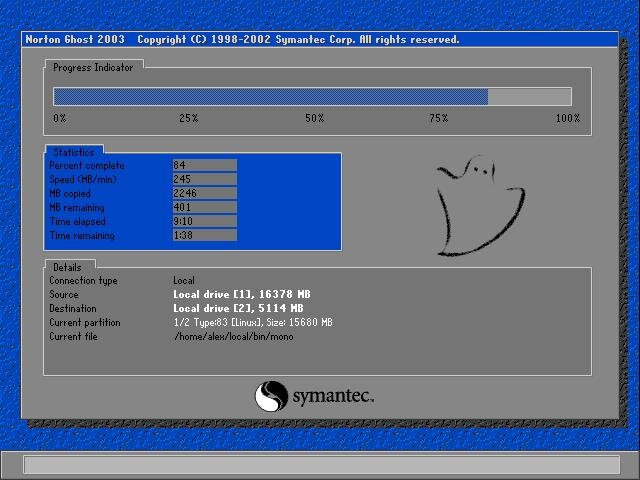
I've been retired from IT for a few years now - is Ghost (the disk utility) no longer a thing?
I couldn't even guess how many hours I spent sitting in front of this screen: https://www.dmcinfo.com/Portals/0/vmware-norton-ghost.jpg
Now I use Acronis True Image (which works very well on Windows and I can recover from a dead boot drive in no time!)
> But you probably want to know about the $5M thing.
No, I'd rather know about what Ghost is :P
Do you really expect them to explain what their software is in every single blog post they make about it?
> It's almost like you can chop off the /blog/3-0/
It's an annoyance of mine in so many company blogs that going to their actual product is so oddly difficult. Sure, I can chop off the URL because I understand what that is, but what about non-technical users? They understand links, not a damn thing goes back to the core product.
It's so weird to me that so many blogs are built around user engagement and SEO, while lacking back linking to the actual product at all.
I've never understood it, but I see it so so often.
But also, https://wordpress.org/plugins/ghost/ has been overhauled to export from WP into a format you can import straight into Ghost 3.0.
Obviously, things have changed a lot since then, and to be honest I never really kept much of an eye on Ghost until two people I used to work with started working for Ghost. Now, Ghost is being pushed as a headless CMS, and seems heavily aligned to the JAM stack.
From what I've seen and heard, this looks like a fantastic release and you should all be proud of this milestone, and just how far Ghost has come. With that being said, there's a niggling thought in my head that won't go away.
What's to stop Ghost from becoming WordPress v2?
In reality: The same thing that has prevented that from happening for the last 6 years; a strong focus on a core set of usecases and no desire to become a generic website builder :)
Slightly off-topic question: Is a handful of the Ghost team based in Bali? I know the team is 100% remote and I've noticed multiple laptops with Ghost stickers at my co-working center.
Doesn't Medium sort of do this? I get that you can't run your own instance or bill specifically for just your content, but otherwise it seems very similar.
As the post mentions, Ghost 3.0 is targeted at people like Ben Thompson (in the extreme case) who have an audience passionate/supportive/large enough to pay them directly and who want to own the entire relationship with no middleman.
The membership feature looks amazing and I honestly am very impressed by your landing page since I work on something a bit similar :).
The Stripe Billing integration sounds exciting, but I am curious about the 0% transaction fees. Stripe usually takes 2.9%+30c on charges and Stripe Billing costs 0.4$ (free for the first $1M so we can ignore that).
Did you negotiate some kind of a special deal with Stripe or the 0% means that YOU don't take additional fees, but Stripe fees are still there?
I like that they are now moving towards static site JAMStack approach, driven by APIs rather than the current SSR model. This lets anybody to customise their themes with the language / framework of choice and generating static builds that can be cached for improved loading times.
This, from my experience as a developer and ops engineer for a newspaper.
But going through this blog post announcement, I saw that Ghost can be used as a headless CMS with frontend frameworks. And since I started using GatsbyJS extensively in the past year, it seems like something that would work _really_ well together.
(It turns out that the official website is actually built with GatsbyJS, so the integration is probably really robust.)
Gonna try it out! And congrats on remaining true to your initial philosophy.
The built in editor and admin panel is great, but the real sweetness comes from the REST API. The ability to integrate into any custom website is fantastic!