Electric motors don't have this particular problem, and they don't need a start gear that is a lot shorter than the other gears (1st to 2nd is usually around a factor two, while from 2nd up to the next higher gear the ratio will change by perhaps 30 % or so) because they can deliver nominal torque at low speeds or from zero speed (so they don't need a clutch, either). An ICE can't do that.
Here are the transmission ratios of a random six speed transmission:
    1st  2nd   3rd   4th   5th   6th   R
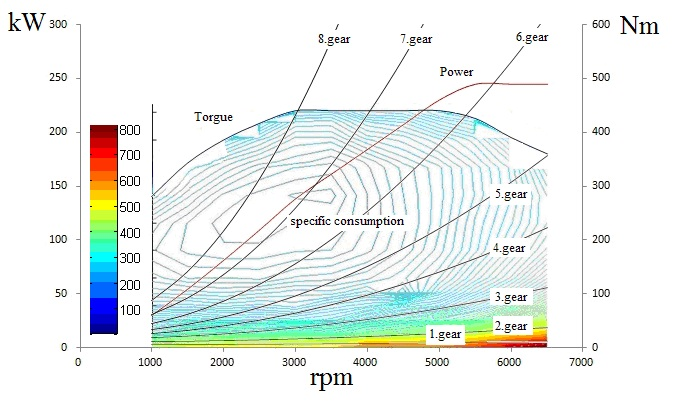
4.2 2.5 1.7 1.3 1 0.8 3.8It isn't that narrow[2]. Engines with fewer gears aren't particularly less efficient, they're just MUCH slower. Look at a map of gears[2]: the top gears are in the efficient range, but the lower gears are only there to allow you to rev the engine high while accelerating. In the ratios you gave, you could cut out 1, 3, 4 and only use gears 2, 5 and 6 and be able to get around fine- you start in second and then shift up as soon as you're rolling. You'd have a much more efficient car but you'd be incredibly slow.
[1]: https://qph.fs.quoracdn.net/main-qimg-0c6c45106b28601fc1aef4...
[2]: http://www.posterus.sk/wp-content/uploads/p12975_02_obr02.pn...
You could get around fine with 2, 4, 6, it's just that it would have very slow and less efficient acceleration (accelerating for longer at low RPM and very high torque is overall less efficient than accelerating for a shorter period of time at a higher RPM, given identical start and end speeds).
And that's exactly the point I made. You need many gears for an ICE because being able to reach a given speed in a given gear says very little on how efficient that is, therefore you need different gears for accelerating versus holding a given speed to get acceptable efficiency.