https://www.goodreads.com/book/show/23047146-tubes
And of course, if you're ever in SW England, the Museum of Submarine Telegraphy near Penzance is an awesome geek-out experience.
https://www.goodreads.com/book/show/410958.A_Thread_Across_t...
Incredibly expensive operation, so you want to avoid this if at all possible...
"(Amazon) will be opening an AWS Region in South Africa in the first half of 2020. The new Region will be based in Cape Town, will be comprised of three Availability Zones, and will give AWS customers and partners the ability to run their workloads and store their data in South Africa."
https://aws.amazon.com/es/blogs/aws/in-the-works-aws-region-...
Also the presence of local CDN doesn't imply Google presence. Eg the steam servers in SA are hosted by ISPs
https://www.geekwire.com/2019/microsofts-south-african-data-...
On the other hand, I feel younger seeing transfer rates in tens of kilobytes.... straight out of the roaring 90's.
Just annoyingly high latency and a bit of jitter and shitty pricing on local cloud stuff (though prob better now with azure)
Surface distance Seattle <-> Berlin is 8143 km which corresponds to 28 ms rounded up at light speed (one way).
Now, these are distances when travelling across earth's curved surface. Neutrino canons or (quite impossible to ever build them) cables in earth's upper mantle would achieve even faster communication. Also, they correspond to direct connections and don't involve putting the cable into international waters far away from any government trying to get some extra bucks from you. The aerospace industry has to jump through a lot of hoops in order to be able to travel through airspace of a particular country.
They might extend it for AMP sites, maybe..
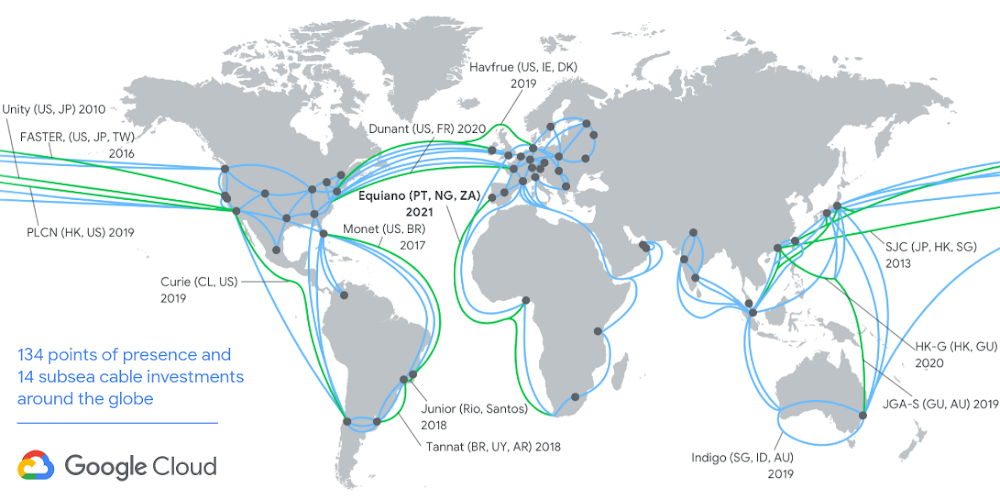
[1] https://storage.googleapis.com/gweb-cloudblog-publish/images...
I understand how undersea cables are laid, but how do you make use of a "branching unit" once it's at the bottom of the sea? Send down a submersible to plug in the branch? Lift the cable back up, plug in the branch, and lower it again? Do they lay the cable with patch leads attached to the branching units, so you just have to dredge those up and plug the rest of the branch in?
https://www.wired.co.uk/article/subsea-internet-cable-ship-b...
The Square Kilometre Array, on its initial phase, will have close to 200 dish radio telescopes and 130000 radio antennas working together in South Africa and Australia. The amount of data produced is predicted at 50% of all internet traffic (this was calculated 2 years ago, probably it changed a bit). A big part of that data will be distributed across the globe for science, being the main link originating in South Africa and ending up in Europe.
This will be the biggest scientific endeavor (by size) of mankind so far.
The Phase 2 of the SKA (for now just an idea), will increase the number of telescope dishes and antennas by a factor of 10.