There's something about planning, planting, and then caring for a garden that appeals to my engineer brain. It's an exercise in organization and planning that scales from "throw seeds at dirt" to "these plants will attract bees near these other plants, these plants will repel insects. These will bloom early, these bloom late".
You can grow flowers, you can grow vegetables which you can turn into cooked, canned, or pickled food.
There's something about putting food on a plate that came from your yard, from your care. There's something about sitting in a green (or red, or blue, or yellow, etc.) space that you made.
I'm a sucker for games like Minecraft, Factorio, etc. Raising a garden is like a slow motion version of those things. It's a fusion of creative and scientific/engineering brains. It's great.
Can't second this enough. This connection between soil (direct environment) to your gut is, as stupid as it seems, a marvellous thing.[1]
> There's something about sitting in a green (or red, or blue, or yellow, etc.) space that you made.
Few time I walk in a forest (semi-wild) I feel like a forest is like a big nest. Enough roof, enough sunlight, enough green things aronud. It feels very safe most of the time[0].
I'll add something, wood is so superb.. as a material too. Using it as construction (small or large) is a great pleasure. The soft sound, the soft touch, the pale color.. when seen with a bit of chemist eye, you appreciate it a lot.
ps: on volcanic side of caribean islands, the nature is also overwhelmingly present. Giving you a lot of opportunities to be around a tiny stream of clear water surrounded by plants. You know people listening to rainy sonuds to relax. It was an amplified version of this. It made my mind trip in a weird way, as if flowing water became my time source and made me forget about the world.
[0] there are times where your spidey senses will wake up though, which is also super surprising because it's not like fear or stress. It's N times more acute senses and focus. Almost a pleasure.. especially considering how dull a modern daily life can make you feel.
[1] society forgot that because of modern times social delegation but it should be a human right. Today you may not have enough to do your own food growing. If you fall of the city tree you'll starve.
After about 3 weeks into a multi thousand mile hike, senses that I didn't even realize I had started to wake up. I could sense animals in the woods around me. I couldn't say if this was sound, smell, or something else, but I just knew they were there. Sometimes I woke up in the middle of the night, immediately knowing that something was going after my food. I also began to sense water sources from very long distances. This was probably a combination of smell and recognizing terrain patterns. Weather was another big one. I gained an intuitive sense for the storm patterns in the mountains, and I could see them changing with the terrain as I moved.
It took half a decade for the positive side effects of that hike to wear off.
Anyways it's odd how our world evolved toward comfort and disconnecting us from such important part of us.
How far and how long did you hike for? I just can't imagine walking through the woods for so many months. Also where did you hike?
Indeed, some research is pointing to the beneficial effects on your microbiome, too. The microscopic critters in the soil where you live may be very well co-evolved to live there, and there's a body of reasoning which says since you live there, too, they can be - sometimes - be very helpful to your own body.
(not that you should eat dirt, of course)
Agreed, and it's also not a stressful task in itself for some reason. I'm somebody that's over analytical and tends to succumb to analysis paralysis, but when it comes to garden work I never experience that. (possibly because I know plants are resilient and it's hard to mess up?)
That said, I know plenty of other hobby gardeners who treat their gardens as an exercise in optimization. Heck, I even know one engineer with a grid of (legal) marijuana plants who varies the nutrient composition of the soil in each planter to play with his quality/yield.
Plants are definitely resilient. I like experimenting with high densities/small pots on the very unlikely chance I find some plants with synergy (or just lack of space).
In 2017 this resulted in tiny (but tasty!) jalapenos (about a quarter of the normal size) growing off a plant that had sat on the windowsill doing nothing for 2 years.
If anyone has advice on plant pairings/symbiosis I would love to hear it!
>In 2017 this resulted in tiny (but tasty!) jalapenos (about a quarter of the normal size) growing off a plant that had sat on the windowsill doing nothing for 2 years.
Very interesting. Must try that out some time.
>If anyone has advice on plant pairings/symbiosis I would love to hear it!
You probably know this, but nitrogen fixation via legumes is one such symbiosis, of a kind. You can plant non-legumes interspersed with legumes. The native North American "Three Sisters" concept [1] is an example of that - they discovered that corn, beans and squash work well in symbiosis - beans being the legume.
[1] https://en.wikipedia.org/wiki/Three_Sisters_(agriculture)
Edit: In fact, with the Three Sisters, it is not a two-way symbiosis - it is three-way:
>The three crops benefit from each other. The maize provides a structure for the beans to climb, eliminating the need for poles. The beans provide the nitrogen to the soil that the other plants use, and the squash spreads along the ground, blocking the sunlight, helping prevent the establishment of weeds. The squash leaves also act as a "living mulch", creating a microclimate to retain moisture in the soil, and the prickly hairs of the vine deter pests. Corn, beans, and squash contain complex carbohydrates, essential fatty acids and all nine essential amino acids, allowing most Native American tribes to thrive on a plant-based diet.[7]
That's stressful!
For example, I had several trees planted for privacy, and I cannot even handle watering them. There's no good recipe to follow, no fixed amount of water, just a vague instruction to dig a hole into the root ball and make sure the soil is "moist" but not "wet" or "dry". Of course, that is just like a customer saying he wants a design that "pops but is not too flashy" - a nightmare. On top of that, there's one watering system for 7 trees, and various holes next to them have different-feeling soil; and often, different holes right next to each other by the same tree have radically different levels of moisture. Even the rain doesn't helps because arborvitae are very dense and while 2 feet from the root ball it may be almost swampy, under the tree still looks dry and I've no idea whether to water or not water them. And that's before we get to fertilizer, pests, etc. Ugh. And ofc unlike e.g. burning a cake, if the trees do die I'll actually feel bad.
It's basically an engineering equivalent of a customer from hell who is super vague, changes specs all the time, and you have multiple bosses who disagree; and if you screw up the project people suffer.
I already wish I just had a taller fence built, cause I'll have to hire someone to deal with this no doubt.
They really should come up with bio-engineered "robot" trees that have an instruction manual with specific quantities of water and stuff to be applied at specific intervals...
Anyway, since you love outdoors, you know there are trees on this earth, who handles growing without human interaction?
And they only have natural rain and groundwater. But yes they do not grow everywhere but only at a specific ground. So most of them die at young age, who were unlucky.
And with gardening you try to engineer the right conditions, but because of the complexity, you just fail so a lot of times. There are basic rules to follow and the rest is experience. So just relax about the thought that things can die because of you. That just will happen a lot with gardening.
And with your arborvitae, well for them it is mostly the soil that matters. Imagine them growing in the wild ... and then try to simulate that as much as possible. So don't panic if the ground moisture is not allways perfect, it allmost never is in the wild. The trees grow nevertheless, unless the ground is really unsuitable. And then you can adjust a bit. But mostly your trees need a lot of water it seems. And then they will grow..
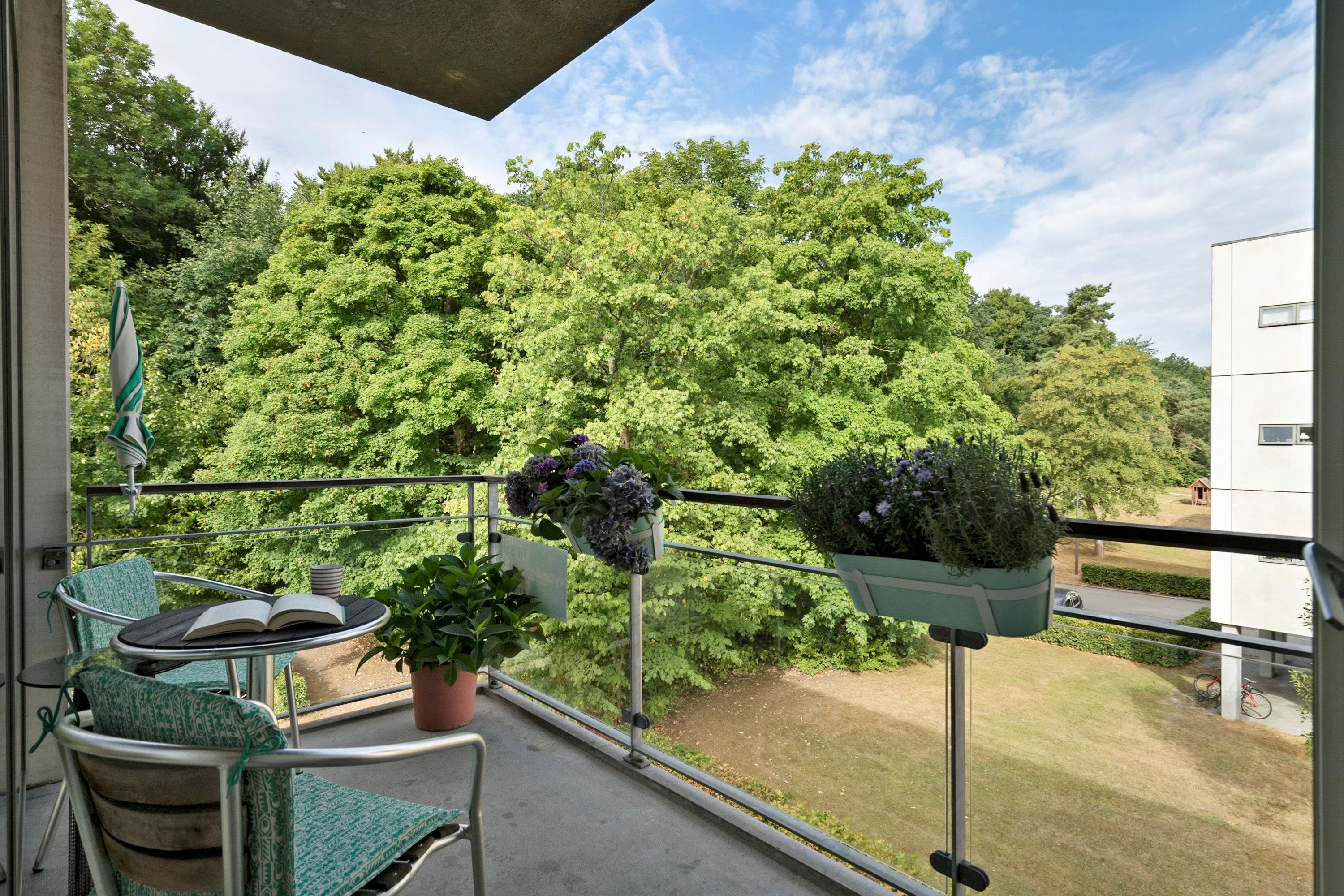
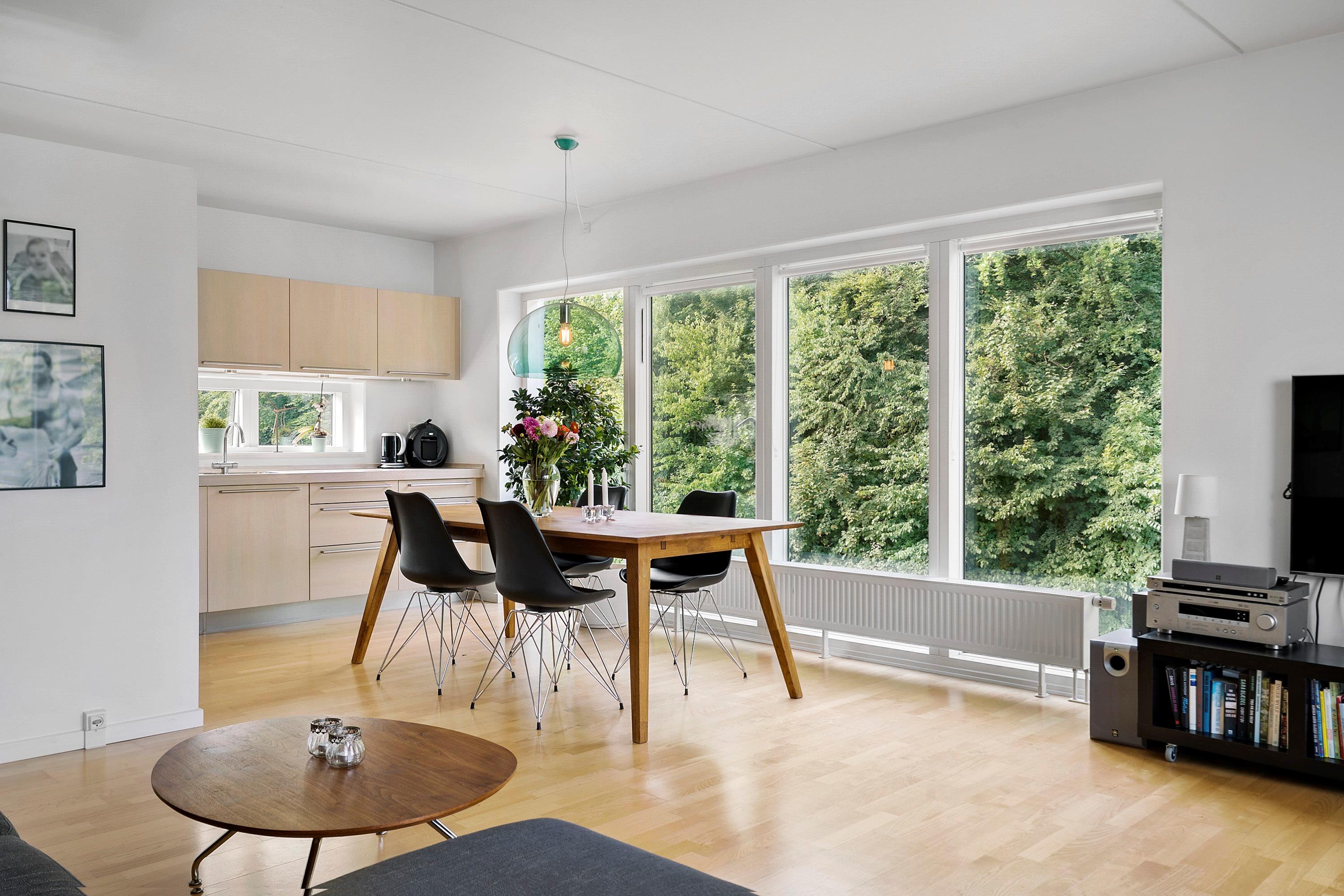
I was living in Copenhagen for a few years, and I was really impressed by how well designed some small blocks of flats were in order to get them integrated into wild gardens and little forests, e.g. [1,2]. Apparently a trend that started with Scandinavian mid-century architecture.
During Spring and Summer, from many living rooms you could not see neighboring blocks because there was an absolutely amazing small forest in between. With Summer breeze, you would only hear leaves moving. Absolutely amazing to work from home in such a property. Silent and very pleasant views.
Trees had been carefully selected and/or flats placed appropriately so that during darker months they would not give any shade. And these were mid-class flats I could rent with a (generous) MSc scholarship, nothing outrageously expensive. Good urban design makes a difference.
[1] https://nybolig.mindworking.eu/resources/shops/N270179/cases...
[2] https://nybolig.mindworking.eu/resources/shops/N270179/cases...
If you wanna prune shrubs, chop and drop weeds, or plant bushes until the sun sets, it starts raining, or GoT comes on, you just can. Doing lawncare with thunderclouds passing overhead is just bad juju.
I can't believe you didn't mention Stardew Valley. It is a smash hit game and your comment is basically a short essay as to why it is so popular and enjoyable.
I think it's mainly about how important soil health is for growing plants and how poorly this concept seems to be modeled in games.
Boy you sound like someone who would really enjoy square foot gardening. I doubt I'm telling you anything you don't know, but here's a link for those unfamiliar:
I'm very fuzzy on the details, but in retrospect, it sounds like a bit of a cruel experiment to conduct.
Weeding, pruning, harvesting become a meditation, after a fashion. That's probably what Grandpa was doing out there futzing with the lawn every weekend. I never got that knack with lawncare, but flowerbeds, sure.
It's such a connective thing for me now. Stress relief, feeling control over my food source, talking to neighbours more often, and thinking about food sources. Highly recommended gardening to anyone looking for a great and fairly easy hobby.
Factorio is next in my queue. Cities: Skylines is my current go to.
I LOVE "Food Grown Right, In Your Backyard: A Beginner's Guide to Growing Crops at Home". It's approachable, it talks about growing vegetables primarily, but it also talks about how to set up a bed, how to fertilize, etc. It's aimed at beginners and it is full of pictures.
The important part is that you can basically experiment with a small plot one year, and see what you like. I built one raised bed. Then the year later, I added two more. Now I have 6 raised beds plus a whole bunch of beds on the ground. I started with carrots and peas. Now I grow basically all the fruits and veggies. :D
After I got comfortable with my veggies, I started looking into French potager gardens and companion planting flowers in my vegetables. I pawed through a bunch of books and didn't find one I loved, but found a lot of blogs and things to search through.
Check out https://github.com/OpenSprinkler/OpenSprinkler-Firmware which you can easily run off an RPi Zero W and a cheap 5v relay.
My favorite is plant propagation which is especially fun and challenging to scale in a small indoor space.
A big part of why nature is so calming is the absence of repeating patterns. In our artificial life everything follows standardized forms and patterns. It's a sterile world. The most obvious example being rectangles and perfect 90 degree angles everywhere. But I would also count things like uniform colors, evenly spread (artificial) light, predictable sounds etc.
That makes me think that somehow something like this absence of patterns - and the knowledge/assumption for our brain that they are not to be expected in nature - helps us.
The beauty in this is that nature _is_ full of patterns. But on a different level, no two patterns are ever the same. When you look at a green tree you simply won't assume to find two leaves with the same color and shape. That's the difference.
Some years ago I got myself an empty canvas frame and put natural linen fabric (https://www.fabric.com/buy/ff-357/kaufman-antwerp-linen-natu...) on it. No painting, just the linen. For the same reason: It's calming to look at
Or maybe I'm just weird :)
Points toward volatile systems (e.g. cells and animals and humans and cultures and all forms of life) preferring a certain degree of fractal dimension and self-similarity, which to me hints at the right balance of chaos and order that is conducive to life and many self-sustaining systems. And so we intuitively "choose" and have preference for a certain fractal dimension range, which nature also happens to prefer at all sorts of different scales.
If this sort of thinking appeals to you, I also highly recommend looking into complexity science :)
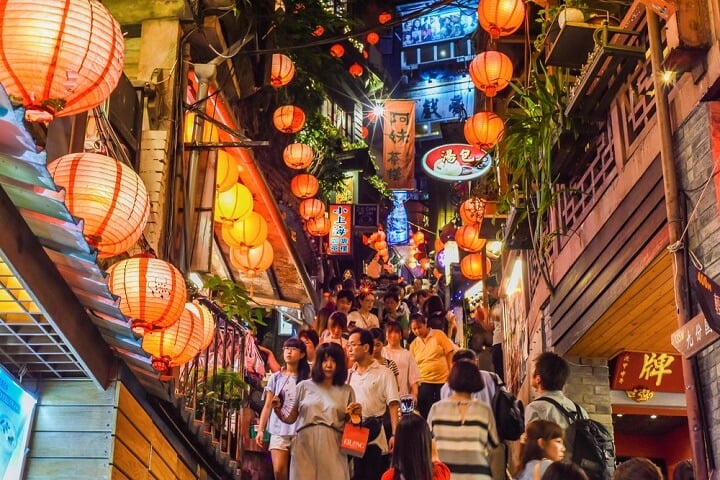
EDIT: fwiw, the gist of this article REALLY struck me when I was in the Juifen market in Taiwan [1] (which the anime Spirited Away was inspired by) -- the chaos of the layered canopy covers and random infrastructural protrusions from the lack of central planning -- it immediately felt comforting, like walking into a shaded forest trail, despite being surrounded by a vibrant economy and commerce! (which I would normally kinda HATE)
[1]: https://www.edreams.com/blog/wp-content/uploads/sites/3/2019...
Also, it is true that sunlight is a fixed resource, but the earth is not 100% covered, even in mature forests. There are disturbances everywhere that can be moved into and stengthening the ecosystem.
There are also resources which are not sunlight. The resource competition is so multidimensional and open that you cannot conceive of life as a zero sum game. Not yet anyway. Maybe in another billion years of evolution we will be at the point where every movement is an invasion.
“True beauty results from that repose which the mind feels when the eye, the intellect, and the affections, are satisfied from the absence of any want.”
https://archive.org/details/grammarornament00Jone/page/n13
The book’s evaluation of leaves and nature at the end is also relevant.
For me it's the practically endless possibility that I will see or hear (or even smell) something new if I'm using my senses (instead of busy thinking about human problems).
There's little difference betweey explanation and yours, but I selfishly think it's all about our experience.
I have witnessed this with my wife who's neurological disorder causes her to be in a "fright or flight" state virtually all day every day.
When she is either planning the garden, tending to the garden or just enjoying the garden I can see a reduced level of stress and increased ability to focus and multitask. All things which are very difficult outside of the garden.
As well I think it empowers her and gives her some semblance of control.
Combined with the satisfaction of taking an idea and seeing it through, and then having that idea grow beyond what you originally intended.
We are planning our new home around the ability to construct and maintain a years-long garden project.
I've seen people talk about car plants, which would be a similar idea. (The feasibility depends a lot on climate of course.) And then of course there are many houseplants enthusiasts, it seems easy to develop some kind of addiction when stressed or mentally not well. Plants everywhere!
"Most people are happier when they’re in at least some Nature, whether this means a grand national park or just a leafy suburb with lots of chirping birds. The average person would consider a concrete lot full of Brutalist apartments a little soul-crushing. This probably comes from an evolutionary heuristic in favor of fertile areas and against barren ones; the closest chimpanzee-parseable equivalent to a concrete lot would be a desert or lava flow, where food and shelter are scarce. But nowadays we can order takeout, and the Brutalist apartment buildings provide all the shelter we need. This is probably another obsolete evolutionary relic, but it’s a very persistent one."
https://slatestarcodex.com/2018/07/24/value-differences-as-d...
At one point I dug out a garden that was 37’ x 14’ and over a foot deep. I did the math once and figured out that I moved more than 2000 lbs of dirt (a literal ton) and then I moved a literal ton of bricks to the back yard to build the retaining walls.
Measuring your accomplishments in tonnage is very satisfying.
Why did you stop? Personally I make an extra effort to get them outside, for young kids theres so much to learn in a garden, or out for a walk.
Its all rusty barbed wire fence by us, so rationally it doesn't make a difference, wouldn't want my kids injuring themselves on something like that in the garden though.
Doesn't mean people shouldn't recommend restaurants to me
It’s concerning to me that such an important aesthetic component is so transient and difficult to control. When you build a house, you control every aspect of its design. It’s materials are tough and long lasting. But the trees around the house are prone to dying. They get too old or they get sick or whatever. And when they do, you can’t really replace them. I’ve seen tons of houses where they had great atmosphere but then one of their large trees died and the feeling of the house is totally ruined. I’m not sure if you can order a grown tree and have it implanted but it’s probably really expensive. We need artificial trees that last longer and are easy to replace.
Humans are drawn to vistas. Standing on the top of a hill and looking at the vista is something everyone agrees is beautiful and feels good. I think it might be because our ancestors were tree-dwelling monkeys. The higher in the tree you climb, the better the view, the safer you are from predators. If we are drawn to views then we would likely spend more time high up in the tree. Maybe that’s also why we find trees themselves so appealing. Ancient wiring.
He boils it all down to fundamentals that are easy to apply.
I found solitude, peace, and healing in the process of working with nature. I worked hard to revitalize the natural environment around me, and through that process I want to believe that nature found a way to heal me too.
Also, I had a therapist and a supporting partner who helped me through the tough times.
Anyways, I can't recommend enough getting your hands in the dirt, appreciating all forms of nature, and learning about the various Eco-systems that are needed for nature to thrive.
We spent a couple of years, maybe 5 or 7 years ago, trying straw bale gardens.
It was quite interesting. I would recommend giving it a try some time. You can do it even with just one bale. We did it with about 10-12 bales of oat straw from a farm we knew.
E.g., https://www.amazon.com/Straw-Bale-Gardens-Complete-Karsten/d... was the author of the book we used, though this seems to be an updated version to the one we used.
I prefer raised soil beds, but this straw bale style was quite enjoyable.
An interesting piece of research into the effects of greenery and nature on wellbeing was conducted back in 2001 by Ming Kuo and William Sullivan [0]. I love referencing it in discussions like these as it's a rather opportunistic experimental setting that might have otherwise never occurred, and gives us some pretty great data to recount when we only otherwise have anecdotes.
In Chicago there was a set of high-rise public-housing buildings. The residents of these buildings had been assigned randomly by the public housing system. Attrition over time had left some buildings surrounded by only concrete and asphalt and others with pockets of green. Kuo and Sullivan were able to compare levels of aggression of 145 residents. They found higher levels of aggression and familial conflict recalled by those living less close to nature. They backed up this data by looking at similar low-rise developments [1]. Controlling for other factors, they compared crime rates of inhabitants who experienced less natural proximity to those with more. They found that roughly 7% of the variation in crime that couldn't be accounted for by other factors could be accounted for by the amount of trees.
Ming Kuo has gone on to research the link between nature and school performance, one of her recent studies concluding that "greening has the potential to mitigate academic underachievement in high-poverty urban schools."[2] In another fascinating piece of research she has also found that "Children with ADHD have fewer symptoms after outdoor activities in lush environments."[3]
Many of this research matches our collective anecdotes. We know that we are somehow hard-wired for nature. Yet we keep ourselves locked away in buildings for hours on end with little of it except corporate potted plants (often fake) and the odd photo or poster on the wall. To pile on with another opinion... I think there's something about 'wild' greenery that is distinctly effective versus manicured greenery. Its chaos and growth somehow synchronise with the minds' inherent nature. In an incredibly fundamental way, we are supposed to be amongst that wildness.
[0] https://www.researchgate.net/publication/245234610_Aggressio...
[1] https://www.researchgate.net/publication/249624302_Environme...
[2] https://www.researchgate.net/publication/327876862_Might_Sch...
[3] https://www.researchgate.net/publication/23192434_Children_W...