That's the introduction paragraph. "Blaming the US" for all turmoil in the Middle East is far too simplistic.
If 5% less rain does bad things for stability, and what surely matters is food per mouth, then what's 4x the population doing?
Sure, you're right (at least in a general sense; Libya, Iraq are 100% on the US/NATO). But saying climate change plays a significant role in a conflict that has been started by external forces is a joke. We might've seen wars in the middle east without US/NATO starting them, and climate change would probably have played a role in those (as would population size), but we won't, because they did start them.
It's a nice meme, though. "It wasn't us by arming, training and directing forces to topple a Regime we didn't like - it was climate change!"
The best research on the table at the moment shows we may be facing a super maunder minimum and possible mini ice age. This research will pan out or not in the next 2-5 years as it is actually falsifiable.
No falsifiable claim = no science
Climate models are not "wrong" or "right," they are models based on finite variables which resemble reality within an expected margin of error. Thus they will always have slight but expected variance from actual measurements in the future. Science doesn't reveal absolute truth, it gets us fractionally closer to absolute truth. Right now 97% of scientists have reached a consensus that even based on the most conservative extremes of the margin of error of our climate models that anthropogenic climate change is real and is marching towards catastrophe. That's a higher degree of certainty than plenty of other scientific concepts that we have put into practice. You are claiming to have better knowledge than the utterly overwhelming majority of evidence and expert observation. Is it because you are miraculously the smartest person on earth, or is it because you are a deluded crank? It's pretty obvious which it is to everyone but yourself and other conspiracy peddlers.
That's not "the best research," that's the research that fits your worldview most comfortably.
https://www.theguardian.com/environment/climate-consensus-97...
It used to be consensus that the world was flat. Consensus is not science. Only falsifiable claims are science.
The solar physicist community has the current most accurate climate models and they only crunch sun data and not C02 data in any way.
Those models show lowering temperatures as we now enter a maunder minimum. Those models will pan out or not in the next few years. Their claim is falsifiable.
How can it be too many people when a person in one country uses 20x as many resources as a person in another?
If 1m have profligate Western lifestyle, the planet and climate would cope just fine.
If 7bn desire and are advertised at to desire a profligate Western lifestyle, then the climate is going to break long before all get there.
The miracle is really that somehow they have almost kept up. Here's the green revolution: Egypt has roughly doubled yield, and (if you click around) roughly trebled the harvest, while quadrupling in population:
https://data.worldbank.org/indicator/AG.YLD.CREL.KG?location...
A non-uniform distribution of resource use and overpopulation are not mutually exclusive, both occur simultaneously.
Now throw in the ramifications of climate change like drinking water shortages, food and resource scarcity, and migrations from coastal cities - the opportunity for conflict will only rise amongst people and nations.
My concern is that this can lead to large scale nuclear war. Yes I'm aware of MAD, but that doesn't protect us from everything. Look at Vasili Arkhipov, Stanislav Petrov, Boris Yeltsin and the Norwegian Rocket Incident. They are just a small number of publicly known incidents where large scale nuclear war was almost triggered due to computer glitches and/or miscommunication. The proliferation of nuclear weapons adds additional challenges in maintaining the peace and we must also deal with existing nuclear actors experiencing wide swings in political leadership - like what has happened with the US presidency.
We live in interesting times.
The great oxygenation event is probably the most similar historical precedent for what could happen if we continue chemically sterilizing the oceans:
https://en.wikipedia.org/wiki/Great_Oxygenation_Event
We're in for a very tough time--I don't want to sow any seeds of defeatism or unnecessary cynicism, but we are no longer looking at a choice between catastrophe and a continuation of our normal way of life. We are looking at a choice between catastrophe and utter cataclysm. Between hundreds of millions of deaths and billions. This is going to eventually come to truly desperate measures. Humankind will not get through this without having to make some incredibly difficult and bloody decisions in the future. Every day we dawdle and ponder what to do makes the decision our descendants will get stuck with more and more horrific and Pyrrhic. It will eventually come to a point that the most rational decision is to start attacking industry and agriculture with force. That's terrible, but there will come a day when it's an act of basic self-defense. It will also lead to strife and death and famine for millions. But we no longer have the privilege of choosing an option that doesn't involve suffering and atrocity--we have missed our best chances and in the future we will be forced to choose based on the degree of harm, not whether or not there will be harm. The horrors of the 20th century won't even hold a candle to what we're currently laying out for our offspring. It's utterly shameful.
The world today is safer, more civilized, and more prosperous than it has ever been in history, but this is a false stability that we're borrowing against our own future to maintain. It's eventually going to come back to us with a shitload of interest.
Climate change is not just some "use electric cars" thing, it's also "change whole industries", "stop producing/selling as much crap" thing, and that flies in the face of constant magnification of everything...
The casual factor that I don't see talked about much: increased local food prices[2] caused by droughts, which in my opinion very much provided the kindling of the "Arab Spring", whose consequences are still very much being played out today.
Related aside: When learning about ancient Rome, it stuck with me that the emperors and ruling elite were acutely aware of the importance of providing sufficient "bread and circuses" with the goal of quelling revolution and uprising. When the political situation is not popular in the first place, revolutions are often sparked when food and basic necessities suddenly become difficult to acquire. This has been true since antiquity. [3]
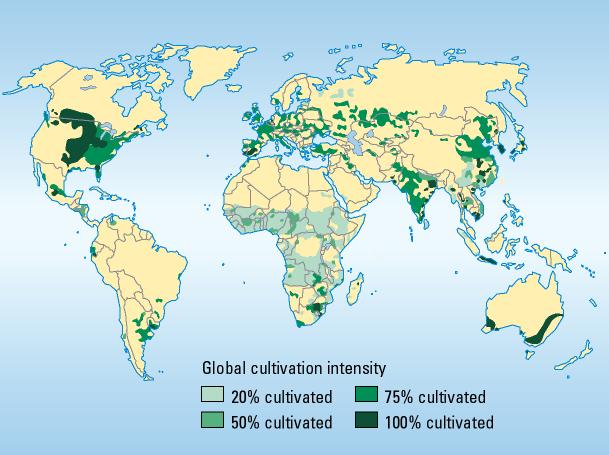
When looking at the impact of climate change, I am very concerned about what the impact of a small number of poorly placed natural disasters could do to the world's food supply and prices. Much of the world's food production is concentrated in a small number of breadbaskets, and global commodity markets can be very sensitive to relatively small changes in supply. These breadbaskets are often close together, represent only a small amount of the world's land area and when conditions are good are highly productive.[4]
I'm sure the security agencies of the world are aware of this and are deeply concerned about this, but unfortunately I can only see our global situation getting worse before it gets better. At some point we need to realize this as a serious, shared issue that ignores borders.
[1] https://www.middleeastmonitor.com/20190123-climate-stress-dr... [2] https://www.americansecurityproject.org/climate-change-the-a... [3] http://www.pbs.org/empires/romans/empire/plebians.html [4] https://myweb.rollins.edu/jsiry/agrcultint.jpg