Seems like a retrofitted use case that is more of an answer to the question "What could technology do next?" rather than the question "How to improve quality of life?"
If one started with the latter question---which is what is worth answering---a significant component of the answer would be to strengthen relationships and make them more authentic. Since the medium undeniably biases the message, it is important to prevent the disintermediation of relationships by corporations looking to insert themselves (or their technology) into positions from where they can better extract rent.
Technology can of course be useful in numerous ways, but the right solutions would put human emotions and relationships front and center, and sparingly sprinkle technical solutions only when needed -- and in many ways force people to interact more directly, even if it were temporarily (somewhat) inconvenient.
Anyway, it feels to me Gates is fixing a real problem but with very 1st world solutions?
> For example, software will be able to notice when you’re feeling down, connect you with your friends, give you personalized tips for sleeping and eating better, and help you use your time more efficiently.
Maybe it is just the skeptic in me but it is a lil captain obvious that more of those activities will give you a better quality of life. In fact, I will say that most people are very aware that they should sleep or eat better or even use their time efficiently and probably wouldn't need any form of software to tell them that. I will even wager that the overwhelming number of people that are feeling down, need more sleep or need to eat better can't do so easily and is possibly due to their personal circumstances such as having to work insanely hours due to (almost uncontrollable) working conditions and/or have a low to middle wage job that won't allow them to have any spare income to eat healthy/organic food.
This feels like a stereotypical 1st world solution to me that will only apply to certain type of people and I say this as someone in the privilege position to do so.
I know I sound dystopian but could someone refute my view? Am I missing something?
Maybe it is just the HN mentality of nitpicking to every mention of the word "software".
I feel like we've lost connection and patience for each other from lack of practicing empathy. More technology is not the answer to that. I hope we find an equilibrium where we move past such an infatuation with tech that we let it be the right amount of a participant in our lives and place more of an emphasis on the human experience and condition and value our humanity first.
I'm sorry, I can't let you do that Dave.
This feels dystopian to me too, not least because in order for software to diagnose this problem you'll need to spend sufficient time generating relevant usage data... usage that will (if existing social media are anything to go by) be a net contributor to problems with self-esteem, fitness, sleep, etc.
I'm not going to pretend to know exactly what he means, or how it'll pan out, but the cynic in me is expecting a greater net benefit from just deleting your FB/Twitter/Insta account.
I think he's very smart and great at setting huge goals then hitting them, but I'm not sure he's a great prognosticator.
The road ahead is from 1995 and is about the Internet ("Information Superhighway") which Microsoft almost missed, but got right just in time.
The Smartphone he saw coming earlier than almost anyone else, and Microsoft desperately tried to conquer that market. They initially failed because existing mobile phone companies (Nokia, Motorola, Ericsson) feared Microsoft too much and refused to partner. Then Microsoft had to enter the market with third tier player HTC, which had no distribution at all. Then they executed very poorly, trying to miniaturize Windows using a pen interface and killing the much better specialized numerical ui they had. Then they got surprised by the iPhone and touch screens, and took way too long to come up with a good implementation of that, with Windows Phone 7. And then finally with Windows 8, they redid everything again for no good reason, loosing any loyalty from customers they had left.
They missed smartphones, but not because Bill Gates did not foresee them.
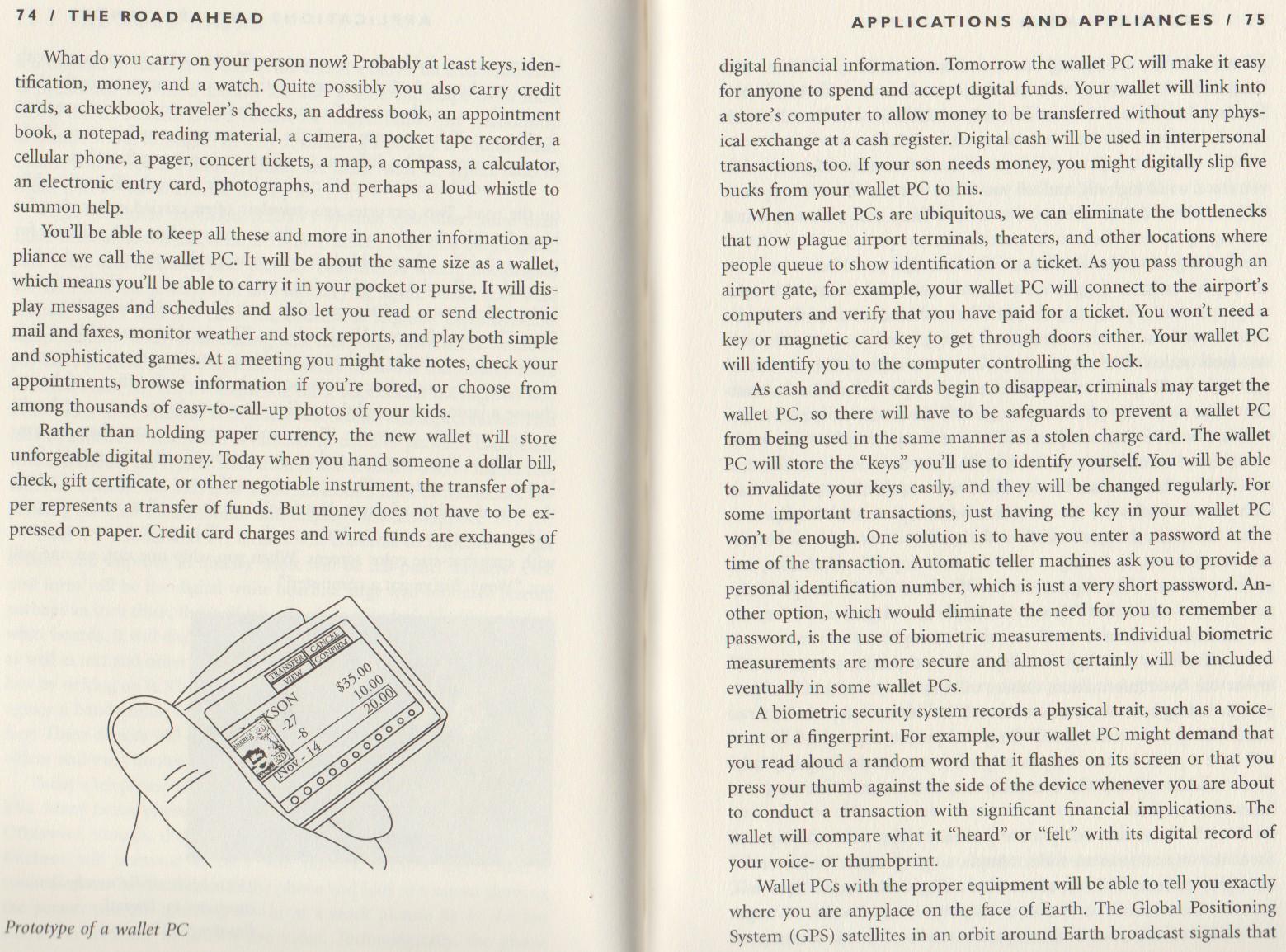
What do you carry on your person now? Probably at least keys, identification, money, and a watch. Quite possibly you also carry credit cards, a checkbook, traveler's checks, an address book, an appointment book, a notepad, reading material, a camera, a pocket tape recorder, a cellular phone, a pager, concert tickets, a map, a compass, a calculator, an electronic entry card, photographs, and perhaps a loud whistle to summon help.
You'll be able to keep all these and more in another information appliance we call the wallet PC.
Microsoft's original mission statement was "A computer on every desk and in every home"
You're looking for a technological solution to a social problem - such things don't generally exist. It's not that technology is bad per se, it simply can't do what you're expecting it to do.
I can imagine a huge host of compensating bad behaviors that would result from something like that. Then should it go away are you just doomed and emotionally catatonic?
So refreshing to see someone with his reach pushing for nuclear.
If it was cheap enough companies would have built more and scaled them up and down to meet demand, instead France only got mostly Nuclear by exporting its excess and nobody else really got very close to full nuclear.
The problem today is wind costs less. But, when you add a lot of wind during times of high wind your nuclear becomes useless. This ends up driving up the effective cost of nuclear even higher.
Storage makes this worse as you would then just want ever more wind due to cost.
It's been pointed out again, again and again. Coal plants pump out more radioactive waste than is ever released by all the accidents to date, catching a plane will irradiate you more than living next to one, etc. etc.
You need to pair it with some sort of grid energy storage. That's not quite a solved problem.
Personally I'm a fan of offshore compressed air... https://www.greentechmedia.com/articles/read/toronto-hydro-p...
Nuclear is expensive because the rampant fear-mongering generates massive amounts of litigation, construction delays, and outdated/unreasonable regulations.
If you look at the cost of reactors in China, Russia, Saudi Arabia, etc, they are one-tenth the US cost for the exact same reactor design.
There's really no innovation needed for the latter. Just educate people and when that fails implement better controls, i.e. sugar taxes on sodas and food. Fundamentally the goal should be get rid of refined sugars in foods, especially high fructose corn syrup.
People however like to blame other things and external factors. I'm X because of Y. It's time to take the pity cock out of the mouth and take responsbility for oneself.
That being said it's hard to rely on education for the average non-educated lazy person (i.e. the general masses) but instead we need to regulate the supply, i.e. what is already done with other poisons such as tobacco, drugs, alcohol. Sugar needs to be added to that list.
0 - https://www.vox.com/science-and-health/2017/12/7/16587316/ba...
I love this.
Given that he’s successful at investing, he must have some other standards.
"That love is watching someone die
So who's gonna watch you die"
On first visit, it pops up a modal subscribe email dialog.
On a second visit, a distracting large survey thing slid in from the bottom.
Why would Bill Gates need spammy patterns that detract from reading the text on his personal blog?
As a bonus, that doesn't get blocked by adblockers, and doesn't annoy those who aren't interested. I might be bored and see what the questions of a survey are, and maybe take it if they're interesting, but not if it's a pop-up.
To solve obesity we need the opposite of innovation. Nature has delivered the perfect array of nutrition for the human animal to thrive. We have innovated ourself into obesity and the reversion to the simple truth of natural nutrition is the cure.
I like not going hungry on a regular basis. Most people do.
So in light of the harsh reality that obesity is essentially a given, what CAN be done?
Facebook-controlled depression, what a dream
https://slate.com/technology/2014/06/facebook-unethical-expe...
I'm almost 30 and those are my priorities, maybe that's why I am not as "successful" as Bill Gates?
>>I desire for my personal growth but I digress.
>>The fact that Gates mentions that he thinks about these things now as opposed to his 20s makes me wonder if I am making the right decisions here.
A few days back some one on HN mentioned that most people on earth, are not going to terrible failures or spectacular successes.
Once you come to this realization. You will take your health, mental health, friendships, relationships and hobbies far more seriously.
After a while all you want is a peaceful, normal life with happy relationships and healthy body. After a while you can earn enough. And you are going to be eating the same burgers, as a billionaire eats to fill stomach. The beef ain't exactly going to come from heaven for trading extra efforts for sure failure.
>> Still, I have made great progress.
That which is in locomotion must arrive at the half-way stage before it arrives at the goal.
— as recounted by Aristotle, Physics VI:9, 239b10
https://en.wikipedia.org/wiki/Zeno%27s_paradoxes#Achilles_an...
For a lot of things in life, there are indeed infinite sub tasks you need to complete. Most of us aren't going to make it. Bail out while you have time.
I haven't had to end friendships as I grew, as those that diverge tend to naturally fade away. But I always make sure to nourish new ones that are more in line with where I'm going, and it feels amazing to have that kind of control in your life.
> We had hoped to build a pilot project in China, but recent policy changes here in the U.S. have made that unlikely.
Maybe running pilot projects in U.S. instead of China can solve the first issue he mentions?
So, presumably, he thinks that mustering the political will is intractable. Then, a few paragraphs later, he admits that his preferred fix of nuclear energy is also blocked by... political constraints. Why he thinks he'll make more progress touting nuclear energy, which is wildly unpopular, instead of "green jobs", which polls well, he doesn't say.
Without considering accidents, for only 50 years of comfort, we have shamefully produced deadly waste, that future generations will have to keep confined at all costs for thousands and thousands and thousands of years.
Unlike CO2, uranium pollutes in the very long term, destroying all bacteria in the environment. It is high time to get up-to-date with renewable sources of energy.
[1] https://www.scientificamerican.com/article/coal-ash-is-more-...
Yes 100% solar/wind would be virtually accident free, but if you argue this point too hard you let the perfect become the enemy of the good.
I always like to point out to people (it often surprises them) that the province of Ontario gets more than half of its energy from nuclear plants [1]. How often do you hear about horrible accidents in Ontario? Not so often - there hasn't been a major clean up required since the mid 90s. And these are facilities built in the 60s! Anecdotal, but this is the sort of "quiet evidence" of nuclear safety that is easy to ignore.
[1] https://www.ontario.ca/document/2017-long-term-energy-plan-d...
Very interesting, I did not know that.
There’s an interesting use case for Facebook’s Machine Learning algorithms
For example, I would not trust my health insurance company with information that may indicate I am predisposed to an illness or disease lest they brand me as a high risk, pre-existing condition patient, and deny or price me out of coverage forever. I'd rather do my own experimentation outside of the 'official' medical community than to risk my own data being used as a weapon against me.
Somewhat unrelated, I feel that the next underexplored area of medical science is that of the gut & intestines. Having a toilet that could do continual personalized analyses of your urine and stool is going to revolutionize medicine. However, as much as I believe that this is an opportunity to change the world for the better, I would never purchase such a device under the current privacy and security climate. I hope we can start to resolve these issues in 2019 and beyond so we can unlock these sorts of innovations to help people on a daily basis with chronic conditions.