Articles like these stir me to action, but what action? Where's the mass movement on this? Where's the group, the party, the leadership?
1. Learn about the best ways to get carbon out of the atmosphere [0]
2. Help build the political will for carbon pricing, ideally via Fee & Dividend. The vast majority of economists agree that once GHG pollution costs are internalized, the problem will solve itself quickly. The most effective organization in this regard is Citizens' Climate Lobby [1] – I highly recommend getting in touch with a local chapter. We all tend to be much more cynical about politics than is warranted; I was surprised how rewarding it feels to participate in the political sausage-making.
3. (Optional) Learn about/work on/invest in future carbon removal technologies [2]
[0] Rank list of the Top 100 carbon removal strategies: https://www.drawdown.org
[1] Citizens' Climate Lobby: https://citizensclimatelobby.org/
What can a technologist do about climate change? By Bret Victor: http://worrydream.com/ClimateChange/
I just came home from a rally for a more climate friendly state budget in my home country of Norway. I'm energized and glad to find that there are many like-minded people in the world. I think I'll be volunteering for an environmental organization soon; turning my thoughts into action today felt good. I've been worried and waiting for change to happen. And now I've finally found somewhere to place my energy.
Globally: https://xrebellion.org/
- Don't travel on planes(And definitely don't be like Leonardo Dicaprio using private planes after giving speech on climate change)
- Don't eat beef/pork
- Don't use AC or use it minimally
- Same with hot water
- Don't have lawn in your house
You can drive an EV, or stop eating beef, or pay the renewable-energy rate on your electric bill, and feel good about it if you want, but it won't make a bit of difference on a global scale.
The focus on our individual behavior is all well and good as far as it goes, but I agree with a commenter below that it can't be the only thing each of us does. I don't own a car, I live in an apartment building, I eat very little red meat, etc. But the hour is getting late, clearly, and it can't just be "let's make sure everyone recycles". Power is real: a small number of people in this world wield vast amounts of it, and they're dead-set on staying the course. My not eating beef will not make a dent in those peoples' behavior, so it's times like these when our/my American focus on "what we can do as individuals" feels maddeningly myopic. I want something more. I guess the good news is a lot of you feel the same way, maybe?
- number of gigatons emitted to date
- rate of ongoing emissions
- change in the rate of ongoing emissions
- what total emissions numbers correspond to what PPM in the atmosphere
- what ppm in the atmosphere correspond to what degrees of C warming (in various timeframes)
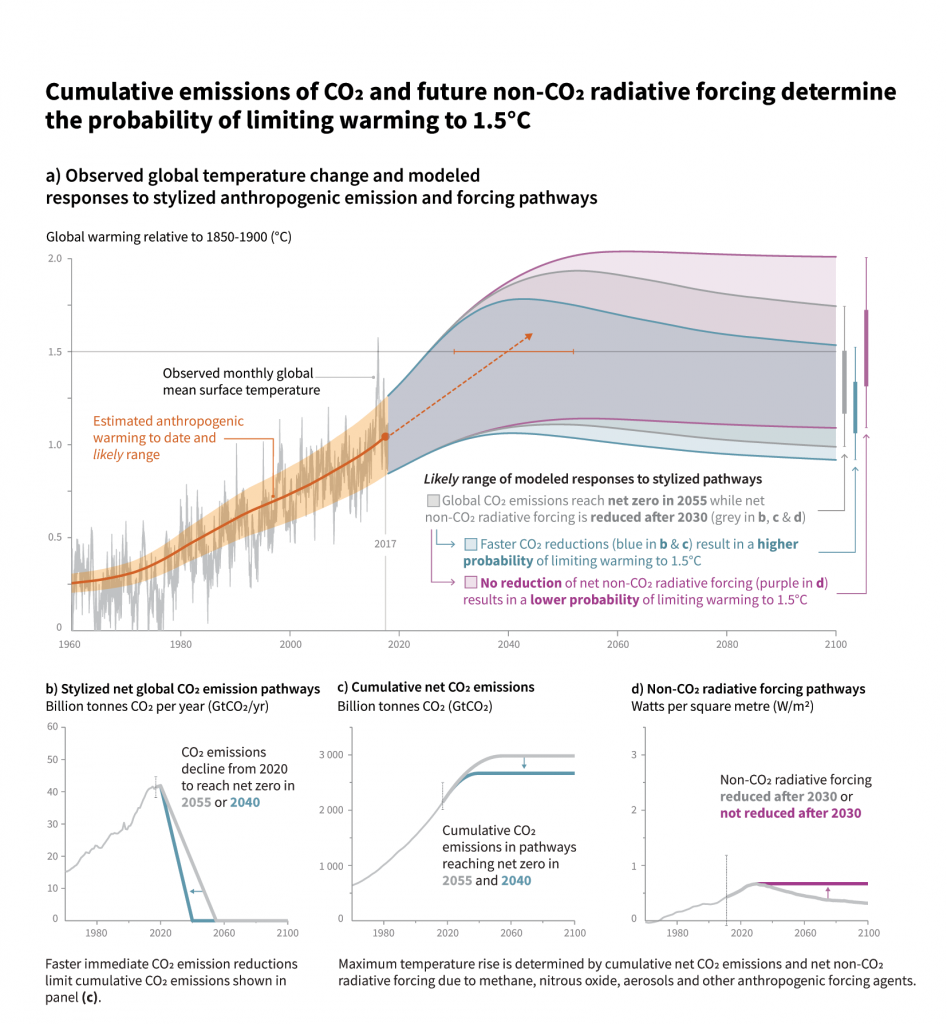
here is a nice infographic from the latest ipcc report that shows some of them: https://www.ipcc.ch/site/assets/uploads/sites/2/2018/10/SPM1... pay particularly close attention to the one in the bottom left.
- what degrees C warming correspond to drought, desertification and crop failures in what areas/river-valleys (note: sea level rise won't actually be a problem until after the famines, focus on the famines)
Once you get a feel for the numbers the "what to do" becomes a fairly obvious "everything/panic/get-super-duper-radical". But I can't elaborate on that more here because it ranges from "borderline communist levels of leftism" to "out and out eco-sabotage".
DO NOT fall for the false framing that a rump dumbass 20-30% of the population doesn't "believe" in global warming. That is smug nonsense that people use to justify a false-framing of some kind of stalemate. No society ever convinced everybody of the way forward. The real problem is the litany of excuses and magical thinking that the so called "believers" will come up with to do nothing. Such as:
- there's nothing we can do, give up, its too late
- magically innovative technology will save us just hold your breath till it comes along
- teh markat will provide! if we can just do this spreadsheet game with tax credits or something
- i can't do that thing i should do because even though I'm one of the richest humans on earth and that ever lived I've cast myself as a victim of the current economic order and cannot afford to do anything.
Now, all that said as context, here are the top 5 things, IN ORDER (assuming you're a middle class american), you can do to curtail your and your families carbon footprint:
1.) have a negative-population-growth number of children. that means somewhere in the <2.1 range (stupid joke about cutting parts of babies goes here).
2.) do not use a car on a daily basis. ideally don't even own one. if you must own one make it electric.
3.) live in a 5+ unit building. this cuts your heating/cooling/lighting footprint roughly in half, and ties into the car thing above (mid rise apts correlate strongly to walkable areas). no amount of solar panels and electric cars will make suburban-sprawl a sustainable land use or energy consumption model in your or your childs lifetime. this is the absolute hardest part for americans to swallow, they will pitch a temper tantrum fit and write off the messenger rather than grasp this one.
4.) fly (round trip) less than once a year
5.) don't eat red meat, or at least cows. even if you're not ready to give it up, you could deliberately replace red meat meals with chicken fish or vegitable alternatives more often.
However, I want to stress that viewing things through the lens of individualized personal consumption levels is a TERRIBLE focus. This is the the most universal problem humanity has ever faced. You want to do the 5 things above not because it will cut your footprint 10 - 20 tons per year (~50 - 80%, which it will), but because you will be contributing to building a society in which everyones footprint is cut. You want to normalize apartment dwelling, walking, public transit, avoiding unecessary flights, and avoiding red meat. That is how you contribute to building a sustainable future society. You need to walk the walk not for a few tons, but to show your children and neighbors the way forward.
- I vaguely recall a Fredric Brown (?) story where people turn to (conceptually, self-defense) violence against cars because they've reached the insight that the fumes are literally killing them, like cigarette smoke.
- Some people (hmmm, "some people I know") have chosen direct action and planned+participated in sabotage of pipelines and railroads (used for coal and oil transport). Several were arrested in multiple states, but the overall outcome was symbolic with limited media coverage; not really what I imagined as effective, direct action. Now, some have spent time in jail, and some are scared because they feel responsible to their young children, and what happens to the kids if their parents spend a long time in jail?
Sure it's good to minimize energy use as you outline. But where does it leave you in terms of tonnes of CO2/year?
AFAIK the Paris accord goals (inadequate as they are) imply a target of around 1500 kg of CO2 per capita yearly. Homeless people achieve that in the west. You won't get near those levels, hower much you try to reduce your personal consumption.
We're not going to individual-responsibility our way out of this, and I wonder if getting people to try will just give them a false sense of accomplishment.
I recently built a site to empower you to take action to Ask them to improve.
See here: https://www.yourstake.org/ask/vanguard-vanguard-tell-compani...
And running a business that's a significant part of your income creates an incentive to keep at it religiously and relentlessly. That incentive is weaker without the profit motive, when it's about making an uncertain contribution to other people over decades.
The fact we do not see such a buy up of future water front property means they either don't think the evidence is there, or they are extremely optimistic about our ability to reverse climate change, or extremely pessimistic about the future such that humankind will be wiped out or something.
> Where's the group, the party, the leadership?
Humanity's failure to respond to the climate change crisis shows that groups, parties, and leadership are inadequate; we need some new way of organizing ourselves. Perhaps the kids will figure it out.
disgusting.
I'm not saying we should ignore it, but we often overstate. It's worth remembering that the effects on QoL will be completely eclipsed by technological progress within that period and that the timescales that GW happen over (50+ years) are long enough that most people will hardly ever notice it. Gradual relocation will be our primary means of fighting it. Other cities will be raised, like Chicago was in the 1850s.
FUD is not a genuine approach to invoke action - which has sadly been the main approach of many. We should remain reasoned.
Designing new cities without the cruft of older ones is a huge opportunity. However, it's likely that most building owners will just add couple extra meters of dirt below when it comes time to rebuild a given structure. Even skyscrapers do not last forever.
[1] https://www.makaan.com/iq/buy-sell-move-property/what-is-the...
[2] https://www.quora.com/What-is-the-life-expectancy-of-a-Skysc...
That highlights what's wrong with your PoV. If sea-level rise were the only issue, your comment might actually make some sense ... but that's not the case. Climate change will also lead to droughts, floods, famine, conflicts over water, species extinction, possible collapse of entire ecosystems, and a host of other ills too numerous to mention. Normal technical progress isn't going to solve biodiversity problems we barely understand, or human-society problems that will be driven by warming. It would require a major leap on par with the birth of atomic physics or molecular genetics. Maybe more than one. You want to talk about what's rational? Faith in the modern equivalent of miracles is not rational.
FWIW I'm convinced that it's serious this time, but history abounds with examples of breathless malthusian doomsday predictions that failed to pass.
Or, pump out even more carbon dioxide to increase the warming and water vapor, and hence increase cloud cover to cool the earth.
I lump climate change deniers into the same category as flat-earthers. Although I have more respect for the latter, as at least they aren't blindly swallowing self-serving nonsense spewed by ignorant politicians and certain news outlets.
How many of those are in climate related sciences?
"many"? The consensus amongst scientists in the relevant fields is quite compelling.
There are no such scientists, let alone "many". And it doesn't matter what people "hypothesize".
I know the names of the handful of "lukewarm" climate scientists who don't hold the consensus position; none of them take the position that you put forth, and I can be certain that you can't name any of these "many" scientists.
The scientists who claim "current changes are, like all past changes, caused by other factors than the man-made" are not taken seriously by the mainstream, form an unimaginably slim minority and frankly are dangerously wrong.
Especially when the "side of science" has become so extremely tied to the idea that the only real solution is taxes that one political side has come up with and of course voting for them. And if you question the tax side of things, you're a filthy denier.
> there are no inconsistencies in my testimonies against the government, against the fossil fuel industry
I lump climate change blamers into the same category. The moment you start talking about individual country (or any specific body) per capita and cumulative, you're making a political statements that someone is responsible and needs to be accountable because of their history (back to the 1750s in this one). ie These people are bad because there's metrics that fit my message and all other people are good because they have different metrics.
Seriously, how is the regional political accounting relevant to the objective analysis of what the correlation, causation and projections are?
I guess the idea is something like: "you're historically the worst (even if you're not the worst today) and you have resources, so it's up to you to try to fix it but we're not gonna even suggest how, but just sayin'". It reads like a lack of confidence in their own conclusions.
More like "So you deserve a larger responsibility for fixing this and we're suggesting, maybe start with stop mining coal and not electing a president who calls climate change a Chinese hoax?" but sure, same thing.
>so it's up to you to try to fix it but we're not gonna even suggest how,
That's the thing though, they are saying how. And it's to give money to the rest of the world and curb your production to allow them to pollute in your place which is "fair".
At least the flat-earthers are harmless. The climate-change deniers are preventing necessary action on issues of life and death.
A calm, collected, scientific representation of both sides.
John Christy (the other side in your video) represents the ~3%. His research was shown to be wrong over and over again. Most recently in 2017: https://journals.ametsoc.org/doi/abs/10.1175/JTECH-D-16-0121.... https://www.theguardian.com/environment/climate-consensus-97...
One can admit to degrees of model uncertainty without insinuating that climate change is a matter of opinion.
i'm still to hear the "other side" of CO2 molecules absorption spectrum, specifically in infrared. 200 years and still no such "other side" ...
https://history.aip.org/climate/co2.htm
"Beginning with work by Joseph Fourier in the 1820s, scientists had understood that gases in the atmosphere might trap the heat received from the Sun. "
While CO2 promoters point out the fact that solar irradiance changes are relatively small over time, they ignore that those same irradiance changes correspond to changes in solar magnetism, which means changes in cosmic ray incidence on planetary atmospheres. It is well known that cosmic rays effect cloud formation.
It's really not as clear cut as you have been taught.
Have a look at the episodes of the Netflix series "Bill Nye Saves the World" on climate change. If you can watch without cringing, congratulations. I can't. Or take this interview Nye did with Tucker Carlsen:
https://www.youtube.com/watch?v=qN5L2q6hfWo
Nye, and those who share his intolerant attitude toward justified skepticism do their cause more harm than good.
Every hypothesis should be questioned. The more sweeping the claims, the more pointed the questioning should be. Science is not immune to groupthink. The problem is magnified when a scientific hypothesis takes on a political dimension.
Take this quote from the article:
Climate has always been changing, but humans are now the principal drive for climate change, overwhelming natural climate variability.
I challenge any reader of the article to find a clear, logical, undeniable chain of evidence from hypothesis to the conclusion that humans are responsible for rising planet temperatures.
"every hypothesis should be questioned."
It is, constantly, literally on a daily basis. That's how we know.
What does pop culture (Bill Nye) has anything to do with this.
Also many of us are a bit beyond just theoretical discussions. It's 2018. We are increasingly affected by climate change to the point that many of us are packing, because the shit already hit the fan. What's a fun theoretical discussion for you (at the moment) is actually life and death for many.
Even the link you gave fails to enumerate the evidence for a human cause, and itself links to another article.
I realize that some have made up their minds, but the extraordinary claim of a mainly human cause requires extraordinary evidence. And that evidence is hardly discussed, nor are alternative hypotheses given their due.
This is the problem I'm trying to highlight. The discussion has veered from scientific to religious.
We've had 40 years of unmistakable data, and at this point, anyone pushing this "the science isn't settled" talking point – adopted from the tobacco industry – either has a vested interest in denialism or simply falls really far left on the Dunning-Kruger curve.
When these people say something about science, for better or worse, they speaks for science in many people's minds.
Key numbers to get the point across.
* Starting mitigation in 2000 would have required mitigation rate 4%/year. (1.5 C goal)
* Starting mitigation in 2018 will require mitigation rate 18%/year. 18 percent! (1.5 C goal). There is no realistic scenario where this can happen.
* Nine years from now complete halt of all manmade CO2 emissions is too late to prevent crossing 1.5C.
* Global fossil and cement CO2 emissions keep going up, not down: http://folk.uio.no/roberan/img/GCB2018/PNG/s09_2018_FossilFu...
* CO2 mitigation curve becomes steeper and steeper. http://folk.uio.no/roberan/img/GCB2018/PNG/s00_2018_Mitigati...
I just read for instance an editorial from nature which said that 10-30% of coral reefs survive at 1.5C but none survive at 2C. I’d like more of that kind of information to understand the risk profile.
If we are serious about the current issues of climate change, and about potential asteroid impacts, why should we not also be planning for the mid- to long-term risk of the return to an Ice Age?
It is hard to sort out exactly what climate change means.
This one is much faster. Not everyone sees it of course. Change blindness is what they call it.
https://www.npr.org/sections/krulwich/2014/02/05/257046530/b...
I don't understand US politics.. Most UK voters, of both political sides, agree there is an issue, and want constructive solutions[0]. Some more US-like differences at the margins, and differences in urgency, but there appears to be a broad consensus among the public. Less so amongst politicians themselves.
Does political consensus no longer exist on any issues in the US any more? Is all science politicised?
Sir Richard Wharton: "In stage one we say nothing is going to happen."
Sir Humphrey Appleby: "Stage two, we say something may be about to happen, but we should do nothing about it."
Sir Richard Wharton: "In stage three, we say that maybe we should do something about it, but there's nothing we can do."
Sir Humphrey Appleby: "Stage four, we say maybe there was something we could have done, but it's too late now."
[0] http://www.lse.ac.uk/GranthamInstitute/news/the-public-suppo...