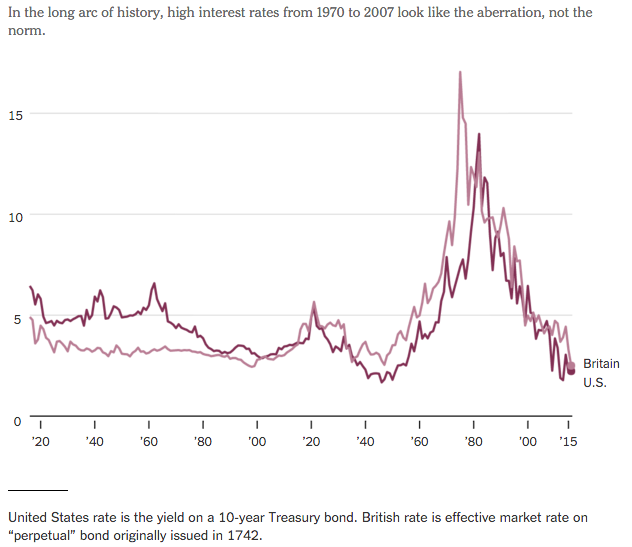
This theory is fundamentally flawed, because it assumes that whoever receives the “new money” buys consumer goods. If this is indeed what happens, then prices should increase. But what if he buys bonds?
If newly produced money is used, not to buy consumer goods (or commodities), but bonds, then the injection of new money into the economy has the opposite effect on the price level, because the new money is used to improve the efficiency of production. E.g. if a producer of chickens sells a $250m bond (bought with “new money”) and invests the proceeds in a chicken plant[1], the price of chickens will decrease, due to increased productivity of producing chickens.
In the above scenario, the only price that will increase is the price of bonds, which is the same as a falling rate of interest (the rate of interest is inversely proportional to the price of the bond). And this is exactly what has been happening for the past 35 years or so[2].
[1] https://markets.businessinsider.com/news/stocks/costco-plans...
[2] https://awealthofcommonsense.com/wp-content/uploads/2015/12/...
"In principle, it could be argued that Cantillon Effects focus on the short-term effect of changes in money supply, but that money neutrality is a long term characteristic of money. Short-run effects in resource allocation are typically not denied, usually due to the fact that they alter “sticky” prices, such as wages." It then goes on to argue that Money Neutrality shouldn't be taken as a given.
I don't think the article states money neutrality is fallacious, though, and I couldn't find any substantiating claims within it. I suppose the argument I am making is for money neutrality. That yes, the initial recipients of capital are temporarily advantaged being able to purchase assets are pre-inflation prices. However, over time, this does balance out. The market makes it so. I'm not sure, maybe I'm missing something? I'd love to read more on this if you think I am.
That said Bitcoin has a worse Gini ratio than any banana republic, worse wealth distribution and all sorts of other economic factors, and an unbounded cost to transact that as a fixed fee unfairly burdens the poor -- that just make it worse all around than the existing USD based financial system.