We were quite shocked to see how german it was. It seemed like a hideout for traditional german values (as in conquering Poland) - no pleasant memory.
Haven’t been there, but it’s probably a bit like Namibia, which had the unfortunate experience of briefly being entangled in German dreams of colonization: they have radio stations continuously playing German folk music from the 1920’s.
It’s not explicitly fascist music (as far as I can tell) but the association was strong with everyone who heard it.
- Introduction to the subject
- Introduction to the “characters”
- “Dramatic thing began to happen, with seemingly innocuous steps taken towards the unforeseen conclusion, but then, as the thing begins to unfo—“
- “Back in 1823, when the ancestor of the grandfather of the person who first set these steps tangentially in motion was born, baby rattles were just becoming popular...” [119 paragraphs giving a detailed biography of the main person]
- “And now, the conclusion...”
I much prefer the "newspaper article" script: Short summary, then detailed long story. It's similar, except that the summary doesn't end in a cliffhanger that makes you want to skip to the end of the article.
The question would be, do we care for longform as a format (as opposed to having bite-sized stories with links between them if they're part of something bigger)? Or do we care about stories that have substantial background that needs to be explained (rather than be a tangential addition to a main story)?
But yeah, I agree it is not enjoyable to read.
...containing detailed descriptions of one or more of the following:
* The weather at the chosen time of introduction
* One or more anatomical features and/or pieces of attire of the subject
* A mode of transport/vehicle used by the protagonist
* Some arbitrary item with personal value to the protagonist
And so on.
Like straight from a "My first novel" writing course. It's grating.
It's cancer.
unfortunately it always rises again...
Perhaps engineers in other fields are not so different from software engineers after all, published code of conduct aside.
If this is true, I don't think I may ever let my child into a water park. Is this true of traditional amusement parks as well, I wonder?
The guy couldn’t find reputable vendors willing to take on the project.
[0] http://www.cnn.com/travel/article/worlds-tallest-water-slide...
That aside, while it's clear the person from the park that led the project was not any kind of engineer, I find it very unlikely that the slide was designed and built without the involvement of any licensed engineers.
Everytime an article related to the Volkswagen emissions scandal is mentioned, a finger is always pointed towards the software developers and it's hinted that they broke the law and should be responsible in some way. I am surprised a similar note isn't struck in this article with regards to the engineers that worked on this project.
http://www.chicagotribune.com/news/opinion/commentary/ct-vw-...
27. HENRY's rushed schedule affected quality control. A steel detailer named Ronald Miller, who was hired to assist with the Verrückt construction, emailed Project Manager Kathrine Fontenot to voice his concerns: "I'll be honest with you. We were forced to ship this [tower platform] way to early. There are still so many unknowns. We would have saved a lot more time (and money) if everything was figured out here at the plant. I have been telling people for months that it was imperative to have all of this stuff figured out prior to shipment. My requests fell on deaf ears and now it is on its way up to KC to be galvanised. Instead of dealing with these questions in a controlled environment, where we have the material and resources to resolve these matters, it is going to have to be done on the fly 160' in the air, on a structure that is galvanised."
> He never got a conventional education beyond high school and never formally studied physics or engineering.
That alone isn't a bad thing. Maybe he's a visionary for these water rides. Provided you retain real engineers and take their advice, that is...
> an engineering firm ... issued a report suggesting ... there was a chance the raft would go airborne on the second hill. The ride opened anyway, with the weight range unchanged.
!!!
> But one of his lawyers acknowledged that Jeff didn’t have such training. He added, “Neither did Henry Ford, and he built the car.”
This is actually a mildly compelling argument. Thousands died in cars for decades [1] before cars competed on safety features and real safety regulations arrived. However, today, I think and hope that other water parks and amusement ride designers do conventionally use simulation and other methods to arrive at safe designs. It's not unreasonably expensive considering the total expenditure of the ride's design and construction.
States like Kansas should come up with some terribly simple low bars like requiring professionally licensed engineers to sign off on a ride's design and maintenance procedures as safe, and requiring annual inspections of ride service and incident records.
[1] https://en.wikipedia.org/wiki/Motor_vehicle_fatality_rate_in...
It's not a good idea to build public buildings without the input of a structrural engineer, but it's not impossible.
> What’s more, according to court documents, the investigators learned that on July 3, 2014, one week before the ride’s grand opening, an engineering firm hired by Jeff and Schooley to perform accelerometer tests on Verrückt’s rafts had issued a report suggesting that if the combined weight of the three passengers in a raft was between 400 and 550 pounds—the weight Jeff and Schooley had agreed was appropriate—there was a chance the raft would go airborne on the second hill. The ride opened anyway, with the weight range unchanged.
In the end, no expert vouched for the ride’a safety.
> Kansas City reporters began digging. They quickly learned that their state, like Texas, allows water parks to be self-inspected. (Under the headline “The making of Schlitterbahn’s Verrückt water slide: Too much, too fast?” a Kansas City Star article concluded that “the ultimate safety of [Verrückt] mostly began and ended with those inspired to build it.”)
I liked your post up to this point. But no, it's not a compelling argument -- especially one made by a lawyer.
I wouldn't absolve Tesla for the liability of its cars just because Elon Musk is a "genius". I would expect a genius to know the limits of his knowledge. Maybe he was too proud to ask for help.
I'd like to hope that everyone's education would be enough to instill an understanding of these things. The alternative is a Grenfell Tower for every generation.
No, no, and no. I at least know of Sinclair and I'm familiar with the subject matter of The Jungle.
You can see them in this video of the ride (start at 1:00)
The mind boggling part is that the netting system worked as designed, but the design was such that the riders of any airborne raft would be going into it head-first. That should have been obvious to anyone the moment it was even proposed as a solution to airborne rafts. They created a system where serious head/face/neck injuries were inevitable.
A parents whole routine with life is do things, check kids, do thing..... every moment you would be aware that something is terribly wrong.
Also, the park is still operating just not that ride.
They went without me (was perfectly fine enjoying myself on my grandma's 20 acre property) and they all came back later that night. But the next morning my one cousin, probably 12-14, stayed in the back room and never came out. Everyone kept bringing her food and water through out the day but she never came out.
I finally asked what was wrong to which my (somewhat crude mouthed) grandma only stated that she hurt herself on a ride and now her vagina is all swelled up and so she can't walk. Being 5yo I really wasn't sure what the heck that meant. Actually, I'm still not sure. But the best I can conjecture was she rode this one really tall water slide where you sit on a plastic sled and I assume the sled came out from under her and when she hit the "water brake", it flew in between her legs. But I don't know, and I'm not going to ask...
I don't remember the size, but at the end of the slide there is about 2-3 inches of standing water in the chute which I guess serves as the "water brake". I was wearing some long swimming shorts, but after hitting that water brake butt and feet first, once I stood up it looked like I was wearing a speedo since the blast of water going between my legs gave me the worlds largest wedgie.
Never rode a slide like that again. I used to stand at the end and laugh at the people getting off and having to pull their cloths out of their crotch as they walked off like penguins.
https://www.injuryrelief.com/blog/how-is-representative-scot...
I don't see how this is either hypocrisy (as alleged in the article you link to) or denying his constituents some benefit that is allowed to him (as you claim).
I am curious why Kansas law allows in the case of an out-of-state tortfeasor applying the laws of the tortfeasor's state for damage limits. (I assume that it is still Kansas law determines whether or not a tort was committed?)
If the tort occurred in another state, and the Kansas victim elected to sue in Kansas, then I believe that normal choice of law rules would have the Kansas court apply the laws of the state where the tort occurred, both for determining whether there is liability, and determining the damages (Kansas law, though, for rules of procedure and rules of evidence).
But here the tort occurred in Kansas, so I'm confused. The only theory that comes to mind is that this is meant to make Kansas more attractive as a home state to companies.
For instance, suppose you are going to set up a company that primarily serves customers in Kansas and Texas. If you make Texas your home, you will be subject to Texas damage limits on your torts in Texas against Texans, and because of the Kansas tort quirk you will also be subject to Texas damage limits on your torts against Kansans in Kansas.
If, on the other hand, you make Kansas your home, you will will be subject to Texas damages on your torts against Texans in Texas, but on your torts against Kansans in Kansas the damages will be limited by the $300k Kansas limit on Kansas companies.
If this is the reason, I wonder if it could be challenged on interstate commerce grounds? Making the damage limit on torts committed in Kansas lower for Kansas companies than for companies in states with higher damage limits advantages Kansas businesses.
Seriously, you don't? It's all "over burdensome regulation" and "tort lawyers looking for a huge payday" until it's YOUR child that is hurt or killed. Legislator is damn lucky the tortfeasor was from out of state.
I worked for 10 years for a industrial controls company and I have a wildly more conservative attitude towards safety than most of the engineers, especially CS people I know. Far as I can tell this doesn't correlate to a having an accredited degree at all.
  What’s more, according to court documents, the
  investigators learned that on July 3, 2014, one week
  before the ride’s grand opening, an engineering firm
  hired by Jeff and Schooley to perform accelerometer tests
  on Verrückt’s rafts had issued a report suggesting that
  if the combined weight of the three passengers in a raft
  was between 400 and 550 pounds—the weight Jeff and
  Schooley had agreed was appropriate—there was a chance
  the raft would go airborne on the second hill. The ride
  opened anyway, with the weight range unchanged.
39. HENRY remarked, "[Verrückt] could hurt me, it could kill me, it is a seriously dangerous piece of equipment today because there are things that we don't know about. Every day we learn more.* I've seen what this one has done to the crash dummies and to the boats we sent down it. Ever since the prototype. And we had boats flying in the prototype too.* It's complex, it's fast, it's mean. If we mess up, it could be the end. I could die going down this ride."
These guys are going to gaol for a long time. Unfortunately, that won't undo anything.
Yep. All you have to do is look at the thing and apply some basic mechanical principles (like conservation of energy) to know that you're rolling the dice. Just a little less friction to dissipate energy on the way to the top of the second hill and -- whee! -- you're airborne.
[1] https://www.texasmonthly.com/wp-content/uploads/2018/07/HR_S...
This incident is horrific in its graphic details but is it actually exceptional?
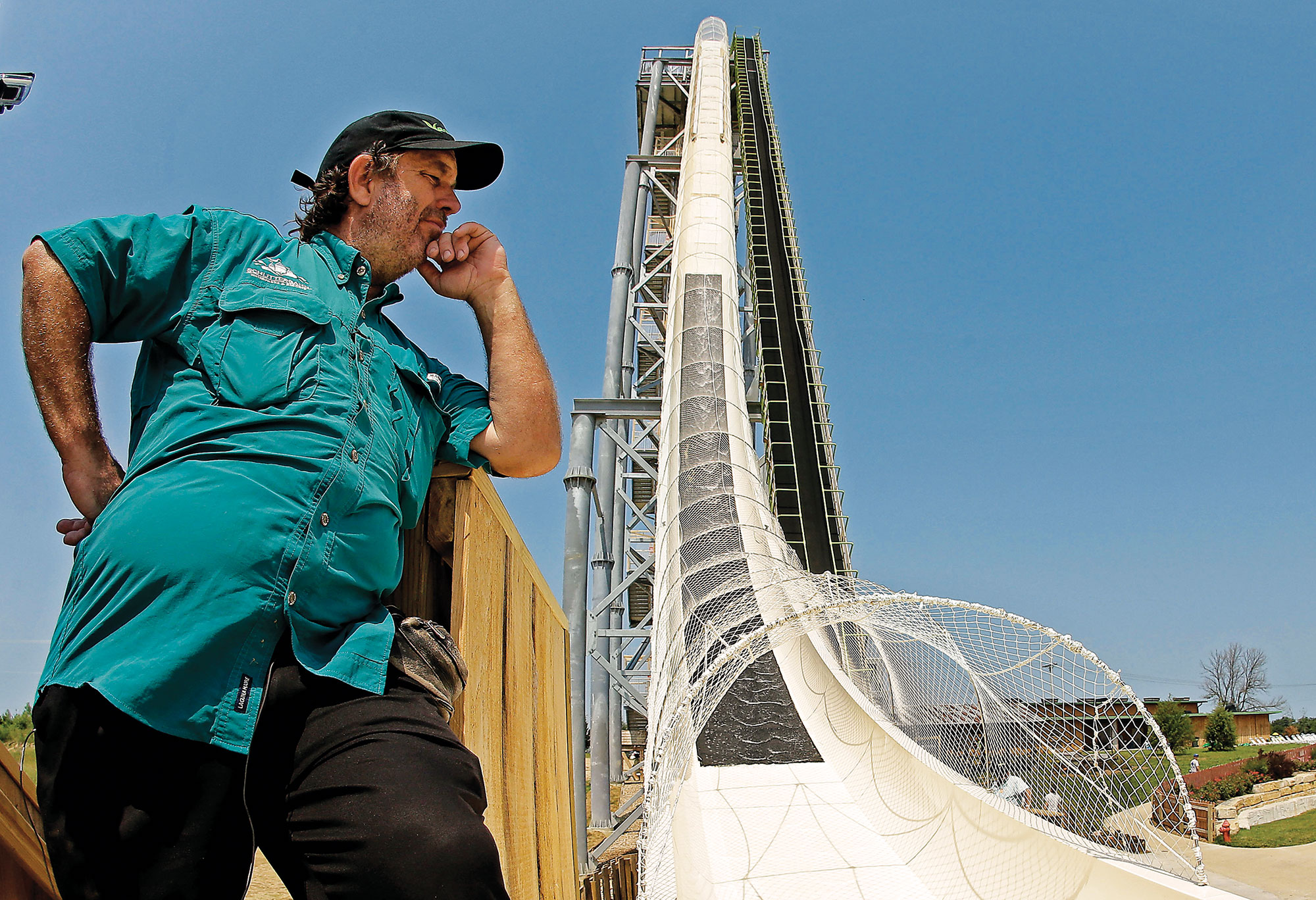
This case is neither. The kid died because the tallest water slide in the world was designed through trial and error by a guy with no experience in physics or engineering.
In terms of real-world testing, not even 100,000 tests (or maybe ~33,300 if each raft had 3 people on it) exposed the problem.
Schlitterbahn ignored and/or attempted to cover up all of these reports, as is documented in the indictment.
[1] https://www.kansascity.com/latest-news/article206611679.ece/...
[2] https://twitter.com/mattdpearce/status/977310924804579329
Case in point, I could have easily drowned as a kid when one of the staff allowed too many riders in tubes to go down a chute at once, creating a log jam at the bottom that I got pulled underneath. The strong current held me underneath other riders' tubes for a good thirty seconds or so until the jam loosened. No one noticed or cared even as I came up coughing and sputtering.
Don't get me wrong, most of the staff seemed to take their job pretty seriously, but in a place as crowded and inherently dangerous as this it doesn't take much for someone to get hurt.
In contrast, the fatality rate of driving in the US is in the 1 in 100M range, so the ride was far more dangerous than driving. That gives a good perspective on the risk.