Anarchism itself is so broad and varied that it resists characterisation. You have the entire spectrum, from primitivists to pacifists to futurists. People who claim that voting in elections is pointless(like many on the Occupy movement) to people who advocate for the lesser evil(Noam Chomsky 'endorsing' Hillary Clinton) to people who advocate for the worse evil(accelerationists)
The one thing that can be said about it with certainty, is that it is seen as "a tendency in human affairs, to question existing power structures". Whether that be the state, religion or interpersonal power relations between race or gender. Much of what we define as "progress" is in reality questioning deep-seated assumptions that seem so obvious that only a fool would question them. In the past, some of these assumptions were things like "It is obvious there are significant difference between races", "It is obvious that men and women are not intellectually equal", "It is obvious that we need a monarch or ruling class to maintain peace and order". Today it is things like "It is obvious that corporations are here to stay and beneficial" or "It is obvious that we need a centralised government to keep order".
One of major problems with society today is that people are essentially told there are 2 positions:
1)You think on balance Government is worse and bloated, and therefore steps should be taken to reduce government influence and increasing private control of resources.
2)You think on balance corporations are worse, and therefore steps should be taken to reduce corporate influence by increasing government control of resources.
Most Anarchists contend that Government and Corporations are undesirable, and that we must work towards some kind of decentralized, federated, non-hierarchical system with free association.
I think in general people need to think more about Libertarian Socialism(https://en.wikipedia.org/wiki/Libertarian_socialism) as a viable alternative to the US/Soviet model, which are more alike than different, as they are both in essence state-capitalist systems. They aren't identical, but fall in a pretty narrow spectrum and incentivise power-seeking. An approach that questions everything on the other hand is the essence of anarchism: a first-principles based method of determining the structure of society.
This is basically the most recent serious anarchist experiment in recent history, and it is not very well know, yet extremely interesting from a governance theory/practice point of view. And, sadly, under attack by a huge power.
Also, a nameclash of "decentralized, federated, non-hierarchical" political systems with decentralized/federated digital systems. I don't see any good reasons why an anarchist ought to choose a decentralized/federated design for an arbitrary piece of software. But I get the sense that anarchists think choosing such a design is an ethical imperative, very often to the chagrin of their potential userbase.
If you think that’s laughable, consider your relationship with Facebook or Google.
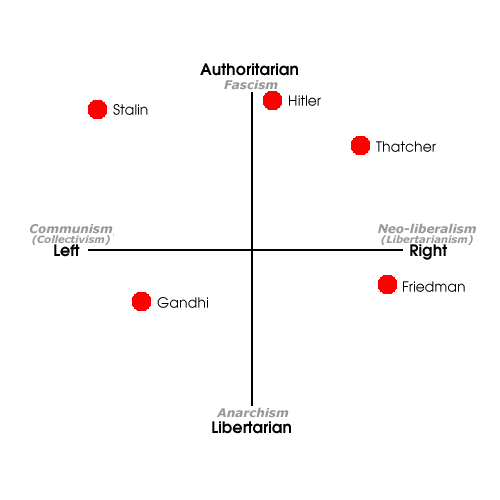
It's worth looking at the political compass https://www.politicalcompass.org/images/axeswithnames.gif to realize that all dictatorships and most of the current "democracies" are very authoritarian.
'Largely based on' is far too strong a term for the relationship between their ideas, after which the connection of the other figures to anarchism becomes even more tenuous.
It is truly a brilliant political ideology, and really hasn't been properly tested as one. It came close in the Spanish Civil War, but this conflict had too many competing ideologies on one side against the fascists, that it was undermined by the communists when it was just starting to show its worth.
Some people who call themselves Anarchists are, indeed, aiming for "collective ownership of [property]". Others are aiming for individualized, self-sufficient control of property (e.g. homesteading).
Everyone sees what they're thinking of when they say "Anarchist", and as long as nobody tries it or fleshes out what they mean by that, everyone gets along because Anarchism is definitely not what we have now.
This is true but its also true that violence (and being maligned for being violent) isn't a new occurrence for anarchism. There were plenty of strands of anarchism that felt violence and other illegal action was justified in order to achieve the aims you set out.
It's mostly a list of things that happened before concluding that the anarchists were completely unprepared for partial success which caused them to fracture and ally them selves with various lesser-of-two-evil factions which further fractured them leading to their eventual irrelevance.
They were exploited and betrayed, but the same could be said for the majority that stayed home and later were sent off to be slaughtered by the power that the USA worked with "against communism". And at the least the CPUSA volunteers had some agency.
Eby's book is good though.
Of course we could say that at the time it was too hard to see, but Purges had already been going on for long, with millions dead in murders and famines, and people knew. Many just chose not to believe.
Good thing that they were betrayed and a very good thing would have been all of them being killed in the war. He who lives by the sword, dies by the sword.
Those guys that wanted revolution should have started it in their own house first.
The Russians managed to acquire millions of dollars of gold reserves from the Republic in exchange for a disappointing array of weaponry, distributed only to their cronies, and accompanied by incompetent military advisors who were more interested in looking good back home than in winning the war. The anarchist unions seem to get more respect, but there's a strong argument that they were militarily ineffective, that their resistance to the Russia-aligned PSUC was destabilising at a critical period, and that the middle of a war against ascendant fascism was not the greatest time in the world to start redistributing land and making enormous social reforms. That's not even getting into Catalan/Basque independence, all the little minor parties, the different police factions, the wave of assassinations that led up the war (though fewer in number and in response to similar assassinations), the immense difficulty of forming a stable government, etc.
Reading into the war gave me a greater awareness of exactly how badly the "good guys" can behave, while in no way mitigating the horrors the Nationalist faction committed.
My grandfather's father and a substantial part of my grandmothers family (her father, brother, ...) were killed by anarchist because they were Catholics and because they were bourgeois (on one side they were a declining industrial family and on the other side they were doctors and pharmacists). They came one night, they put them into trucks and they never came back.
That was their crime, to go to church every Sunday, to be richer than the average, and have studied at the university. So the part of the family that survived had to support Franco, it was a question of survival.
Franco's side did the same with communists and anarchists, so many people had to join radical left-wing militias, more radical than themselves, just to survive.
There is nothing to romanticize about the Spanish Civil war. There were no good guys, it was all chaos, injustice and death all over the place, and today we still pay the consequences of so much stupidity.
Well, each to his own likings I guess.
But you know "missguided" socialists killed people for being born rich and fascists killed people for being born jewish. Sounds pretty similar to me.
As opposed to what, lauding Franco?
Having said that I fully concur with your recommendation of Homage to Catalonia. Amazing book about a pretty amazing time.
It shows the true possibilities for social change and the dangerous forces that can undermine idealism.
But yes, he simply saw only parts of the whole picture, but what he saw, he gave an accurate review about.
But what I wanted to talk about is something the article omits. Basically because it wasn't really known until barely half a year ago, when Sònia Garangou published Les Joventuts Llibertàries de Catalunya (1932-1939), about the libertarian youth in catalonia (JLC from here on), not to be confused with the FIJL, the iberian federation of libertarian youth. Even within the libertarian and anarchist movements, Catalonia had many differences with other spanish groups, and it really went on its own path.
> As late as 1936, the CNT devoted an entire discussion at its national congress to the place of vegetarians, nudists, naturists, and "opponents of industrial technology" in a libertarian communist society.
CNT, FAI, POUM, etc. have always been the highlighted organizations in the spanish anarchist, communist and libertarian movements, but the recent research tells us that in Catalonia, the JLC might have been equally or even more relevant (in those years, CNT had around 550.000 affiliates in all Spain, FAI between 5.000 and 30.000, POUM even less, and JLC around 32.000 only in Catalonia). They were highly organized and decentralized, and besides vegetarianism and naturism, and maybe even more importantly, they were one of the first organizations in Spain to promote gender equality, have many women leading the local and regional groups, and also promoting culture through the creation of local libraries.
I think we will be able to read more about all this in a few years, after more studies and research are done, but for the moment, I thought it was interesting to mention this forgotten fragment of history, that might be so relevant to put the historical events and differences in context.
Nowadays, it's true that the anarchist movements have lost a lot of strength, but even if they seem residual, they are still organized enough and have the capacity to initiate direct action and mobilize people when needed, and the last events in catalonia are good proof of it. We have been seeing a resurgence of small groups of people organized at a local level, and even when it might seem they are organized for a very different reason, anarchist groups and individuals have been highly participative in these processes, as they have historically been with any social movement.
And it's really characteristic that the differences between the anarchist groups from Catalonia and the rest of Spain that we talk about from 85 years ago still happen nowadays. 85 years later, and in Madrid they still don't quite understand what catalans are doing.
P.S. I'm not an expert, so don't take my words too seriously, I'm just giving my opinion on a few points I think can be interesting to better understand anarchist movements in Spain and the influence they still have today.
Do you have first hand information on this claim, or do you asume it was the anarchists organizing it? Because as far as I know, they are not really important there. They do exists and they certainly push things, but I doubt in a crucial way. Most anarchistic groups I met, were rather anachronistic and lived and thought in terminology of the 19. century ... and had as much vitality.
This said, I'm not talking about the rallies from september 11's and those organized by ANC and Òmnium Cultural, which have been the most massive ones. Neither they are the sole organizers of every local action, but they have been actively participating in most.
Most anarchists doing real work do not really talk about themselves as anarchists so much. There's a lot of people that pretend and talk a lot but in contrast do and know very little. That's common and it's easy to be confused by it. Most anarchists doing real work I have met are very wary of letting themselves be identified or put themselves in front of the cameras, both figuratively and literally.
The final conclusion, that anarchists should abandon their theories in favor of Trotsky's, has a bad taste. There was another anarchist-y society, the Free Territory[0] in east Ukraine, which, with its 3 years of existence, was quite successful (for anarchist societies standards). Sadly, it is often unmentioned, though it had even better starting conditions: while the CNT had to struggle with Franco's army (and the support of the other facist leaders), the equivalent reactionary White Army was later defeated by the alliance of Soviet and anarchist troops. They didn't mingle with any local government, and their leader Makhno[1] - though not elected - did limit himself to the militancy. So there was only one part left of the problems of spanish anarchists, as analyzed in the article's conclusion: Franco’s army, the complicity of the PSOE leadership, and the treachery of the Communists–but [also] the betrayal of the revolution by the anarchist leaders. With former diplomatic aggressions from Trotsky[2], attempted assassionations by the Cheka, finally the Red Army took over the Free Territory.
[0] https://en.wikipedia.org/wiki/Free_Territory [1] https://en.wikipedia.org/wiki/Nestor_Makhno [2] http://nestormakhno.info/english/trotsky/ord1824.htm