A cube looks like a square from three orthogonal directions. A cylinder can look like a square from infinitely many directions, but they are all coplanar. Can you find a convex shape that looks like a square from more than three directions, without all of them being coplanar? In particular, can you find a convex shape that looks like a square from two distinct sets of three orthogonal directions? Can you find all such shapes?
Ubj nobhg n grgenurqeba? Begubtencuvp cebwrpgvba nybat gur yvar pbaarpgvat nal rqtr zvqcbvag gb gur bccbfvgr rqtr zvqcbvag tvirf n fdhner, lvryqvat 3 fhpu cebwrpgvbaf (cyhf gurve bccbfvgr pbhagrecnegf). Abg fher vs gurer ner bgure fhpu funcrf (vtabevat gevivny zbqvsvpngvbaf bs gur grgenurqeba) - qvq lbh znantr gb svther guvf cneg bhg?
I wish higher level mathematics and physics paid more attention to the use of visual schematics and diagrams. So much can be communicated with them. Words often pale in comparison.
His procedurally generated videos really make you think of certain math that looked unintuitive or hard to explain in a truly intuitive, visual way.
His series on linear algebra was very eye opening to me, as well as many of his videos about subjects I was initially failing to understand.
[1] https://www.youtube.com/channel/UCYO_jab_esuFRV4b17AJtAw
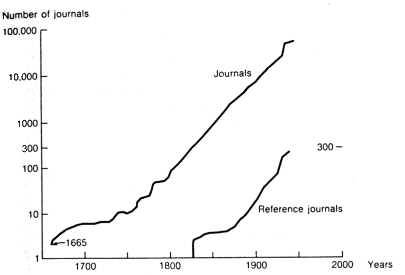
Why do we no longer have Renaissance men/women today, contributing to the sciences, philosophy and the arts? What did we lose?
A lot of the low-hanging fruit has already been claimed, and it's very difficult now for amateurs to make discoveries in mathematics and physics. There are people today doing amazing research, it just takes a career and a team (and in many cases expensive equipment) to do so.
If by "Renaissance men/women" you mean "well-versed/engaged in many topics", well, you just need to open your eyes. There are many folks like this now, likely millions. It was a bit more of a rarity a few hundred years ago, so it was much easier for these individuals to be documented/preserved.
It would have been possible to read every book in existence on mathematics in a lifetime in the 17th century, but not in the 21st century.
In any case, there are plenty of people contributing in a wide array of fields who are alive today. How about Franklin Story Musgraves, who has academic degrees in six different fields, including medicine, computer programming and literature. He also went into space for NASA no less than six times, served in numerous conflicts while he was in the air force, was briefly employed as a mathematician for Kodak, practiced and taught clinical medicine and is/was a consultant for Disney. I found him with the briefest of google searches for "modern renaissance men" :)