I find it very sad that the people that are making these critical decisions that could affect my life are some randomly appointed panel of "experts".
Why should these people in particular have any say in the matter? Or have more say than I do about whether I live or die?
It's also sad how so much of the medical community tries to hand over the ethical decisions to others, and treats their words as inviolate truth instead of thinking for themselves.
> I find it very sad that the people that are making these critical decisions that could affect my life is some randomly appointed panel of "experts".
Two things there—first, they aren't "experts", they're just experts. These are people who had access to the best literature on what is possible and were respected in the field for their opinions. This is evidenced by the fact that the report they issued was not forced upon anyone. The 27 states that issued new definitions of death were not under some external pressure to adopt those definitions. If there was some deep controversy about the report, then it doesn't have to lead to anything. These experts were empowered to do precisely one thing—issue their opinion. That so many states adopted their opinion suggests that it was pretty good.
> Why should these people in particular have any say in the matter? Or have more say than I do about whether I live or die?
If you are permanently comatose, then those experts, by virtue of having thought about the issues deeply and also having viable brain function should have more say than you do while you have no brain function. If you provide advanced directives about what should be done in case of catastrophic brain damage, then that should by all means be taken into account as well.
> It's also sad how so much of the medical community tries to hand over the ethical decisions to others, and treats their words as inviolate truth instead of thinking for themselves.
The medical community does this because they are in an emotionally compromised position. Because they have a relationship with the person their family, they might ignore what is medically possible or likely and attempt heroic measures that would lead to huge expenses and/or lead to an undesirable outcome. Asking dispassionate outsiders for their opinions should improve the overall outcomes. I also would
Just 50 years ago or so "not 'experts' but experts" were practicing lobotomy as a great new cure that would save us all. They had access to the best literature, probably were respected.
There was an article not so long ago here about a IIRC 12 y.o. boy who got lobotomized because his step mother decided that'd be a great idea. Rosemary Kennedy was lobotomized by the same doctor. American health care has always been great.
> huge expenses
Pretty much this.
Only 1-2% should rightfully be put on that pedestal our culture reserves for health workers, and the other.
What makes you think these people were respected in the field for their opinions? I see no evidence of that in the article. They're just described as "men who already knew one another: ten doctors, one lawyer, one historian, and one theologian." To me that doesn't make them any more an expert than anyone else.
As for "access to the best literature on what is possible", who in this era of the internet doesn't have such access? Again, this is no indication that they're an expert.
Then you say that the above qualifications are "evidenced by the fact that the report they issued was not forced upon anyone. The 27 states that issued new definitions of death were not under some external pressure to adopt those definitions. If there was some deep controversy about the report, then it doesn't have to lead to anything. These experts were empowered to do precisely one thing--issue their opinion. That so many states adopted their opinion suggests that it was pretty good."
Legislators pass all sorts of stupid laws all the time, often without even reading them. I don't take the lack of "deep controversy about the report" (if there really was none) to be evidence of anything but just that. The reason for such a lack could be anything from lack of publicity to having hired a good PR agency, to having biased or ignorant legislators, etc.
Anyway, there's a section of the article in which even one of the "experts" admitted that he was being disengenous:
"The commission’s staff philosopher, Daniel Wikler, a professor at Harvard and the first staff ethicist for the World Health Organization, told me that he didn’t think the commission’s theory of death was supported by the scientific facts it cited. "I thought it was demonstrably untrue, but so what?" he said. "I didn’t see a downside at the time." Wikler told the commission that it would be more logical to say that death occurred when the cerebrum--the center for consciousness, thoughts, and feelings, the properties essential to having a personal identity--was destroyed. His formulation would have rendered a much broader population of patients, including those who could breathe on their own, dead.
"Despite Wikler’s reservations, he drafted the third chapter of the report, "Understanding the ‘Meaning’ of Death." "I was put in a tight spot, and I fudged," he told me. "I knew that there was an air of bad faith about it. I made it seem like there are a lot of profound unknowns and went in the direction of fuzziness, so that no one could say, ‘Hey, your philosopher says this is nonsense.’ That’s what I thought, but you’d never know from what I wrote."
You wrote:
"The medical community does this because they are in an emotionally compromised position. Because they have a relationship with the person their family, they might ignore what is medically possible or likely and attempt heroic measures that would lead to huge expenses and/or lead to an undesirable outcome."
Huge expenses? How much is a life worth?
And if the person is already dead, in the eyes of the doctors, what "undesirable outcome" could their measures have?
First, I'd recommend everyone (but especially people like doctors, who are in positions of trust and power) take philosophy and ethics courses so that they're better equipped to understand ethical arguments and make their own ethical decisions, without feeling that they must defer to the judgment of "experts".
Second, on the specific issue of when to end care, I think that living wills (when they exist) should be respected and otherwise the judgment of the family should be respected, though the necessary course of action becomes murkier when, for example, the family is estranged from the patient or can't be reached.
From the perspective of society, even assuming that someone declared brain-dead could be revived -- maybe with some future technology if they just keep the body functioning -- at what cost does it make sense to end the life?
Are there other cases where the unpleasant (edit: was "distasteful) subject of the cost of a life (as valued by society rather than Bill Gates) comes into play?
Each time there is a decision whether to spend some money or not to reduce risk to human life, it puts a monetary value on life.
These decisions can relate to how many doctors and nurses to employ, what and how much medical equipment to buy etc, but also more removed like investing into the reliability of infrastructure, the cost of education to become a doctor, deciding how much to value economic benefit vs. potential harm to humans through pollution, etc.
Each time you decide to spend the money, you put a lower boundary on the value of life. Each time you don't spend the money, you put an upper boundary on it.
Each time these boundaries become inconsistent, you could save more lives by spending money elsewhere.
I really wish society wouldn't treat the subject of the cost of life as distasteful -- more consistent decisions would arguably raise the quality of life.
http://www.paulgraham.com/say.html
It is taboo to plainly talk about the value of human life, yet everybody is making such calculations every day, though almost entirely at the subconscious level.
Consider the following pairs of people. Imagine that you must choose death for one out of each pair.
A sick 90 year old man, a healthy 5 year old child.
A terminally ill mother, a middle aged man in jail for multiple violent felonies.
Your young child, a young child living in South Sudan.
A woman with a lifetime of schizophrenia, an undocumented worker who is trimming your trees.
Your spouse, your child.
These kinds of questions are uncomfortable to consider, and the answers are very personal.
I wonder: are the benefits of such conscious valuations greater than possible downsides?
In any case, I don't know of any modern political system in which this important issue can be addressed directly -- rather than letting each authority silently make decisions based on their own values.
It's also worth noting that the absolute value of people's lives (in terms of what's spent) changes depending on who's doing the spending. This is the same as saying "money is worth progressively less as you get more of it". That's unlikely to make the topic more approachable.
http://faculty.haas.berkeley.edu/tetlock/Vita/Philip%20Tetlo...
Sure, we make those decisions every day. Everything we do has a risk to our lives and others, and we decide if it is "worth it" constantly. You can die playing baseball, skiing, jogging, etc. You can die from being vaccinated. Most deaths are caused by lifestyle choices.
Whenever some outfit says "safety is our top priority" that's marketing, not reality. A 100% safe automobile would never move an inch. You make a value judgement about life in the choice of car you drive, how you drive, where you drive, how often you drive, etc.
That said, this paragraph about Shewmon caused me to basically dismiss his perspective about any of it:
> "When Shewmon was a college sophomore, at Harvard, he listened to Chopin’s Trois Nouvelles Études No. 2, in his dorm room, and the music lifted him into such a state of ecstasy that he had an epiphany: he no longer thought it possible that all conscious experience, particularly one’s perception of beauty, could be a “mere electrophysiological epiphenomenon,” he said. The music seemed to transcend “the spatial limitations of matter.” An atheist, he converted to Catholicism and studied Aristotelian-Thomistic philosophy. He went to medical school, in 1971, and then specialized in neurology, because he wanted to understand the relationship between the mind and the brain."
It seems the main tragedy here is that a family went in for a relatively routine (possibly inappropriate if the apnea was due to obesity) surgery and had their child die. That they don't trust the medical staff after that doesn't seem unreasonable to me, but it doesn't mean the medical staff is wrong.
The determination of death in this case seems less important than the determination of suffering or quality of life.
Disregarding his scientific opinion because he had a conversion experience in college is rather bigoted, don't you think?
Though when he's making statements about the mind and how it could define what 'death' means in a clinical sense, then nonsense like "The music seemed to transcend the spatial limitations of matter" which is contradicted by all existing evidence, reduces my respect for him on that topic and makes me nervous about his scientific/critical thinking in general.
If they can't get that right why would I think they have a good idea about something where there's less evidence that's even more controversial?
Same is true of Shewmon. It calls into question his evaluation of the subject when he's previously demonstrated questionable judgement in a similar - related - matter.
Not that it discredits the work itself mind you - if it's good, it's good - but right now the work seems mostly opinion based so calling into question is biases reaching conclusions on this subject is not only not bigoted and quite valid it is required to have an intellectual rigor.
Again, the work may stand by itself. That's not demonstrated yet however.
You could point to all manner of quantum-woo that uses similar arguments (basically everything from the atrocious What The Bleep Do We Know "documentary" for example).
I couldn't agree more.
Although the case is different, I cannot help but remember Salvatore Crisafulli [1], which went into coma after an accident and entered Persistent Vegetative State (PVS). After two years he showed signs of conscience and was even able to begin communicate again using the movements of his own eyes. What is most striking is the fact that he was able to recall a number of events happened around him while he was in PVS (e.g., the nurses accidentally dropping him while moving his bed) [2]. This happened despite the fact that at the time a number of doctors kept repeating that he was completely unconscious.
The human body is so complex. We can try to gather some knowledge by means of experiments, models and statistical data, but we must realize that the scientific method is a human endeavour and is therefore imperfect by definition. Being a scientist (I study cosmology), I feel deeply embarrassed whenever I hear people professing their irreducible faith in «science».
[1] https://it.m.wikipedia.org/wiki/Stato_vegetativo (Italian) [2] https://www.ibs.it/con-occhi-sbarrati-straordinaria-storia-l... (book in Italian)
Hear, hear! And 'faith' in this case is indeed the right term... I have a similar reaction to those who are convinced there is a bright line between 'hard' and 'soft' sciences. Strictly speaking, you can never accumulate all the evidence.
I have faith in the process of science in that I believe iterative addition to our knowledge based on evidence and ezperimentation is the best process we’ve found to adapt out understanding to changing circumstances and affect outcomes.
Why is that bad?
1) The scientific method will only validate (or fail to validate) predictions that you have made. If you haven't made a prediction about something, or fail to consider other effects, the scientific method often will not reveal those other things.
2) There are a lot of things we understand in many branches of science, but there's also a ton we don't understand. Death is one of many areas where we have a bunch of gaps, and many people don't realize that, or realize that some things that we take as established fact is more like established policy.
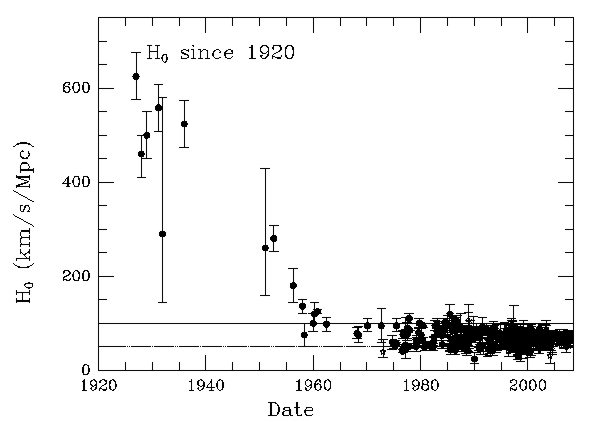
Ignaz Semmelweis' sad story is very telling in this regard [1]; however, since i feel uneasy in talking of the scientific method applied to a discipline (medicine) that is alien to me, I'll present another case. In 1929, Edwin Hubble discovered what would have been called Hubble's law, which was the first strong evidence of the expansion of the universe predicted by Friedmann and Lemaitre [2]. The core of this law is a numerical factor, called "Hubble's constant", which quantifies how fast galaxies seem to recede as a function of their distance.
As year passed, several people improved the estimate of the Hubble constant, which moved from 600 km/s/mpc to the current estimate of 60-70 km/s/mpc. As plot [3] shows, the first estimates had confidence intervals (the error bars around each point) that were far too small: in fact, the best value found so far (70 km/s/mpc) is several sigmas out of the oldest one: therefore, Hubble's original confidence interval was blatantly wrong.
What happened is that Hubble relied on Cepheid stars to estimate distances, but he was unaware of the fact that there exist two groups of cepheids, with quite different characteristics.
When I used the expression "people with an irreducible faith in science", I meant that this sort of people would have dismissed any claim that the Hubble constant is far smaller than the estimate because they would have blindly stuck to the error bars found in Hubble's paper. Salvatore Crisafulli's and this girl's stories are in my opinion like the "true values" falling far out of the currently acknowledged "error bar".
[1] https://en.m.wikipedia.org/wiki/Ignaz_Semmelweis [2] https://en.m.wikipedia.org/wiki/Friedmann%E2%80%93Lema%C3%AE... [3] https://www.cfa.harvard.edu/~dfabricant/huchra/hubble/h1920....
I have to wonder if our conception of death as a strictly one-way street is mistaken. When death meant cardiovascular death, this was reasonable — within minutes, the heart tissue itself dies from lack of oxygen perfusion, and thus this form of death is self-reinforcing.
For brain death, however, are we 100% certain that, given life support over a long enough period, the brain cannot heal from ischemic damage? At least enough to bring basic elements of consciousness back online? If so, it would be possible to be “dead”, and then subsequently “not dead”.
Is there any scientific understanding one way or the other on this?
https://www.newscientist.com/article/dn12301-man-with-tiny-b...
But this is a case where brain tissue is killed/removed over the course of decades, giving neuroplasticity time to work.
I think the 'scientific understanding' would be that there's no such thing as 100% metaphysical certainty. However, that doesn't mean that all bets are suddenly off.
So, we should probably use statistical reasoning and evidence, science-based reasoning of the sort that tells us if there's at least a minimally plausible mechanism where X could possibly work. That sort of thing.
... and, if you're hungry enough for the answers to these -- and many considerably more niche questions -- become a scientist!
Vox, Slate, Salon, New Yorker pretty much all the same, ... except a major difference (that makes it even more annoying). With the former I generally expect utter trash and am not surprised when it is trash, but the latter is trash dressed up in fancy pseudo-intellectualism.
reading Taleb's Black Swan might help also understand some peoples distaste for it: https://twitter.com/nntaleb/status/877259529196642306
If a family wants to keep a brain-dead body alive, it should be their right. However the family is on Medicaid, and the article says the girl's body costs the state of NJ 150K per week for 24/7 nursing care. That's 8 million dollars a year the taxpayers are spending while this family lives in denial.
How many living kids could be helped with 8 million a year in Medicaid funding?
It's tragic to see a little girl die from a tonsil removal operation. And If the McMath family can arrange for private funding for this, then so be it, but millions of public tax dollars are sadly better spent on the living.
Given infinite resources, I would agree: if a life can be saved at any cost, then save it. But we don't have infinite resources. If the quality of other patient care was reduced because of attempts to keep this girl alive (if "alive" is indeed the right term), is that trade off worth it? I'm not sure. I mean, given the extraordinary results they've gotten so far, it's possible that, given more time (perhaps on the scale of decades), she'd get to a point where she'd be able to communicate more richly with people around her. Is it worth spending tens (hundreds?) of millions of (public!) dollars to get her there, especially if other people with better prognoses are getting worse care because of it? I'm not sure I can say yes to that. But I've also never been in a position where a loved one was in dire straits to the point where throwing heaps of money at the problem would help, so I don't know how that feels.
EDIT: To get a feeling for the course maybe watch lecture 14 first which is also quite close to the article. Not that the first lectures are not interesting, quite the opposite, but - at least if my memory serves me well - it takes quite a few lectures to establish and discuss fundamental concepts before the focus really shifts towards death. If you like that lecture, watch the entire course.
[1] https://www.youtube.com/playlist?list=PLEA18FAF1AD9047B0
Not to mention: how will her other children fare under this whole ordeal. In some way her religious attitude has caused her to make a ton of bad decisions. And now to admit that her girl is actually dead is inconceivable. Because then she basically admits that the past years were for nothing. But the sad truth is that in reality, the mother lives in a fantasy world. Her girl is no more and for the sake of herself and her children, she should really move on and find a way - left or right - to come to terms with the fact that although her girl may seem to be alive, she isn't (anymore).
https://www.npr.org/sections/health-shots/2015/01/09/3760841...
I then had minor surgery which required full anesthetics. I was looking at the anesthetist who said "ok, shall we start?" and I tried not to sleep. I blinked and opened my eyes in another room. I had a complete blackout, like if time did not happen during the surgery.
I thought "this is what death looks like". I am not afraid of death anymore. I will just close my eyes and this will be the end.
I reserved judgement on if this child is dead or not... But this makes absolutely no fucking sense for someone whose being kept alive on machines. If you remove the human element and unplug the machines, certainly, "God" will swiftly do his thing.