This author is well known for incorrect predictions, and for not particularly caring about the truth of what he writes:
http://www.businessinsider.com/paul-krugman-responds-to-inte...
By 2005 or so, it will become clear that the Internet's impact on the economy has been no greater than the fax machine's.
His defense was essentially that he writes things to attract attention:
It was a thing for the Times magazine's 100th anniversary, written as if by someone looking back from 2098, so the point was to be fun and provocative, not to engage in careful forecasting;
https://www.nytimes.com/interactive/projects/cp/opinion/elec...
On election night:
It really does now look like President Donald J. Trump, and markets are plunging. When might we expect them to recover? ... Still, I guess people want an answer: If the question is when markets will recover, a first-pass answer is never.
Regardless of what you think of Trump, this statement is hilariously inaccurate.
I might even agree with him, but I don't read articles by trolls as a matter of personal policy.
Other HN users might not know what he has written in the past, so I thought it was a good idea to inform them.
There's no guarantee of quality other than the author's credential and history. If an author repeatedly makes incorrect and outlandish claim, why would you give his future articles the benefit of the doubt?
https://www.quora.com/What-things-has-Paul-Krugman-been-very...
There's nothing in his article. No content. He basically quotes a couple other articles, a personal unsubstantiated anecdote, a "let's talk", and the headline is "Bitcoin is evil".
Article is noise.
Bush Debt: "Not good"
Obama Debt: "Good"
Trump Debt: "Not good"[1]
Anyway, he's entertaining --but not a good prognosticator.
[1]I have not voted republican, if that means anything.
https://en.wikipedia.org/wiki/Keynesian_economics#Active_fis...
Care to provide your opinion on the actual reason he feels it is evil, or are is it knee-jerk Ad-Hominem day on Hacker news?
We're like the richest we've ever been as a society. Even poor Americans are pretty damn rich compared to the past. Even if you want to make an argument about wealth inequality, crypto doesn't really solve that.
The Federal Reserve is actually an extremely responsible body, despite what people claim or what banks that they have no real control over do.
You do not see folks wandering around the tenderloin getting negative real interest rate loans or their businesses bailed out. The economic value to fund the fed's operations comes out of the spending power of the rest of us.
How has the average life experience between the quintiles changed? I think this is something that cannot be so easily quantified, even more so when there's subjectivity involved in the quantification. So for instance it's easy to consider ourselves rich when we do things like look at prices 'back in the day.' A quick search for prices in the 50s gives me $21 [2] for a toaster in 1951. That'd be about $200 today. So, at a glance, it makes it seem like we must be fabulously wealthy for anybody to be able to afford for $10 or $20 what would have been a fairly meaningful purchase back then. But then we get into weird things when we start looking at relative pricing. Another datum [3] there is that you could get a 1958 Chevrolet Corvette for $3631 in 1958 dollars. But wait... that's only about 180 toasters...? In toaster relative prices that'd be like getting a nice Porsche today for $1800 - $3600!
Of course the relative prices of things change over time, and this is something that inflation completely misses. I'd be curious to know exactly how, which is why I think examining a representative lifestyle in the different quintiles over time would be most informative. How much of the representative income was spent on what things? How distant were their remaining consumer desires away from their means? How much were they able to save? What would be the expected economic impact of some sort of emergency? Inflation alone is far too imprecise a measurement to answer these questions or, equivalently, to justify the grand statements it's used to make.
[1] - https://www.fool.com/investing/2016/09/25/how-much-does-the-...
http://www.econdataus.com/fedbal.html
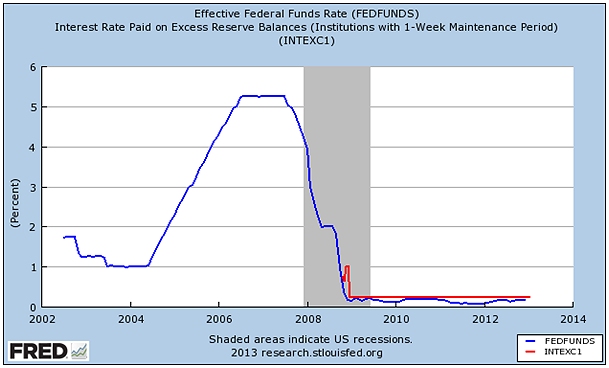
This is the effective federal funds rate:
https://www.frbatlanta.org/-/media/images/education/publicat...
Do those charts really look "conservative" to you?
Well, if that's the goal, BTC with its high transaction costs/low throughput/high backlog is not going to do it. It would be some other CCY. The problem with this is that once BTC is no longer "special" than all crytpo currencies are just fiat money and even if you cannot create more than 21MM bitcoins, you can create unlimited crypto currencies. put another way, set membership is fixed, but the number of sets is limitless.
So the biggest risk from a valuation perspective is if BTC starts to seem less "special".
This economy has gone nowhere but up. Those who are not going up with it are likely being held down by other systemic issues, not because the game is "rigged".
that's a subjective call encodes what things you care about. Look nobody's going to say the median standard of living hasn't increased (although it has stagnated of late), but we don't know what it could have been. How much of the increase in standard of living is due to the economic structure, and how much is due to technological improvement? People aren't starving in the streets when we have a depression-level economic displacement. The fed loves to argue that it's because of its stewardship, but let's be honest, it's because of Norman Borlaug (and the like).
Finally, you can't be sure that the 'systemic issues' that are 'holding down' those who are 'not going up' aren't the factors that causing the rest of the economy to go up.
If you don't think the game is 'rigged' show me where I can get one of those negative real interest rate loan I keep hearing are getting floated to 'keep our economy stable'.
"evil"
As for the Charlie Stross link and the claim that BitCoin is 'designed to damage central bankers' - that depends. It certainly is likely to have the effect of making central bankers more honest. Up until recently there were real consequences to printing free-money but after the 2007 financial crisis it seems central bankers banded together to collectively print money from nothing - it became ok as long as others were doing it too. Well the reality is that printing money does have repercussions and one could well argue that the rise of BitCoin is one such repercussion.
Same with the global attempt to eliminate physical cash - it's all great to go digital but when the central bankers decide they want to force everyone to spend more with negative interest rates it can indiscriminately hurt an average worker trying to save money to buy a home! Same goes for taxation - governments think its easy to raise money by increasing taxation, the offshore finance industry used to keep a lid on that until they were cracked down on - digital currencies can fill that gap.
Now there's no doubt that governments and central bankers might dislike control being taken away from them but to claim BitCoin hurts them is a bit like claiming jails hurt convicted felons... IMO.
To whom is this control being handed? It's not going to be the ordinary citizen; it's going to be the global wealthy plus a few early adopters.
> force everyone to spend more with negative interest rates it can indiscriminately hurt an average worker trying to save money to buy a home
Buying a home on a negative interest rate mortgage could be an interesting experience.
- Negative interest rates are horrible because they tend to impact savers whilst borrowers are typically now subject to a minimum interest rate on their loans.
EDIT: This article is actually from 2013. Around the time Bitcoin went from ~10 to ~1000 USD. I suppose the same was true at that time. Bitcoin was relatively stable hovering around ~500USD from 2014 to 2017.
He's too hung up on this:
BitCoin looks like it was designed as a weapon intended to damage central banking and money issuing banks, with a Libertarian political agenda in mind—to damage states ability to collect tax and monitor their citizens financial transactions.
Stross doesn’t like that agenda, and neither do I
pity
That's exactly why I (and most people) like it so much..
Now somebody may say "That's now but wait until Bitcoin takes over the world." That's a another problem. Global currency or fixing exchange rates is not a good idea (Bretton Woods was a failure). There is thing called optimum currency area. Euroarea is in trouble because it misses many criteria for optimum currency area. They are fixing them now. Without global fiscal union, world government and free movement of labour, global currency and single global unit of account is not a good thing.
As a payment system it's already choking and can't easily move value form one person to another. You need intermediaries and intermediaries between intermediaries to fix the system. If you end up using Visa or Mastercard payment system to pay in BTC what's the point?
I think cryptocurrencies and have a place in the future, but Bitcoin is not it.
There seemed to be a set of fundamentals or values borrowed from existing phonomena and applied to the internet, internet companies, and their potential (for great or evil). These of course lacked the benefit of hindsight and today much of what was said (although well intentioned) turned out to be frankly ridiculous.
I have a gut feeling that in 10 or 20 years we will look back and realize that this new thing has a set of fundamentals all its own. Once those emerge we will be able to have wonderful arguments. Until then I just try to focus on the technology. It’s the only thing I can make reasonable sense of. Let the talking people talk. Let the builders build and let’s just see where this goes.
Crypto currencies like we see now are a new phonomena. We won’t know who the brilliant minds and the fools are until this all shakes out.
https://www.antipope.org/charlie/blog-static/2013/12/why-i-w...
ROTFL. This really describes Krugman well. Of cause bitcoin is "evil" since it limits his ideas of how to "experiment" with money.