Not only will this be more secure, it'll also be 10s or 100s of times more performant.
There have also been plenty of exploits in applications written entirely with native code.
However, to say that browsers are secure is pure nonsense. Browsers get exploited all of the time, I'd argue that this is not as big of an issue as it could be because browser vendors respond to new vulnerabilities very quickly. WebGL, for instance, is still a massive mess in terms of security.
This has lead to some pretty bad hacks. I'm not sure what more you could want really, a vulnerability where people can be punched in the face over the internet?
Great idea! Now show me an application that can be extended in the same way Atom can, that didn't have 30-40 development behind it...
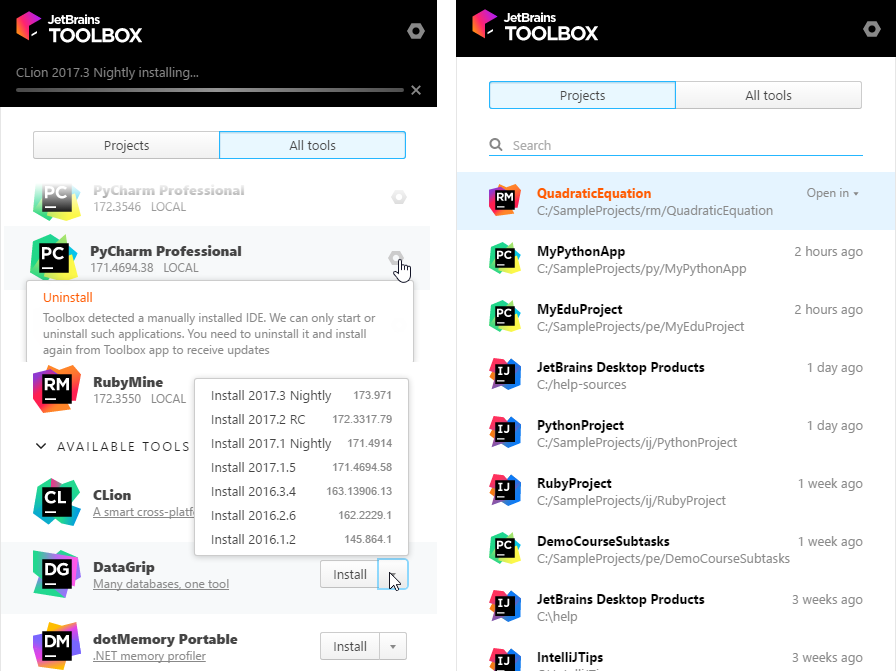
You couldn't be further from the truth. Have you seen the Blizzard app (Qt) [0]? The JetBrains Toolbox app(Qt) [1]?
Also, here's a small app I wrote in kotlin and swing for my GF who wanted to download music from youtube without installing crapware downloaders [2]. You'll notice it has a custom window frame, support for drag and drop, and fully customized table and buttons. I spent about 5 hours styling the UI, and half a weekend writing the entire app.
Yes, I agree, dowloading music from youtube is immoral and illegal, but I'm showcasing the UI so please ignore the underlying purpose of the app.
[0] http://l3.yimg.com/ny/api/res/1.2/v.xvnI7eUsLskyHopY6Kkg--/Y...
[1] https://www.jetbrains.com/help/img/idea/2017.2/rm_py_toolbox...
WxWidgets [0], bindings in: Python, Perl, Ruby, Lua, C++, C#, and others.
Qt [1], bindings in: JS, Python, C++, and others. Also has QML to make things easier.
Tk [2], bindings in just about everything. Included in most Python distributions.
Kivy [3], Python only.
Java/FX [4] Java and other JVM languages.
If your main problem is the duplication effort between the web and an application: Qt is the simple path. Qt includes WebKit. Everything Electron can do, Qt can do, but faster and smaller.
[4] https://docs.oracle.com/javafx/2/overview/jfxpub-overview.ht...
That means I'm stuck with the web browser version of Slack, Skype, Signal (going away), and so forth, which is a shame. But it's better than the security nightmare that is Electron.
I wish developers wanting to make cross platform GUI applications would look instead at Qt. It's extremely easy to use, really fast, and generates great GUIs. It's been around for ages and continually sees updates. Usually people who see the Qt light are pretty satisfied. It can also be used from a wide variety of languages, in case you're not into writing C++.
I sort of suspect that Electron's popularity is due to it being accessible to the hordes of JavaScript developers who otherwise wouldn't have had any clue how to make desktop/native applications. However, do I really want to be running unsandboxed xss==>rce code written by clueless devs? No, no I do not. So, in the end, refusing to run Electron apps turns out to be a somewhat reasonable security posture.
But the rise of web apps, and Electron along with it, have turned the Linux desktop from a "you need to dual boot or use wine" machine into one where all my tools and apps are Linux compatible and have feature parity with Windows and macOS.
I also wish Qt would see more use, I also wish more people would write desktop apps using desktop frameworks when it's meant to be a desktop app, and I really wish people would start writing tiny CLI apps in nodejs and include 70 dependencies. But truth be told, I'm happy to live in a world where I can do 100% of what I do on Linux without feeling like a second class citizen.
I think the "Web on desktop" paradigm is the future, even if it's currently a bleak one. Ten years ago, it was becoming pretty clear that Javascript would be the future, and at the time that was a bleak prospect -- but tooling improved and today, things like Typescript, React, the plethora of incredible development tooling and excellent cross-platform compatibility have turned what used to be bleak into an excellent environment.
There's a lot of improvements that can happen with Electron, if rather than fight it we actually embrace it. Running 10 different web browser engines for 10 different apps may be silly, but what if Electron was global to the desktop instead of included in every fat app?
You'll note that Google has been dipping their toe in that water for years with ChromeOS; Mozilla also tried their version of it with FirefoxOS, which failed for a plethora of reasons that don't undermine the concept at its core.
Basically, JS on the desktop is in the same uncanny valley as it was on the web a decade ago. It's ugly, slow, overwhelming and changing too fast. But there's an end goal there, which doesn't have to suck.
The adoration of Electron apps among Linux users will be the final nail on the year of desktop Linux.
did you mean /s/start/stop/ above?
There really is no competition and any claim to the contrary would need to offer more than a cross platform desktop app.
In fact none can be applied except ease of use and it's about the same, until the app grows and one realizes that the typical JS architecture is as easy to structure as a pile of mush.
Electron supporters are really taking the piss in this thread. Slapping together a bunch of statements which can be easily disproved doesn't qualify as an argument.
Look, let's not kid ourselves, we all hate JavaScript like it's the plague, but no other framework comes even close to the ease of CSS/HTML and a drop of JavaScript for interactivity (transpiled from a sensible language), when it comes to GUI development. It's such a fucking embarrassment working with Gtk, Qt, Tk whatever have you, it's not even funny. Even native mobile dev (Swift/Java) is easier through a web interface, because nobody wants to have to remember that you had to "drag click from here to your source code" or "add this to your xml file to make it accessible".
Honestly, Electron is a shitty resource hog, but it is a trillion miles better than what the current offerings are.
C#/F# would be a great candidate for this kind of thing too.
On the other hand you have JS with a document markup language combined with style sheets.
And the first one is embarassing you say. And declaring UIs in HTML and CSS is easier than in QML.
Why do you even post this. I mean... it's trivial to disprove it. Do you subscribe to the idea that if one makes enough noise their arguments will win out?
Is this a joke? I can't use either of those for more than 5 minutes without wanting to commit self-harm.
it is a very known fact for all unix grey beards (insert more inclusive analogy if you can think any) that containers and fat binaries lead to way more code rot than anything else. and consequently more bugs and security bugs.
I blame this fad coming back on apple. linux and even Microsoft were happy with shared libraries, until osx adopted the bait and switch tactics of Microsoft and got the whole industry by playing the "but I am unix" tune. and with it the whole (webdev) industry was back to fat binaries.
then people started to realize they dont have to find out the source code to patch that old application just because they have to patch openssl or something. they can just release an entire image! and they have no idea they will make it even harder to have a legacy build when that other openssl bug hit. but for now, everyone can be agile and live serverless! and users now have to update the OS, the few shared libraries, and every and each one of their fat binary applications and container images!
good luck with that
The co-inventor of Unix, Ken Thompson, and the Unix team engineer and author of The Unix Programming Environment, Rob Pike, are both big advocates of static linking. They designed Go and made a big point of emphasising static linking. Pike: "Shared libraries are obviously a good idea until you've actually used them. Whether it's obvious or not that they're a bad idea is mostly a matter of how close you are to trying to get them to work." He wrote the first windowing system for Unix, which surely qualifies him as a greybeard.
It doesn't get more "unix greybeard" than Ken Thompson, the original bearded creator of Unix. And his latest project suggests he is pro static linking.
The solution, is to bump the version in the dockerfile, rebuild, and deploy.
This is especially useful when you want to test the latest version before deployment or when you need to deploy to many machines.
Conversely, using a VM and trying to patch it means the updates are not part of the normal development process so you would need to spin up a new VM to test before patching production VMs.
Now sysadmins and developers think differently so this is purely subjective (note I’m a dev), so surely there are merits to the other approach, but I prefer the container approach.
The challenge in language design is to erect the right number of boundaries and barriers, in the right places. Too many, and you get people complaining that they can't write Rust because of the borrow checker. Too few, and you get people vaporising multi-million-dollar Etherum contracts by mistake.
This is disingenuous; the whole browser infrastructure is present to run an application. This shouldn't be surprising because that is exactly what a browser is: an application execution environment.
http://blog.llvm.org/2011/05/what-every-c-programmer-should-...
http://blog.llvm.org/2011/05/what-every-c-programmer-should-...
http://blog.llvm.org/2011/05/what-every-c-programmer-should-...
I guess whitelisting only the things they are absolutely sure are harmless is way more work.
Basically the experience of a web developer every day, no matter how experienced you are.
But it's hard to restrain yourself from doing: allow any (possibly except some) at any stage of whitelisting.
Even to a point of not allowing string of any characters as attribute value.
The way I'm using electron for my pet projects is only passing untrusted HTML to DOMParser and then sanitizing with strict whitelist of attributes/html elements. Only then will any HTML code get interpreted by the browser engine.
Feels somewhat safe, but I haven't read the bug list. :)
Image format decoding and HTTP/TLS/request processing layer bugs may be other source of issues in any case. But hopefully that runs in some restricted environment.
Because end users are soooo good at that?
https://chromereleases.googleblog.com/2017/07/stable-channel... https://chromereleases.googleblog.com/2017/09/stable-channel... https://chromereleases.googleblog.com/2017/10/stable-channel...
- The potential impact of an XSS or other security exploits is much higher. You can limit the impact of most of these with additional layers of security, such as running untrusted html in isolated environments with node integration disabled. However, also remember that...
- Many security features are opt-in. Content security policies (CSP) are a good example. Pages without a CPS default to allowing anything, which sort of makes sense in browser world for backwards compatibility, but is not a good idea for desktop apps.
The title literally says "from Markdown to remote code execution" what else were you expecting?!
It shits me that it is a research task with all the attendant uncertainty about whether or not I did in fact make it secure.
I do appreciate that security is complex and even such a document would not guarantee security, or that you had not somehow created your own security hole, but I just want to do the very best possible effort at security and currently that is too hard with Electron.
UPDATE: this post has led me to attempt to redesign my application to not use Electron. I just can't afford some misconfiguration or coding error leading to user machines being cracked.
But if the user is already downloading your package, why bother with an exploit? You’ve got all the permissions allocated to packages (which I imagine are most permissions). You can just execute the malicious code directly from the package.
Edit: nvm
> So a malicious attacker would just have to register a bunch of malicious packages for every letter or offer a few packages with similar names to existing ones. As soon as someone clicked on the name to see the full entry (not installing it!), the malicious code would already be executed.
Wonderful :)