Apple-earth collisions primarily radiate apple sauce, black hole mergers primarily radiate in gravitational energy.
Minor nit: In general relativity black holes are not actually comprised of matter---they're entirely warping of spacetime. Whether that remains true in a quantum theory of gravity is unknown.
In modern gravitational physics you can treat components of the Einstein or stress-energy tensors as like these energies, e.g. for a family of observers, the apple-breaking kinetic energy is like the pressure components (T^ij, i=j, i!=0 ~ \gamma mv^2) and mostly in T^zz or T^rr or whichever, depending on one's choice of system of coordinates. However, simply by changing frame of reference, at each point where we find the apple/applesauce transition we can shuffle the whole of T^zz into one or more of the other components in G = T (keeping that relation invariant), and it is really stretching things to suggest that a change of coordinates is a process in the sense of the question in your first sentence.
> In general relativity black holes are not actually comprised of matter---they're entirely warping of spacetime
Well, that's not true of stellar collapse black holes; whatever you want to make of the trapping surface / apparent horizon, it encloses matter that existed before that formed. You don't need quantum anything, or even any future infalling, to deal with the fact that there is real matter inside at the time of formation.
The Schwarzschild vacuum solution is matter-free, but then astrophysical black holes of all masses and all origins generally do not truly source the Schwarzschild metric, just a usefully close approximation.
What you can say is that whatever's inside a black hole, eventually it will bald all its "hair" and can be effectively described (by an outside observer) at any point in time in terms of its spatial position (3 components), linear momentum (3 components), angular momentum (3 components), electromagnetic charge (1 component), and mass (1 component), with any other features irrelevant in the Kenneth Wilson sense. That is, eventually it doesn't matter whether it was all neutron degenerate matter or whether there were some other particles inside the horizon when it formed, but there was some matter there: the apparent horizon around V616 Monocerotis didn't just pop up spontaneously far from any matter.
Quantum gravity only matters if you want to make guesses about what state the matter is in within the horizon (assuming you're unhappy about it inevitably being crunched into an infinitesimal point as in classical General Relativity), or about what it looks like when during evaporation the horizon retreats far enough to expose that state. I'll assume you favour keeping unitarity in any solution to the AMPS firewalls problem, and would happily ditch the apparent validity of the EFT outside the horizon. :-)
In addition to that, the ultimate merger of the black holes releases the incredible amount of gravitational potential energy that existed between them when they were separate bodies.
No mass escapes the event horizon. These are black holes after all :)
OK, that makes sense (for whatever that's worth).
But from the article:
> ... the latest discovery was produced by the merger of two relatively light black holes, 7 and 12 times the mass of the sun ... The merger left behind a final black hole 18 times the mass of the sun, meaning that energy equivalent to about 1 solar mass was emitted as gravitational waves during the collision.
And you say:
> the ultimate merger of the black holes releases the incredible amount of gravitational potential energy that existed between them when they were separate bodies.
I think that I get it. It's just that the stated masses of the merging black holes (7 and 12 solar masses) include gravitational potential energy. So the rest masses of the black holes didn't change, just their gravitational potential energy.
Yes?
This is an excellent question, although the formal answer is essentially "mu", or alternatively in some useful approximations of General Relativity we have a research project along the lines of "what is the mechanism that generates the (final) metric of merged black holes?".
I'll try to give you a more useful answer.
The important things are that we go from observables relating to a periodically perturbed near-Schwarzschild spacetime sourced by the inspirallers (this requires us to remove other contributors to the "true" metric, so we're left only with the contributions from the inspirallers) to a much more stable near-Schwarzschild spacetime. The energy-momentum density implied at the origin before merger is higher than that afterwards. So we can ask your question: where did that energy-momentum go?
Ultimately the search for an answer comes down to making a few choices about how to describe a collection of values that appear at various points of interest in a (nonvacuum) spacetime solution of the Einstein Field Equations of General Relativity that survive a degree of calculational simplification.
A more technical response is that by choosing how to split spacetime into space and time, and by choosing to represent spacetime curvature at every point in space (for a slice of spacetime that all has the same time coordinate) as a perturbation of a fixed background metric, one can treat changes in the metric as propagating like massless waves. This is easier when the masses sourcing the metric move slowly compared to the speed of light, and when one is dealing with the increasingly-flat metric far from the source (at least tens of wavelengths from the inspiralling objects), since one can then use linearized gravity. So we're in fairly good shape far from some black holes (or neutron stars) embedded in a galaxy a few million light-years away.
One can then decide that we are not obliged to treat the perturbations as being exclusively sourced by matter, that is, the propagating gravitational waves can induce a squash-strain on matter. With some further choices of gauge and a change to a formalism like linearized gravity, one can treat some components of the two relevant tensors (the Einstein tensor G and the stress-energy tensor T) as representing specific forms of energy, with some (e.g. kinetic energy or angular momentum) being dumped into others (e.g. gravitational potential energy).
General Relativity has at its heart a relationship between matter and spacetime curvature. The former contributes to the stress-energy tensor (T) mentioned above. The components of the tensor relate to the flux of momentum-energy between a point p and its neighbouring points in the four spacetime directions. While the tensor value itself is the same for all observers, the values of the individual components (e.g. the numerical values if you write the tensor out in 4x4 matrix form) depend on choice of coordinates, different observers have almost total freedom when it comes to choosing coordinates. Spacetime curvature is represented by the Einstein tensor G, which is a non-linear function of the metric tensor g. Omitting constant factors and indices (which range from 0 to 3 for each of the four dimension of spacetime), we can write the core of General Relativity as G = T. That is, spacetime curvature is totally determined by matter. For example, G = T = 0 is the case where there is no matter, and thus flat spacetime; that's the spacetime of Special Relativity. When we add any matter at all, we deviate from flat spacetime, however because the contribution of small amounts of matter to the stress-energy tensor is small, it can be very hard to distinguish between true flat spacetime and very very slightly curved spacetime.
While in general it is convenient to think in terms of G = T -- the Einstein Tensor and thus the metric is totally determined by the configuration of matter -- there is a history of vacuum solutions of the Einstein Field equations in which G != 0, T = 0, that is that there is spacetime curvature even without matter being present. An early example was the Schwarzschild vacuum solution ("Schwarzschild spacetime"), which is perfectly spherically symmetric about an eternal gravitational singularity. Some study revealed that for a perfectly spherical uncharged unrotating arrangement of mass gives you Schwarzschild spacetime at a bit of a distance from the mass. For slight deviations from this perfect arrangement of central matter, we still get something very similar to Schwarzschild at a sufficient distance. Indeed, if one goes to enormous distances, Schwarzschild-like spacetime also starts to look like flat spacetime -- it's "asymptotically flat".
We can then ask: at a sufficient distance from a pair of inspiralling objects, is the spacetime very similar to Schwarzschild spacetime? The answer is almost "yes". If you consider these objects as if they were a barbell with an infinitesimally thin handle connecting the two weighted ends, and tumble the barbell around the middle, to a chosen distant observer stationary with respect to the centre of mass of our inspiralling objects, sometimes sometimes one or the other weight will be spatially closer. When the observer is trying to figure out if it is in Schwarzschild spacetime or something else, and using Schwarzschild coordinates, the changing proximity of the barbell ends compared to the centre of mass will become apparent.
If we go back to my fourth paragraph, the observer can make a choice to consider the local measurements of the true metric compared to his or her wristwatch or atomic clock, and a further choice to compare that with the Schwarzschild metric. There will be a periodic change in difference from the Schwarzschild background, relating to the orbital period of the inspiralling objects sourcing the true approximately Schwarzschild metric.
Near the end of the inspiral, the "up and down" of the measurements of the metric they source follows a predictable evolution as the orbital period increases until the objects inevitably collide. The relative deviation from the perfect Schwarzschild metric also increases prior to collision. But after the collision the waves cease (the collided entities settle into a configuration that is much more like the perfect uncharged non-rotating sphere that would source a true Schwarzschild metric, a process called "balding" if the end result is a black hole (with perhaps some debris around it, depending on what the inspiralled objects were). Inevitably, measurements will show a greater Schwarzschild distance from the mass, or equivalently, that the source of the new "truer" Schwarzschild-like metric has less mass-energy at the origin of Schwarzschild coordinates than was in the pre-collision configuration.
We are pretty free to interpret these observations. Generally there is no reason to invoke any local magic rather than suggest that the reduction of energy-momentum is exactly balanced by the increase in the perturbations from Schwarzschild that all possible observers would record, and look for evidence of that.
Finally, how does one measure the deviation from a background like a Schwarzschild metric? Well, one option is to do it in the style of the https://en.wikipedia.org/wiki/Cavendish_experiment . Another is to use interferometry, LIGO and Virgo (and so on) style. Either way, the measurer is looking for a little change in the arrangement of matter "here-and-now" correlated with the big change in the arrangement in matter "there-and-then".
With some deliberate choices one can think of the change "here-and-now" as being various types of energy from "there-and-then" carried to us by gravitational radiation from the source, and calculate robustly on that basis. That picture holds up pretty well under detailed analysis given current experimental results.
Although this invites all sorts of analogies or statements like "spacetime is plastic" or "gravitational waves are real in the sense of being observer-independent", those are big stretches of the theoretical underpinnings (i.e., General Relativity). All we have is a metric that covers the whole of spacetime -- all points at all times -- that we can slice up so that we can think of the value of the metric changing over time. But generally different observers will prefer different slicings, and for a family of observers any inspiraller will shed no gravitational waves at all [consider a diagram BHA ---- x ---- BHB where x is an observer at rest at the centre-of-mass of a pair of black holes in a mutual circular orbit; x will not measure any gravitational radiation under any spacetime slicing]. So they are really a gauging effect. Conveniently, when one turns a gravitational wave into a bunch of particles, one finds that the particles almost certainly have to have the characteristics of a gauge boson.
And now I'm out of space and time. :-) Hopefully this was helpful, or at least somewhat interesting.
I wonder if one would experience any macroscopic effects from the gravitational waves if one were close enough to the black holes during the merger. Or would one have to be so close that tidal effects from the black holes' gravity would mask any of those effects?
I ask because one solar mass worth of energy sounds like ... a lot. At least to me as an astronomical layperson.
[1] https://www.reddit.com/r/askscience/comments/45n0sz/how_clos...
EDIT: What I meant to say was: It would probably be quite awesome to experience such an event up close, provided it is possible to do so safely. ;-)
https://upload.wikimedia.org/wikipedia/commons/thumb/9/91/Ca...
You'd effectively turn yourself into one of the grey "M"s and record the tugs and jolts you feel as you attempt to keep stationary (with respect to distant stars) above the inspirallers.
If you try to keep a fixed orientation and appparent (to you) distance between your navel and a distant galaxy, you will be pretty busy with your rocket pack if you are fairly close to the rotating system (the period of the tug you feel is driven by the orbital period, which in turn determines the frequency of gravitational waves).
Other observers are generally unlikely to agree with you about your navel-to-galaxy distance and orientation among other things (e.g. close in you may have a unique idea of the orbital period for sufficiently massive black holes), but General Relativity lets one be solipsistic if one wants. :-)
Now continue to imagine the red "m"s as black holes and the point at which the torsion wire connects the bar approximately corresponds to the centre-of-mass of the system. That's not quite right, but you can imagine that there is an invisibly thin bar -- or better still a slowly contracting spring -- connecting the two black holes, and that an imaginary torsion wire or pole could be kept perpendicular to that connection, and that you could float at the point the torsion wire connects to the bar. Your jetpack would not be very busy in that case, at least not until the black holes were almost in contact.
Finally, there's a gotcha here. The linearized gravity formalism that is used to study gravitational waves is only reliable (or even sensible) in the far field, which is no closer than some tens of wavelengths from the rotating system. The gravitational radiation (strictly speaking, the change in the metric under a particular splitting of spacetime into 3+1 space and time) propagates as a massless wave, so goes at the speed of light. So unfortunately near the end of the inspiral, if you are close enough to notice a relatively high frequency periodic tug, you also are also very likely in the near field limit, and have to do some exceptionally tricky solutions of the full field equations with all their glorious hyperbolic-elliptic nonlinearities in order to make robust predictions about your experience.
(Lots of theorists would love you to jot down your observations in great detail, though; we can figure out an approximate solution if you ever return. :-) )
Was it all emitted as gravity waves? Given the forces I'd assume that some of it may have been emitted as radiation (acceleration/heating of any surrounding matter etc). And I'm waiting for someone to prove that something might even escape from either of the holes during the final spin. There must be a moment where the two event horizons balance each other out + spinning = potential for very strange things. Maybe, like two bubbles merging, some smaller holes could have pealed off.
It’s a ridiculously large amount of energy. Someone might want to check my numbers, but a standard candle Type 1A supernova releases ~2x10^44 Joules. 1 Solar mass energy is equivalent to roughly ~2x10^47 Joules. So this black hole merger is about 1000x times the energy released by an ordinary supernova. And there’s nothing ordinary about a supernova, pace https://what-if.xkcd.com/73/
One would need to be very close to the merger to experience any macroscopic effects from gravitational waves alone, if at all. Spacetime is very stiff.
I wonder if this would give us any insights w.r.t. matter and its distribution across the Universe, and/or help us better understand/estimate dark matter/energy.
http://4.bp.blogspot.com/-jnY74NBc7ic/V2UcuCswL-I/AAAAAAAAB7...
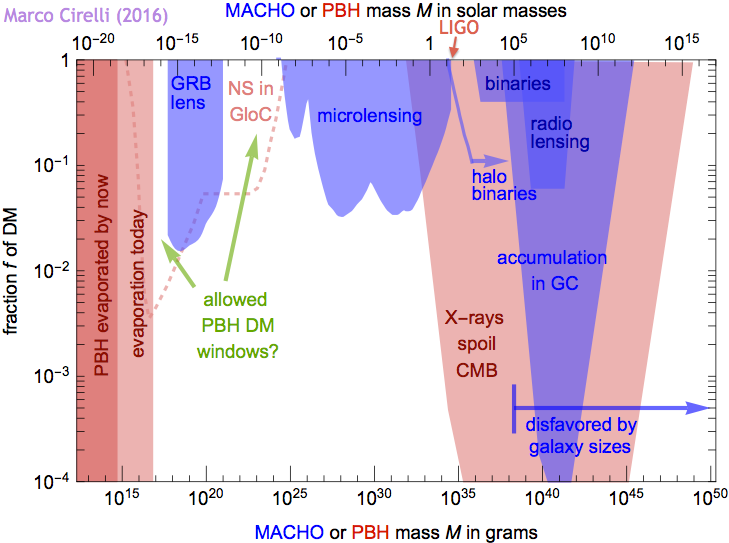
The odds are still very low on MACHO's as a source of most dark matter.
Presumably a sudden mass-energy conversion of said kilogram would generate a sharp gravitational wave. Assuming someone went back through LIGOs algorithms to fine tune them for such a detection, doesn't it seem plausible that it would be able to do so? And presumably even locate it?
Still, 1kg has a field strength that's 5 orders of magnitude greater than a solar mass a billion light years away...10mg would be in the neighborhood.
If i didn't screw up the math, that's ridiculous.
Damn. That's something like 179 100 000 000 000 000 000 000 000 000 000 000 000 000 000 000 J
That's an insane amount of energy. It's equivalent to what you would get if you converted the entire mass of the sun into pure energy.
This was a couple of days days before Virgo got online AND one of the Ligo detectors was undergoing a noise modelling test (its mirrors were being vibrated at the time)
https://notebooks.azure.com/roywilliams/libraries/LIGOOpenSc...
Click Clone to get your own copy, then edit/run/etc.