If anyone else was saying this, was showing these graphics, you'd think it was just wish fulfillment; a fantasy. And I'm sure their timeline is a bit aggressive. But I fully believe the SpaceX team can do this.
This has made me feel inspired for the future almost more than anything else has in recent memory.
(For context, and to the doubters, I've been following SpaceX for a long time, through their many failures, and they've already revolutionized the space industry. They have a drive and a vision and they're just going for it. This isn't about profits for them, it's about pushing humanity forwards -- and if that sounds grand, it's because it is.)
I think a lot of people feel the same way about Elon. He's not overpolished, rehearsed, or manipulative...it's just honest and unapologetic.
Not Elon specifically, politics would only get in his way, but inspiring yet pragmatic visionaries... willing to make mistakes, challenge common beliefs, and build the future.
As in, it's not as marketable. It's doesn't seem like it's been a style of preparation for a pure sales/marketing kind of pitch.
Kind of interesting, in my opinion.
Completely agreed that it's raw in a good way -- you can tell he really has technical detail down too, I noticed one of the times when a slide left too early he still knew the numbers that had been on it. Also he has an understated sense of humor ("mountain").
I also sometimes got the sense he genuinely was in awe at what he was seeing. Like it still took him by surprise. It was interesting to watch.
> It's not as crisp/polished as Jobs' presentations were
All this said, I wish there were a Jobs-like figure to sell SpaceX. I'm sure there are people who'd disagree with me on this, but I can only imagine how popular/well-known SpaceX would be if they had someone who could pitch to the general public. SpaceX keynotes could be tune-in television with the right person, but it'd have to be someone really tied to the company, I don't think you could hire someone to do this. It'd have to be authentic.
The slides were not in sync confusing the audience. Not knowing when to clap, made it really uncomfortable.
He seemed to just drop stuff randomly without a narrative thread. When he showed the BFR/ITS for the first time, he had a much clear threwline, even while rambling in between.
Going to space is fun and exciting. The future of space travel is going to be interesting, but it essential that when we imagine the future that we do so while recognizing the glaring problems of today.
So while your sentiment is fine in a vacuum, I don't think it fits on this thread, and it's certainly not a sound criticism against advancing space colonization. In fact, there's a sizable sentiment that this planet is beyond saving due to political failures, and colonizing other planets is the only way for our species to survive.
Progress is not made by politicians, it is made by engineers. If you want clean water for all humans, you should be supportive of discovering new stuff.
For example, for humans to survive in hostile environments on other planets we need to create new innovations and that creates a big incentive to figure out technological solutions to hard problems.
Turning salt water into drinkable water is one, this one is actually already solved and being implemented across different countries and if we can improve that and make it cheaper we will have solved the problem of water already.
How come this argument only gets dragged up when we’re talkign about space, but not when we’re talking about movies, holidays, computer games, etc. It just seems weirdly disproportionate.
Having a civilization that can use resources from space will help earth as well.
Are our efforts of colonizing space a detriment to our efforts to keep earth habitable?
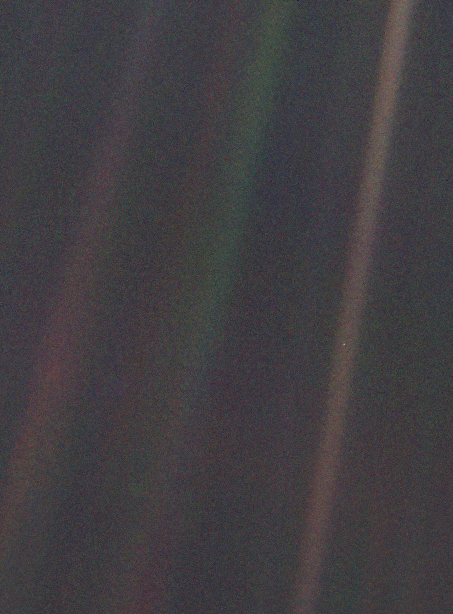
Or, "Pale Blue Dot" from Voyager 1: https://upload.wikimedia.org/wikipedia/commons/7/73/Pale_Blu...
Space exploration has given us some of the most profoundly transformative new views of life on Earth, giving us a greater appreciation and a greater understanding of what Earth is, what its value is, and informing our relationship with Earth. Mars colonization will be no different, I suspect.
Not only will it help crystallize our self-conception of who we are and what we're about as a species, it will provide a greater clarity on what it means to create proper "living conditions" here on Earth. On Earth it's easy to take things for granted. Which sometimes means we also allow progress to stall because we perceive things as being just "good enough for now". A lot of that will change with Mars colonization, and for the better I think. On Mars they won't have clean air or clean water without putting in a tremendous amount of work to create them. Which they will do, of course, because the alternative is to live without them, which isn't reasonable. But consider life back here on Earth, where we take our air and water for granted. Where we can approach the issues of a lack of clean water or air in a lackadaisical manner, without it being the highest emergency priority. And that's true not only in the developing world (India or Sub-saharan Africa) but also in the midst of the developed world (the lead tainted water in Flint and elsewhere, Victoria, BC in Canada flushing its toilets directly into the Ocean, etc, etc.) And the way we treat environmental issues as something that our grandchildren might have to finally get around to sorting out, but not something to actually begin tackling right now today.
Imagine what it's like on Mars where the starting condition is a bare rock with zero trees, zero rivers, zero lakes. Will Martians plant forests, will they create lakes and rivers? Of course they will. That'll be one of the first things they begin doing. And those things will be precious treasures to them. Just as with air and water, that simple act will help remind us of the natural treasures we exploit and take for granted on Earth rather than preserve and cherish.
Additionally, the technologies developed on the path of Martian colonization will have immanent applicability to Earth. The BFR alone is a perfect example of that, suitable not just for Mars colonization but also for Earth satellite delivery, and point-to-point travel, among other functions. Colonists will pioneer a lot of new techniques and a lot of new technologies for their own unique needs. But I think we'll find that while those needs are unique, the advances they make will have a lot wider application. One thing that will be necessary on Mars is figuring out how to build stuff using a minimal base of machine tools and industrial infrastructure. That sort of cost/complexity reduction will be just as applicable on Earth. As will figuring out how to use advanced machine tools (CNC, 3D printers, laser/water cutters, etc.) to their maximum utility. Growing high yield crops sustainably. Achieving high efficiency of recycling. And on and on.
Musk's stated goal is $500k/ticket to Mars.
It's a shorter trip, so perhaps ~5x as many passengers in the same volume (i.e. 500 total; cf. a380 which seats 850).
It takes five (?) orbital refuel trips for the martian journey, but we'd need none of those. Depending on how much less than a full tank the passenger vehicle needs (payload could be smaller; the ship would also not reach fully orbital velocity), the fuel cost would be between 1/5 and 1/10 the Mars fuel cost.
So that would bring the cost down to between $10 and $20k/ticket, within reach of business travelers.
If maximum the number of flight cycles per vehicle is greater for Earth-to-Earth trips than for Mars, then that could further reduce the ticket cost. It's unclear to me which direction that number would go-- Earth's atmosphere is much thicker on re-entry, though the velocities will be much lower than an interplanetary re-entry. Since aerodynamic drag goes as the cube of velocity but only linearly with density, I'm guessing the speed would matter far more. That would imply much better lifetime on Earth.
So if the E2E fuselage gets (conservatively) only 2x as many flight cycles as a Mars trip, that could bring down the per-seat cost to $5k-- now getting close to the cost of an ordinary international ticket. Of course this is all assuming that Musk's baseline of $500k to Mars is reasonable.
Would be curious to hear from some rocket engineers about these guesses at the numbers/efficiency.
Not accounted for is amortized development cost for E2E-only vehicles, as well as all the infrastructure and ground support at the destinations.
Edit: If you wanted to be less conservative, you could pack in 1000 people instead of 500 (0.5x ticket price multiplier), or use a different source for the Mars ticket price (0.4x), which would bring it to $1k.
So it seems a bit premature to concern yourself with interplanetary ambitions before we are even sure if we can maintain our own planet (which is, and will remain for an extremely long time, the only place for autonomous life in space that humanity has).
Then again, maybe I'm nitpicking since it's not like Musk demands the whole world to commit its resources to his ideas. If he wants to play around with adventurous Mars trips that's fine.
Edit: Of course I'm also aware that Musk is still using his money better than many other wealthy people, so more power to him. This comment was mostly about space exploration vs. sustainable life on earth, all other things being equal.
- a submarine
- the middle of Death Valley
- the middle of Antarctica
- the (completely lifeless) top of mount Fuji
Living in a Mars colony would be a combination of all these experiences.
If you somehow have the magic sauce to make Mars enjoyable, you could offer this experience in the middle of the desert as well. You could tackle real habitation problems on this planet.
Just building a couple school buses (ISS) to float around the Earth took hundreds of billions.
And to the "what about nuclear war on Earth" argument: are you going to build a lightbulb factory on Mars? Semiconductor fab? Smelter? No Mars colony would be self sufficient for a realllllly long time
EDIT: Earth 2 Earth is interesting, though I don't know how you solve the vomit problem. Or the "sometimes the rockets explode " problem.
Neither of these statements are true. It's only a question of money, and money spent appropriately. Musk is demonstrating both of these.
As soon as we have a self-sustaining base on Mars, we're multi-planetary. There have been enough experiments to show that a man-made self-sustaining bio-sphere is possible. If Musk's timeline happens, this could be easily within a century, if not decades. To quote a phrase, 'necessity is the mother of invention'. It's likely that settling on Mars will drive the science and research that will solve these problems.
As for interstellar travel, that's well documented elsewhere on the web. It's doable, now, with current technology, without humans, but is massively expensive. And we don't know where to go. Once we do, it's just an engineering challenge for Musk V2 to solve.
He calms down when he starts talking about risk and it being the anniversary of a launch.
edit: Good and fun presentation regardless!
edit2: Thoughts:
- Maybe he feels in over his head. The timing when he relaxed seemed to coincide with talking about a previous experience that might have felt overwhelming at the time but paid off.
- Maybe he typically takes beta blockers or something for speeches and take them until late this time (the talk did start late)
- Maybe it's just random.
Any spacex watchers have thoughts on cause?
edit3: Definitely not a diss. Love Elon/SpaceX/the vision.
The talk was on the 9th anniversary of their first successful launch, which basically made SpaceX possible.
Clearly no gamers in the audience, I died.
Also weird to think about the long-term implications of Earth's resources leaving Earth permanently/irrecoverably.
- Government/intragovernment contracts to cleanup space debris.
- Government/Private satellite launches.
- Earth to earth transportation which Elon announced on Instagram that the cost would be comparable to an economy fare. https://www.instagram.com/p/BZnVfWxgdLe/
- Transporting gear for ESA's moon base plan http://www.esa.int/About_Us/Ministerial_Council_2016/Moon_Vi....
- Transporting Government/Private equipment to Mars.
This is very much a realistic business approach compared to last year's vision presentation.
The original space shuttle had a 40% vehicular failure rate. The SpaceX Shuttle need to have commercial airline rates of failure and reusability. That's a big step up.
You know the way we still have 80 column terminals because punch cards had 80 units?
The decisions SpaceX make now are going to become space-faring standards for decades if not centuries to come.
Additionally with the entire flight being automated, what happens if the software gets taken over in space and they just drop it like a rock onto a city? The damage would be catastrophic. We need Elon to invest in city wide force field technology too it would seem.
OTOH, what if terrorists gain access to that system?...
You have to gather the people, check them in and clear them during internation flights. Then you have to load everybody on a boat, ship them to the platform X miles into sea, unload them, take them up the big tower, letting them board and settle and depending on how predicatable this is, wait for clearance to take off.
Now is the short flight.
And afterwards we can do the entire thing in reverse.
Some things might be a bit more optimized, like perform customs, safety instructions etc during the boat trip. But the entire trip from arriving at the sea/space-port until leaving it at the destination would probably be making this a diminishing returns and only really interesting for the extremely long flights.
- Get everybody on a boat in NYC harbor with ferry level security (i.e. not much)
- As the boat is travelling to the platform, perform the more thorough check in, any security scans, etc. Everyone simultaneously straps down in their seats, last minute toilet runs etc.
- Slot the passenger capsule into the rocket like a cartridge and take-off immediately at arrival. Plot twist: the capsule was on the boat. Passengers might not even get to see the rocket.
If this were to happen I would imagine it to not be a capsule, but simply entire rows of chairs.
The main killer would still be the whole transit between the harbor and the rocket, but this could probably shave about half an hour.
That's not saying there is no market for something like this, but for anything but the longest flights it's going to be a very specific kind of customer.
> Fly to most places on Earth in under 30 mins and anywhere in under 60. Cost per seat should be about the same as full fare economy in an aircraft. Forgot to mention that.
1. You can't leave your seat. Very high seat density.
2. No restrooms.
3. No food or any other services.
4. Very few (if any) cabin staff.
5. Fully automated flight; perhaps no pilot.
6. More reliable flight schedule; only a small bit of earth's weather on either side of the flight matters.
Personally, I'd put up with a lot if the whole flight was <40 minutes.
On the other hand, the vomit. So much vomit. :(
The ticket is worth much more than economy!
Makes him feel more authentic. Like an engineer talking about his stuff, not a marketing guy
I think the dreams of being multi-planetary are similar to buying doomsday bunkers in New Zealand. I see it as a desire to escape the problems of earth.
I would ask a question to Anjum Choudhary, "If there is a colony on Mars, and your ideology got hold of major countries on Earth, would you try to convert those on Mars?". I think the answer, undoubtedly would be yes.
Humanity has much to resolve on earth, if we go multi-planetary before we reconcile then all we would end up doing is make our problems multi-planetary.
Unless few people escape earth and destroy earth so that there won't be anyone following them. Equivalent to you first going into a safe bunker and then nuking the world, wait out the nuclear fallout to emerge. But then you would be pure evil.
I don't know if they have thought this through. On the scale of centuries, not quarter ends, all they are doing is working for those with higher rate of reproduction.
Secondly, I know I am speculating but IMO the reason Elon want to do this now may have something to do with emergence of singularity. I think he wants to have backup BEFORE we create artificial superintelligence which by median of estimates of AI researcher is to be believed around 2045.
I think having a backup of humanity would make world leaders to be more dangerous with their decision making, destroying earth in the process. Why, they have backup of humanity in outer space.
And after disaster on earth, they try to restore the backup and realize that restore is not going to work. Any DBA will tell you stories of failing restore and the dread that sets in when that happens, it does happen.
My worst fear is that in space we would realize that humans need a certain bacteria in our stomach to develop brain or to just be humans, and our last colony-wide anti-viral shot killed those bacteria's, and that bacteria only is found in cow's milk, cows that eat grass on earth. And then that's it, end of story.
I think the physics of space exploration can be worked out, biology is not going to be.
Living in fear of Islam (or LDS, or Branch Davidians) is a foolish way to evaluate a scientific/societal exploration project.
Yeah, the first ones to look at earth from outer space had an mind altering experience. I am sure the few who flew in first airplanes had similar story to tell, but now we complain about service while flying.
We would just get used to being in space, and keep doing what we do best, be humans and have conflict.
I want earth treated right, people on earth treated right, space escape will only bring out worst from people.
Why? This is not a government bureaucracy. People die in many places in private business. As long the company has high level of assurance that they will not get sued or regulated, I don't see how a failure could collapse the whole endeavor.
An extremely aggressive and impressive timeline.
Of course this level of reusability and reliability has never been achieved before, but the whole thing depends on it.
I would love to know what their plans are, since shielding is heavy. [2] seems to suggest electromagnetic deflection as viable (which would be insanely cool, and could probably reuse SpaceX's cryogenics work for superconductors).
Also, a quick search didn't turn up much on the anisotropy of interplanetary radiation, but I wonder how much a reduction would be achieved by angling the crewless area of the ship towards the solar wind (which I think Musk had touched on in an earlier talk).
[0]: http://www.srl.caltech.edu/ACE/ASC/DATA/bibliography/ICRC200... [1]: https://xkcd.com/radiation/ [2]: https://engineering.dartmouth.edu/~d76205x/research/shieldin...
EDIT: Of course these sorts of talks are really exciting! This is just one more in a laundry list of crazy-cool engineering problems that have to be/are being solved.
We know enough to get started and we will have to figure the rest as we go along.
Part of me thinks that the whole moon base thing was a pitch to legislators/NASA.
Especially the intercontinental transport part. That is a real business use-case, potentially very lucrative. I also suspect that could get quite a few more billionaires excited (after all they spend a lot of time in private jets and I'm sure they'd like to cut that time off) which could help raising more investment.
I don't believe there is much to do on mars or the moon, not much that would make economical sense anyway. But intercontinental transport? That could work.
If they can get that infrastructure heavily subsidised, then perhaps it's a different story. That said, I can't see many cities that would be willing to invest in this, except perhaps the ultra-rich ones, like Dubai.
Imagine getting this built for New York or London. I can't.
Edit: I don't mean to sound so negative; I actually think the rest of the talk was super positive in that it feels realistic - it's just the inter-continental travel bit that gave me pause.
I think you misunderstood him. Musk doesn't plan on founding a mars colony. He plans on giving a solid business plan for a big, fully reusable rocket capable of transporting hundreds of people. He believes transportation is the main obstacle to people building a city on mars.
The SLS specifically was designed to build a coalition between NASA centers who were involved with the SpaceShuttle, a group of large influential companies who produce the core components for the Shuttle and the SLS and a group of senators who are well located to defend these private and NASA jobs in their state.
Together the bureaucracy, business and the political can enforce this utterly foolish project to continue. This goes for both SLS and Orion, two of the biggest pork projects in US space history.
If you don't want the space agency to be controlled by corporations not owned by Musk you can do something about it via the many channels that exist for that explicit purpose.
I disappointingly see F is for Falcon, but still I really like the lack of marketing in the name.
Plus I like the parallel with Roald Dahl's BFG.
[0]: https://waitbutwhy.com/2016/09/spacexs-big-fking-rocket-the-...
Compared to F9, BFR is fatter and would have less trouble with high-altitude winds at launch.
Now landing weather, that's another thing.
I'm enjoying this, it's basically laying out goals that he's essentially saying 'hold us to this'.
The successful projects are usually not the expensive once. Compare the cost of Commercial Cargo (1&2) and Commercial Crew to SLS/Orion is truly eye opening.
The other reasons to go to Mars that he has mentioned before are (arguably) valid.
This man might be the most inspirational voice in our lifetime.
Would love to see these kinds of big picture roadmaps in other areas/industries. It's a shame so much of our possible progress is politicised.