edit: I stand corrected; didn't see the asterisk and the separate page specifying that an active subscription isn't necessary to continue using the current version of the software.
You only need to keep paying if you want to keep getting updates. If you're happy with the current version no one is forcing you to keep paying or keep updating.
I can't speak to all IDEs, but at least with IntelliJ you're not just renting it.
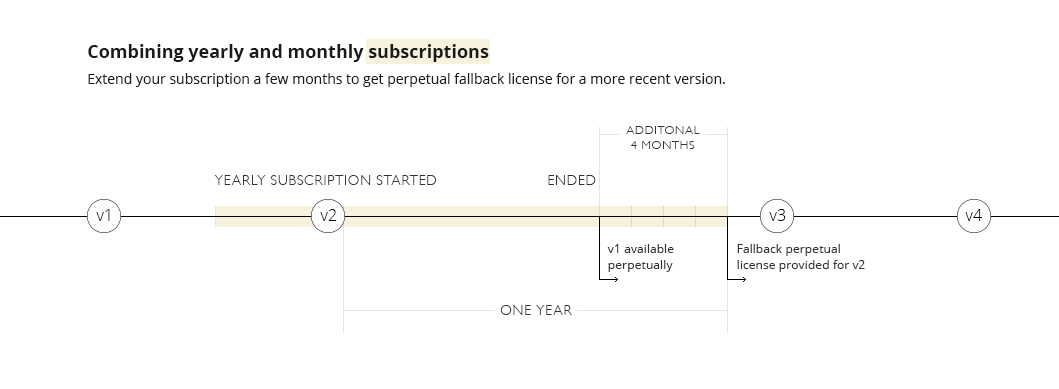
They even give you a helpful info-graphic telling you how to minimize subscription cost if you just want to get a perpetual license for a particular version:
https://sales.jetbrains.com/hc/article_attachments/203545445...
It still seems bizarre that one standard case is that you pay for a subscription, presumably using version x, and then are pushed down to version x-1 if you didn't subscribe for at least a year under version x.
At least bug fixes are included:
"The license also includes all bugfix updates, more specifically in X.Y.Z version all Z releases are included."
I can understand giving you the major version at the time you bought the subscription but it's a bit stingy to exclude minor version bumps (Y releases).
You're forced to upgrade when the language you're using upgrades. Or the ecosystem around the product evolves. The IDE doesn't live in a vacuum that will work in perpetuity.
It's realistically much closer to renting than buying as once the updates stop it's not that much longer until the product is no longer usable in a modern environment. Simple example would be if you want to use Kotlin 1.1.4 (latest stable) you must be using Intellij 2016.2 or newer to get the corresponding 1.1.4 kotlin plugin. And if you use an older plugin, the IDE will complain at you and things will be buggy and not work right. Similarly since gradle support is built into the IDE at some point that will fail if your IDE is no longer being updated.
It's not realistic to avoid updating the IDE for long. That's why Jetbrains prominently features subscription and yearly renewals - because you're very nearly forced into it.
I'm not a fan of their license change either, but calling it perpetual rent is just not correct.
It used to be there was a plugin package to allow you to use IntelliJ for C/C++ development, in addition to all the other languages. That changed, though - and they split CLion off the main branch.
So now - if for instance you want to do NodeJS robotics work, and interface to an Arduino (for example), you would need to use regular IntelliJ with the extensions for javascript, and CLion separately for C/C++ development. Essentially dinging you twice for what should be the same damn product.
It wouldn't surprise me in the least to see them split the javascript portion off into its own editor suite as well.
Atom may not be or have everything that IntelliJ does, but because it is open source, and extensible, and not controlled by a singular entity, I know that I don't have to worry about it changing like that in the future.
Don't get me wrong, though - I like IntelliJ, I think it's a great IDE (started out with PHPStorm). But I think it should have stayed general purpose and extensible, and not lock languages out to move people to another (but essentially the same) IDE. I'd have no problem paying the yearly fee - but I'm not going to pay for it twice.