I wish there was a very general purpose graph editing and visualizing tool that could be as general purpose as spreadsheets.
- Graph layout algorithms
- Graph scoring (centrality etc.)
- Variety of node types
- You can add custom node types (to a point), even use pictures of things
- Cross-platform (not open source sadly)
- Swim-lanes, grids, grouping structures
- Graphs are saved as .graphml xml
and so on. It's not perfect, I wish I could also just drop in multi-media type files and turn them into node representations.
Leo can do this.
You can 'clone' nodes into different parts of the tree.
It's a general purpose property-graph editor, backed by a CSS-like language that allows you to transform and style your graphs.
- https://docs.kumu.io/guides/views-advanced.html
(disclosure: cofounder / lead dev)
I am currently working on Solvent and one of its features is an object graph management system that can be used to construct any sort of hierarchical data structure, in particular I have started demoing in to DevOps people configuring things like Kubernetes, cloudformation..etc.
Product page: http://codesolvent.com/config-mgr/
Was going to do some polishing before I did a Show HN.
Feel free to reach out to the email in my profile if you want to talk about it.
(I wanted a nice GUI, but failed to make it)
That's a lofty claim, might want to make it more specific to thought mapping.
Other than that looks cool, will try it out when I'm home. What's the GUI framework, out of curiousity?
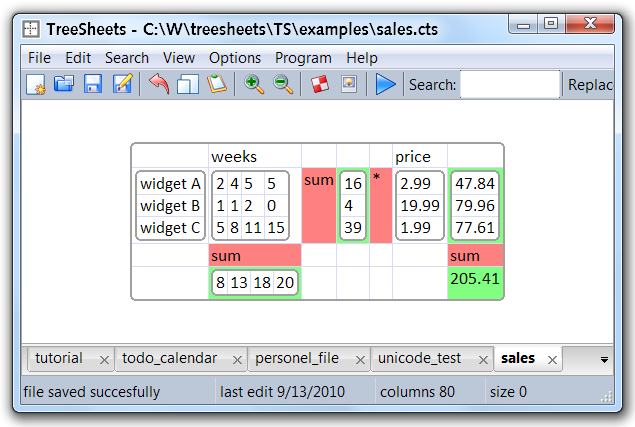
Example: http://strlen.com/treesheets/docs/images/screenshots/screens...
But yes, I must admit, that part is very unfinished.
And yes, I'm also guilty of using the tools I'm familiar with, as a predominantly C++ developer, I enjoy efficient things.
Hope the question came across constructively to you at least, it was meant to be. I think to some it read it as "why not cool trends". Should have clarified it was just curiosity about an engineering decision.
In case in matters the reason I ask is usage scenarios. Even if I take notes at my laptop 95% of the time, using a phone once in a while when an idea comes is helpful.
Currently, you can save your TreeSheets file in, say, DropBox, have it open on multiple computers, and any save will automatically reload the document on other computers (if they don't have unsaved changes, otherwise it will ask).
https://news.ycombinator.com/item?id=11247372
https://news.ycombinator.com/item?id=13578662
https://news.ycombinator.com/item?id=3394418
But hey, I don't mind the attention :)
The main code base also gained localization support since your fork :)
I've been working on similar things on and off for a long time (specifically a sort of meld between Workflowy and spreadsheets, but supporting DAGs), but it takes significant effort to reach a stage where tools are useful and reliable...
It's barely good enough to do our own work with and highly specific to the application so no, it will not be open sourced.
It's small enough that it starts really fast. Simple enough that I can write, organise, and curate what little I have to deal with quickly enough that I don't give up or get interrupted midstream. And it works on most of the platforms I use. If it were available for my iPad, I'd buy it but I can totally understand not wanting to deal the iTunes store.
One reason I'm not happy with traditional spreadsheets is that there's no non-hackish way to implement "tagging" (as in, hashtagging) a given row. You can create a "tag" column for storing "tag strings" (all the tags that have been applied to this row, delimited by say comma) and then filter by instr or some regex, but it's inconvenient.
Haven't fully checked out the features of TreeSheets yet but I imagine it would be quite suited for this purpose? Is it possible to do a search for all the rows whose 'tag' column's value includes as a member (not: contains as a substring) a particular tag?
On the downside, the built-in search is purely textual, not structural, so your example query can't be done. Structural queries would be an awesome addition though.
The Mac version is a little clunky (and yet, it's wxWidgets), but works. The file format is... probably my only concern, but there is XML export.
The file format is documented and open source, but it is binary for speed and compactness (especially since it may contain images).
For non-linear organizing on iOS, the indie app MindScope (https://www.macstories.net/reviews/mindscope-review/) is uniquely fast for brainstorming and re-factoring visual layout, before exporting an outline to another tool. A single node can be linked from more than one location in the hierarchy.
There is a large gap in software for non-linear thinking/sketching. It's not obvious for tasks that require linear thinking, like programming, but when you are trying to explore solutions in an fuzzy problem space, something along the lines of TreeSheets is certainly useful.
Will check it out.
Looks interesting, wish luck