Now that I have a 5 year old daughter and we play Lego a lot, I see the value of the sets. They teach discipline, and following the instructions is very challenging for a child, requiring quite a bit of mental modelling, spatial awareness, patience and diligence. A feeling of satisfaction when complete, and a teachable moment when you encourage them destroy the built structure and combine it with your loose brick collection for later reuse.
Great toy.
I transitioned from Lego to Knex once I got the Big Ball Factory at 11
Ship in a bottle
Woodworking projects (especially involving measuring, proportion, etc.)
Journaling
I Hate Mathematics Book by Marilyn Burns
Stolen Sharpie Revolution by Alex Wrekk (and other books on creating Zines)
Problem solving/lateral thinking books.
I would have suggested Make Magazine but its a lot of digital now. Instructables book is good though.
Old (70s and earlier) popular mechanics popular sciene and science and mechanics magazines. Older Scientific American magazines too
Balanced ternary could be a real fun starting point-- getting negative numbers involved asap surely has some great benefits. I think if balanced ternary was exposed to children more often at an early age we'd have a lot of these new fangled type level numbers being balanced ternary. I was playing around with implementing such in Rust: https://github.com/serprex/lambdaski/blob/master/src/typenum...
Binary comes off as particularly weak when type systems are still resolving lambda terms / prolog logic as associative maps & trees. http://repository.readscheme.org/ftp/papers/topps/D-456.pdf benchmarks 5 as being an ideal radix perfwise, but that does seem implementation dependent
My father wrote a song reflecting on our digital world: https://drive.google.com/file/d/0Bw-au4sqKD2gWVJqOGFzSEVoakx... Stay strong & good luck
1) Prime Climb https://www.amazon.com/Math-for-Love-Prime-Climb/dp/B00PG959...
2) Tiny Polka Dots https://www.amazon.com/Math-For-Love-Tiny-Polka/dp/B01N1UUHP...
- Tiny Polka Dots might seem too basic, but counting is this complex topic that we forget because, well, we know how to count. Lots of downstream advantages of having the kind of secure understanding a kid can get from understanding counting inside and out. Tiny Polka Dots can help.
We have Qwirkle and City of Zombies in the classroom. I hate them :) mainly because I am rubbish at them.
  Tanagram
  Frisbee
  Bike
  Prism
Magnifying glassTangrams are amazing, I would recommend presenting the silhouettes in varying sizes and at the other end of a room - makes it more fiendish.
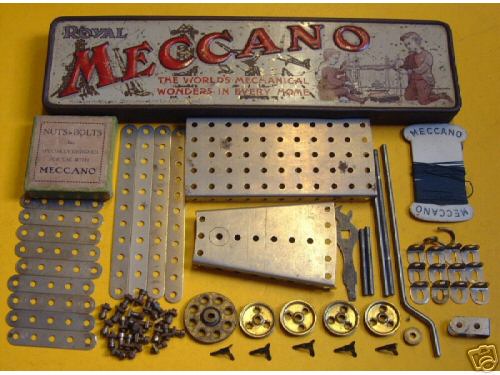
6 might be a bit on the younger side for it, but 10 definitely not. You learn to use a screwdriver and screws and basic mechanics. You can go all the way to elaborate designs.
It's a timeless toy, my father already played with it (looked like this back then: http://www.dalefield.com/nzfmm/slap/RoyalMeccano.JPG ) and so did I. Heck, even an adult can use these, I once made a distillery platform with height-adjustable burner with these. Really nice to slap together sturdy prototypes.
EDIT: Now that I'm looking at modern MECCANO, I feel like they have diverted too much from the original path. I'd rather have the basic old metal kit in the second image than a fancy MECCANO car consisting of oddly shaped plastic pieces.
Yes, a 6yo can learn to use a saw, just make sure it is sized accordingly and has small teeth - both because they are easier to use as well as less likely to cause injury.
We had some aerated concrete brick left after rebuilding our bathroom and my son (4yo at the time) "crafted" them with tools like saw or nails and screws. He really enjoyed that.
It stressed a lot his grandfather, to see his grandson with sharp tools, but the boy was very proud of his work.
Literature: A membership in the local library was enough for me.
Problem Solving: Chess and related board games; any kind of puzzles - I loved metal puzzles where I had to separate/join pieces (e.g. those found here[2] - not endorsing the shop, just the first hit on DDG).
[0] https://youtu.be/2zvjW9arAZ0 [1] www.improviseforreal.com
Card games like Rook, Spades, Cribbage (mentioned elsewhere), Casino are great for math and pattern matching, planning ahead. These just require a standard deck of playing cards, maybe two (habit from playing Bridge, have one deck in play and one shuffled and ready for the next hand).
24 Game was a good one for arithmetic (4 numbers, put any of +, -, *, / between them and try to get the result to be 24).
Mastermind is another good strategy, logic type game. It can also be played with pencil and paper which makes it a very fun one to teach kids so they can play it anywhere.
Dots and Boxes is a nice abstract strategy game to play on paper, which can serve as a good gateway to other abstract strategy games.
Guess Who was a good game of logical deduction. Shades of 20 Questions where you ask for features of the person and mark off people who don't qualify. Clue, of course, is strictly a game of logical deduction if you can get past the movement mechanics and all (always frustrated me to get low dice rolls and not have a chance to win even when I knew or was very close to the answer). From Clue, books of logic puzzles that practice deductive reasoning from a set of facts (along the lines of Einstein's puzzle).
Others mentioned RPGs, these can be good with kids. Particularly if you focus the emphasis on teamwork (discourage showboating and hogging the limelight), storytelling (goes back to vocabulary, but also thinking about complex situations), planning and strategy. You can incorporate lots of puzzles into the game that emphasize wordplay (riddles and such) or math (numeric puzzles) or logic (colors, connecting their actions with specific effects) or just general problem solving.
https://amzn.com/B00HN2BXUY $21.89
(originally a Kickstarter)
Same goes for puzzle games - Sudoku, or even those little golf tee + peg board games you see at like cracker barrel. Simple but educational and they exercise the brain.
As others have said, Legos and similar toys teach spatial reasoning and similar skills as well.
If you are looking for toys that teach a specific skill (eg algebra) that is likely trickier to find.
A compelling way to introduce children to laws of nature. You can see him sharing his philosophy here: https://www.youtube.com/watch?v=YOllmFfELT8
Also the games by thinkfun.com (Rush Hour etc) are very good
Cribbage is a nice blend of strategy, applied math and pattern matching. I plan to teach my 17 month old daughter cribbage as soon as I can.
As kids we loved it, and then, even in college we still used it in our robotics projects :)
Kapla Blocks (building) https://www.amazon.com/CitiBlocs-200-Piece-Natural-Colored-B...
Dominos for Toppling (lots of tutorials online to do amazing runs) https://bulkdominoes.com/collections/all
Wooden Blocks https://www.amazon.com/ECR4Kids-Hardwood-Building-Storage-48...
If you don't have a hard smooth floor pick up a sheet of plexiglass for dominos and kapala blocks.
Legos, get a variety of sets, encourage mixing and building your own creations.
Board Games
---------------------
Catan Junior Settlers of Catan
Ticket to Ride
Blockus
Scrabble (deluxe with plastic grid)
Chess
Stratego (Original General is 1)
Uno Card Game.
----------------------------
Snap Circuits (Electricity Projects)
----------------------------
Do science night where parents use a white board to teach how things work, let them ask questions/explain things they know.
----------------------------
Lego Mindstorms is good too, but they would need to be on a screen some for this.
A Pound of dice: https://www.amazon.com/Wiz-Dice-Pack-Random-Polyhedral/dp/B0... (I'd be keen to know if there's dice at a similar price in the UK)
You can then play something like Button Men (which could easily be rethemed to "Pokemon battle") https://en.wikipedia.org/wiki/Button_Men
Pretty much anything you throw at them will teach them something.
The question is, what do you want them to learn?
Reading of course.