>Based on 16 months' worth of measurements, it calculated Planck's constant to be 6.626069934 x 10⁻³⁴ kg∙m2/s.
We rearrange the approximation: h = 6.626069934 x 10⁻³⁴ kg∙m2/s to solve for kg and thus have our definition in terms of h?
Under the new system, Planck's constant would be defined to be exactly 6.626070040e−34 kg.m^2.s^-1, with no error bars, and the prototype would no longer be exactly 1 kg. If we refine our estimate for the physical value of Planck's constant, its numerical value of 6.626070040e−34 kg.m^2.s^-1 would not change, but the numerical value for everything's mass would.
This definition of 1 kg requires we first define 1 m and 1 s, but there are already good definitions for these quantities based on fundamental physical properties (namely, the speed of light and the frequency of the transition between the two hyperfine levels of ground state of the caesium-133 atom).
I.e., if you know how to measure a second, you could define the meter based on the speed of light by creating light in a vacuum and timing it.
Meanwhile, you can't define a meter or a second in terms of pi, because it has no units. It's just a ratio of the surface area of certain classes of object or shape to thheir dimensions.
[0] https://en.wikipedia.org/wiki/SI_base_unit#Seven_SI_base_uni...
[1] https://en.wikipedia.org/wiki/Proposed_redefinition_of_SI_ba...
Now to Google to figure out what the heck you just said...:)
Although, it makes sense politically
Also, anything physical will shed atoms, which will affect the mass.
https://www.wired.com/2013/01/keeping-kilogram-constant/
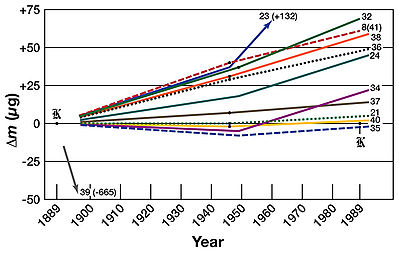
> Cumpson suspects that because the kilos living in national labs have been retrieved and handled more frequently than the international kilo, more carbon-containing contaminants have built up on them over time.
Most people can continue to depend on prototypes for calibration, so it does not cost us any complexity in that respect. What we're gaining is to be able to independently re-calibrate multiple prototypes.
A better kilogram might not have a practical use right away, but it might in the future, if for instance we want to do things like look for time dependent variations in the physical constants, tiny departures from existing theories of mechanics, etc.
Would it have been possible to define it as the weight of N amount of electrons (assuming all electrons have the exact same weight under all circumstances) or another fundamental particle?
EDIT: it would be the weight of 9.10938356e31 electrons at rest
>For electrons or electron holes in a solid, the effective mass is usually stated in units of the rest mass of an electron, me (9.11×10⁻³¹ kg). In these units it is usually in the range 0.01 to 10, but can also be lower or higher—for example, reaching 1,000 in exotic heavy fermion materials, or anywhere from zero to infinity (depending on definition) in graphene. <
Can we stop this nonsense? It would be a big problem if it were true, but it isn't. It's the later (contamination weight gain) and we have fairly good understanding of what's going on. For example, see https://phys.org/news/2013-01-kilogram-weight.html
Of course, what's probably happened is that our measuring tools have gotten more accurate!
https://www.nist.gov/physical-measurement-laboratory/silicon...
What's really need though is a universal, stable over eons, single standard for time, length, and mass. I believe time is N cycles of an excited sodium (light) emission. Length is N wavelengths of that same emission in a vacuum. Mass would be N atoms.
So why are they not using a single element to define everything? Is it a matter of finding the proper element that is easy to excite and stable enough (chemically and atomically) over the long term? Sodium is very reactive and easy to excite. Silicon is probably the opposite.
Turns out they know that :-)
The problem isn't definition, its the accuracy of reproducibility. You need a mechanism that can be built from scratch and can be believed to produce identical results. You can pull that off counting wavelengths of an unknown number of a known pure atom. Counting actual numbers of atoms is quite difficult. Typically we do it statistically...via mass! We could get it precisely by using a small number, but then actually measuring the mass (rather than calculating it) would be difficult.
What is the problem that would be solved by switching to a single element?
https://upload.wikimedia.org/wikipedia/commons/thumb/c/c9/Pr...
http://www.bipm.org/en/bipm/mass/ipk/ (verifications tab)
I don't quite understand this, as they could've defined it to be the mass of one cubic centimetre of water, rather than a cubic decimetre of water. Or they could've said that the unit is gram, and 1 g is 1/1000 of the mass of this artefact.
I've also read stories that revolutionaries objected to the name "grave", as it is close to Grave (French), Graf (German), that is, the title of nobility (anathema for the Republicans of the French Revolution). Thus, instead of 1 grave we have 1 kilogram.
At any rate, it was all rather messy and political, as the delightful book Whatever Happened to the Metric System?: How America Kept Its Feet by John Bemelmans Marciano recounts.
See also precisely this question at Physics StackExchange:
https://physics.stackexchange.com/questions/64562/why-metric...
...except actually it's the International Committee for Weights and Measures.
However I will help you retain your justifiable sense of ironic superiority: the US is one of the 17 original signatories to the metre convention (in May 1875: http://www.bipm.org/en/about-us/member-states/original_seven...). Also all the US conventional units have been based on the SI metre and kilogramme since 1959. And of course the metric system is familiar to any American in the military and/or who uses illegal drugs.
Although its not part of the BIPM, my favorite such standards organization is the International Earth Rotation Service (justified paying my taxes -- what if they stopped???). Sadly they recently renamed themselves "International Earth Rotation and Reference Systems Service"
Apropos of little: I used to live quite close (a couple of hundred metres) to an official metre, as there is one on the wall across the street from the French Senate. When the system was originally promulgated, markers were erected around France; you could bring something (piece of string or whatnot) and make your "own" metre to bring home and measure things. There are two or three of them still extant.
> So in 2014, at the quadrennial General Conference on Weights and Measures (yep, that's a thing), the scientific community resolved to redefine the kilogram based on Planck's constant, a value from quantum mechanics that describes the packets energy comes in. If physicists could get a good enough measure of Planck's constant, the committee would calculate a kilogram from that value.
> “But it's a very difficult constant to measure,” Pratt said. He would know: He and his colleagues at NIST have spent much of the past few years trying to come up with a number accurate and precise enough to please the finicky physics community.
Basically, it was hard to measure Planck's constant precisely enough to be as precise as the old standard. For compatibility reasons, the way this usually works is that they will measure Planck's constant and then define the kilogram so that `(k * Planck's constant) = (old mass of the kilogram)`, where `k` is whatever constant that makes this work out. To do this properly, you need to be able to measure Planck's constant with the same level of precision (and accuracy) as the old mass of the kilogram was known. Apparently this wasn't easy, presumably because Planck's constant is very small.
https://youtu.be/JKHUaNAxsTg?t=591
The other parts are a bit "woo" and I'm sure would be laughed at by the HN crowd. But his points about fundamental "constants" changing, and the metrologists' dogmatic (really, anti-scientific) response, are worth pondering.
> Sheldrake's morphic resonance hypothesis posits that "memory is inherent in nature" and that "natural systems, such as termite colonies, or pigeons, or orchid plants, or insulin molecules, inherit a collective memory from all previous things of their kind" ... Sheldrake proposes that it is also responsible for "telepathy-type interconnections between organisms". His advocacy of the idea encompasses paranormal subjects such as precognition, telepathy and the psychic staring effect as well as unconventional explanations of standard subjects in biology such as development, inheritance, and memory.
The reason his TED talk was pulled is because he's a crank, and the entire talk is a confused defense of pure BS.
>The weights and measures committee will meet this month to establish a global value for Planck's constant by averaging the values calculated at NIST and other labs. And in 2018, at the next General Conference on Weights and Measures, the scientific community will draft a resolution to redefine kilogram based on this constant.
Looks like the current title "NIST to redefine the kilogram based on a fundamental universal constant" is confusing because it implies that NIST defines kilogram but it's International Committee's for Weights and Measures job.