> Interest in the potential exploitation of polymetallic nodules generated a great deal of activity among prospective mining consortia in the 1960s and 1970s. Almost half a billion dollars was invested in identifying potential deposits and in research and development of technology for mining and processing nodules.
And in a few cases they actually succeeded in extracting some metals:
> In the late-seventies, two of the international joint ventures succeeded in collecting several hundred ton quantities of manganese nodules from the abyssal plains (18,000 feet, 5.5 km + depth) of the eastern equatorial Pacific Ocean. Significant quantities of nickel (the primary target) as well as copper and cobalt were subsequently extracted from this "ore" using both pyrometallurgical and hydrometallurgical methods.
A lot of R&D money was sunk into this before it even had a hope of commercially viable (and it still isn't to this day), but it wasn't a hoax either.
[1] https://en.wikipedia.org/wiki/Manganese_nodule#Proposed_Mini...
Were the authors that were listed on these papers CIA employees with a fake cover job, or just completely made-up names?
Source?
With everything stemming from one big organization, the question is never if the government did it, but which government agents are the ranking officials responsible, and what are they up to?
When you have a non-totalitarian government, where officials are lesser celebrities if at all, and maybe such a government that acts as a referee for the rest of its citizens, the way it behaves gets weirder, and less predictable.
It then had a second life 25 years later as the hanger for the Sea Shadow. Then they were both put in mothballs in the Suisan Bay fleet. Someone broke in and photographed it.
http://scotthaefner.com/beyond/mothball-fleet-ghost-ships/
The Sea Shadow was sold for scrap to Bay Marine for something $2.5M. But Bay Marine got to keep the HMB and that's what's on the Estuary.
http://www.dailymail.co.uk/news/article-2185831/Declassified...
https://en.wikipedia.org/wiki/Hughes_Mining_Barge
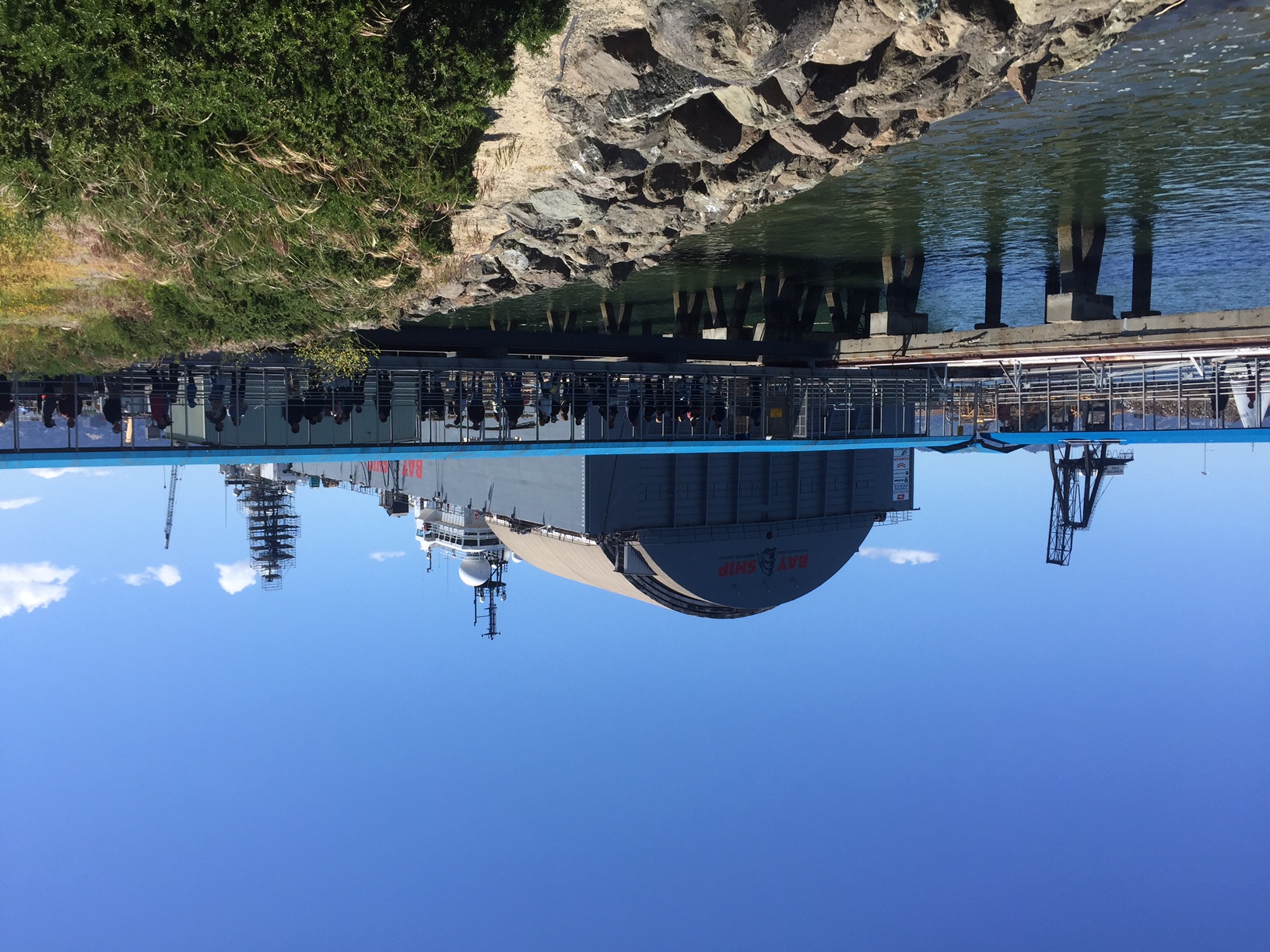
It's docked at Bay and Ship right next to the ferry terminal on Alameda. Here's a picture I took of it [1].
If you're in the Bay Area, it's probably not worth making the trip out there for just the ship, but it's neat to walk around the old naval base close to there, and I'd recommend a stop off at Rock Wall Wine Company along Monarch St. There's a spacious outdoor area with a very unique perspective of downtown San Francisco.
Anyways, this is a Google Maps satellite photo.
https://www.google.com/maps/@37.7912901,-122.2931087,173m/da...
The HMB is now used as a floating dry dock which was its original purpose.
https://web.archive.org/web/20131224162647/http://www.bay-sh...
I remember reading the Sea Shadow itself went for $400,000 and yeah, you had to break it. You pay $400,000 to ship break a 572 ton boat; at $.20/lb that isn't gonna work. I suppose that only makes sense if you get the HMB-1 for a decent price and you can use it. Apparently that was the case for Bay Ship.
Setting aside the fact it's a complete tragedy that no one has picked these two vessels up as museum pieces, I wonder how radioactive those Pepsi cans would be—considering the entire point of the operation was to raise a nuclear submarine, carrying nuclear weapons—one that supposedly broke in half according to the official story.
I'm sure contaminated areas (if any) were decontaminated, but perhaps there's still trace amounts resident in the ship that might tell an interesting story.
When it was sold for scrap, it went really really cheap. Like $100,000 I was tempted to put a bid on it until I learned I would be contractually obligated to destroy it.
The Sas Shadow was sold for scrap.