> But he cautioned Jobs never to forget that the money was just a vehicle for creating things. "But he forgot," Wayne says now. "He probably won't like me for saying this, but I think he got caught up in the business of business. He became so enamored with succeeding at this stuff that he began doing it for the sake of itself. He began making money for the sake of making money. What can somebody do with $200 million that they can't do with $100 million?"
That's loser talk. That's fully not getting it. Jobs isn't in it for the money at this point, he is doing things that matter to him, he's got a team of crazy-bright designers and engineers and he's pushing the world forwards. I'm actually much less of an Apple fan than most people, I think the Apple's got a lot more hype and sizzle than steak, but you do have to hand it to them for what they've done.
And Jobs himself? Forced out of Apple. Builds up Pixar. I mean, Pixar! There's a happiness-spreading company right there, maybe even more than Apple. Then Apple gets into trouble, and Jobs goes and digs through the ruins and builds this amazing company.
So typical loser thinking goes, "Oh yeah, well, maybe he's got hundreds of millions, but he lost focus! Yeah, that's it, he's not doing things that really matter!" Like playing penny slot machines?
Never fall into that trap. If you catch yourself making a loser statement about how much someone else has, stop yourself and be gracious. Not for the builder's sake, but for your own.
Money is not the only measure of success but it is one of the measures. It allows you the freedom to see your visions through. If your vision is to have a nice house and family then you can be truly successful with little money, just enough to fulfill your needs. If you have a vision to change the world of computing then yes, there are things that you can do with 200 million that you can't do with 100 million.
Also, before Pixar he founded NeXT, absolutely breakthrough stuff, though not a big commercial success:
http://online.wsj.com/article_email/SB116863379291775523-lMy...
Google, Apple, Microsoft, etc. should pool some money and fund some sort of Social Security for aging hackers.
I wont discuss him further out of respect to him, but stuff happens, even to people with "jobs".
Uh... no.
Second, it confuses me that this guy is living off Social Security.
"After Apple, he spent two years creating the model shop at Lawrence Livermore National Laboratory, then was chief engineer at Thor Electronics in Salinas for 16 years. He holds a dozen patents, but he has never had the money to develop them into products."
Being a chief anything for 16 years in the Valley, I would think should let you sock enough away for a comfortable retirement, even investing conservatively. I suspect this guy is just bad at managing money all around, which he pretty much admits.
"I don't know why, it just never happened. It's probably because I'm not the businessman I should be."
As for your own choice - go for it - you can't win if you ain't in the game.
I actually have a lot of respect for anybody who could find peace after that.
What's their rationale for forming a partnership and not incorporating right away as a means of protecting personal assets? Was the official / lawyering process radically different (i.e. terribly expensive) back then?
But I think you can't abstract away the particulars. I'm sure it didn't occur to the Steves to spend money to protect their assets, because they didn't have any. Assets or money, that is. And this fellow Ron could have done so, but perhaps it didn't occur to him because he was too busy burying gold nuggets in his backyard and cleaning his weapons collection.
The early history of Apple is such a fun story. I now have this awesome vision of the Apple cofounders as the bowling team from The Big Lebowski.
I wonder why Jobs or Woz never gifted a tiny fraction of their shares in Apple at a later point to Wayne, as a token of appreciation (if tiny). It would have been a nice gesture.
everyone wants to be charitable with someone else's money...
Not really. Merely telling the story of a survivor isn't survivorship bias; the bias would be extrapolating from this story to believe that his situation is common.
Fair enough, but I am going to regret it for him. 22 billion dollars. That's twice as much as eleventy billion!
http://www.digibarn.com/history/06-11-4-VCF9-Apple30/images/...
Number 9 in http://freebsd.zaks.com/news/msg-1151459306-41182-0/
He was terrified of creditors, of debt, of risk - in other words of all the things that great entrepreneurs embrace and manage.
He was 42 and living with his mother at the time.
His role was to be the "problem solver" between Woz & Jobs.
He was to be the "respected adult" and provide guidance.
What if he'd blocked the development of the macintosh platform?
What if he'd blocked jobs from coming back?
Just useless after-lunch daydreaming, but my point is this guy looks more like a bullet Apple dodged, than a sure fire loser of billions . . .
http://www.foundersatwork.com/steve-wozniak.html
Livingston: What about Ron Wayne? Wasn't he wasn't one of the founders?
Wozniak: Yes, but not when we incorporated as a real company. We had two phases. One was as a partnership with Steve Jobs for the Apple I and then for the Apple II, we became a corporation, Apple Computer Incorporated.
Steve knew Ron at Atari and liked him. Ron was a super conservative guy. I didn't know anything about politics of any sort; I avoided it. But he had read all these right-wing books like "None Dare Call it Treason" and he could rattle the stuff off. I didn't realize it until later.
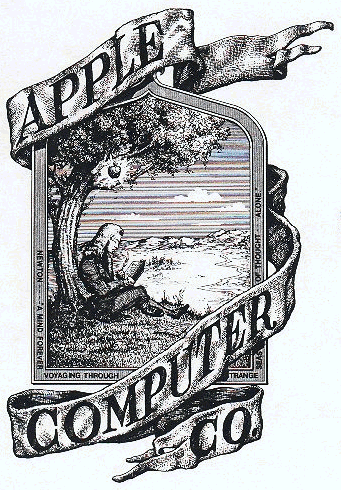
He had instant answers to everything. He had experience with businesses and times he'd been gypped out of stock deals. He always had something very quick to say and, wow, it sounded like he was very knowledgeable about this stuff. He sat down at a typewriter and typed our partnership contract right out of his head using lawyer type words. I just thought, "How do you know what to say, all rights and privileges and all the different words that are in there"—I don't even know what they are. He did an etching of Newton under the apple tree for the cover of our Apple I manual. He wrote the manual. So he helped in a number of ways. Steve had 45% of this partnership, I had 45%, and Ron had 10% because both of us agreed that we could trust him to resolve any dispute, and we would trust his judgment.
Then what happened was that we were going to sell PC boards for $20 each and fund it out of our own pockets. I sold my HP calculator, Steve sold his van, so we had a few hundred bucks each. Then Steve got the $50,000 order. Over at the company that was making our PC board, as soon as the PC boards were made, they opened up a closet that had our parts and it started a 30-day clock ticking. We had 30 days to pay for the parts. The parts got stuffed into the computers, we made them work, we delivered them to the store and got paid in cash. The parts suppliers—the distributors in Mountain View—had checked with the store owner and knew that he was going to pay us. So basically, we didn't have the credit; he was good for it. But, here was the problem: What if he didn't accept them one time or didn't pay us? We would owe a ton of money on those chips.
I had no money and Steve had no money. We didn't own cars, we didn't have savings accounts, we didn't have houses. So Ron Wayne figured they'd come after him for his golden nuggets that he kept under his mattress. (He actually tells me it was in a safe—but he was afraid they'd come and get his gold.) So he sold out. It was too risky for him, so he sold out his 10% of Apple to us for a few hundred bucks. Maybe $600, maybe $800, maybe $300, but a few hundred bucks. And this was even when we had an Apple II designed and were heading toward future business. He was just scared that something was going to catch him.
Maybe he's right. If you're the type to worry - and everyone has that to some extent - it is very stressful.
I think you need to get to the point where it's in the lap of the gods; you just do your thing and the outcome does its thing. I am a leaf on the wind Doesn't Steve Jobs have some non-attachment/buddhist/meditation thing? Like he doesn't have any furniture (or didn't at one point).
I saw a story recently of a guy released from jail after some 20 years of wrongful incarceration, and his attitude was so amazing. Wayne reminds me of that. We can learn a lot from both - they both make me feel so petty.
Ron Wayne's conservative disposition probably helped him a great deal up to the point of selling out of Apple, but counted against him subsequently. None of us can know the future, and we can only rely upon previous experience to estimate the possible outcomes which a decision might have.