You seem to be thinking of cell tower triangulation, not GPS. I do agree that GPS also does not do particularly well in areas with large buildings: it needs a clear view of the sky which can be hard to come by when there's skyscrapers everywhere.
What does "old" have to do with it? Modern code is all like that too. Every time I complain about it, including just a day or two right here on HN, I get a bunch of responses saying "I don't need comments, my code is self-documenting". In my experience, most programmers do not use comments much at all, and it's entirely incomprehensible to anyone new to the project.
Dead reckoning using just acceleration data loses accuracy quickly. Using turns to reset position is a really good idea. I think I've seen my iPhone do a similar "recovery" procedure when it gets a little off track.
http://corporate.tomtom.com/releasedetail.cfm?releaseid=3185...
Best navigation with Enhanced Positioning Technology
TomTom’s new Enhanced Positioning Technology uses movement and gravity sensors to calculate drivers’ positions when GPS signals are unavailable.
TomTom GO 920 T users will have a much more continuous navigation experience as the Enhanced Positioning Technology ensures the device continues to navigate to its destination, even in circumstances where there may not be a direct line-of-sight connection to a satellite. For example, when driving in a city with tall buildings, underpasses or bridges.
http://www.pocketgpsworld.com/tomtom-go-930-review-a1042.php
As you drive along you will often encounter places where the Satellite signal is blocked such as tunnels and underground parking lots. TomTom has introduced a system called EPT (Enhanced Position Technology) to keep track of your position using accelerometers. This is not as accurate as GPS but will help guide you in places like Boston where the Big Dig has created a network of underground roads.
https://en.wikipedia.org/wiki/TomTom#Enhanced_Positioning
2008: Enhanced Positioning
TomTom released the GO x30 range in April 2008 based on NavCore 8. New features included IQ Routes, which estimated journey times based on average recorded speeds, rather than speed limits, and Advanced Lane Guidance, an on-screen representation of the correct lane to take. The 930, like the x20, had Enhanced Positioning Technology. GSM HD Traffic receivers, plugging into the car's cigarette lighter, added HD Traffic to the GO range.
Refreshed ONE and XL models were released in May 2008, still based on NavCore 7, with an improved speaker.
NavCore 8 updates for NavCore 7 devices, including the ONE v3 and v4, were released in June 2008, giving x20 users (only) IQ Routes and Advanced Lane Guidance, with the purchase of new maps.
This happens too often for benign reasons (and GPS hacking too rare) for it to be useful. The GPS system in my Ford Focus jumps around wildly if I start the car in an enclosed space before it gets a good lock, and it can be thrown-off under bridges and around tall buildings as it doesn't have A-GPS (does any car have A-GPS?). The worst is when a poor signal is combined with road-snapping - I've had a lot of trouble with off-ramps on partially submerged urban highways, the I-5 in downtown Seattle, for example.
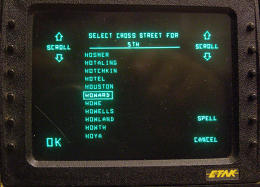
The original Etak units always had the map oriented with north at the top. That was the way sailors used maps. Honey said they'd discovered that about 20% of the population could not cope with a map that wasn't aligned with the direction they were going, which is why they started rotating the map based on vehicle travel. Now everybody does that, and that's why.
That's me. I have a tough time orienting maps in my head. I still use a mnemonic for compass directions and (occasionally) use my left hand as an L to make sure I'm not screwing it up.
I don't know if there is any research into what the structural differences of brains that suffer from this might be, let alone if there is a name for it.
    > I don't know if there is any research into [needing to
    > reorient maps when driving].
There's a really good description of this and other brain attributes correlated with gender or male homosexuality in the BBC show "The Making of Me - John Barrowman". This specific part starts around 6m30s in: http://www.dailymotion.com/video/x6a063_the-making-of-me-joh...
Here's an article about it in New Scientist, "Gay men read maps like women": https://www.newscientist.com/article/dn7069-gay-men-read-map...
That's not to suggest that you're either a homosexual man or a heterosexual woman based on this datapoint alone. There's of course plenty of people who don't fall into those groups who prefer to read maps that way, just to answer your question about whether there's research about it. Yeah, there's at least some research showing that spatial recognition is indicative of gender & sexual orientation.
The additional cognitive load is worth it for me.
Every once in awhile (maybe a couple times a month) I'll have this sort of experience (though not as dramatic) where everything is a mirror image. I expect a store to be on the opposite side of the street for example, and it's momentarily disorienting. I've learned to not rely on my intuition when navigating.
I am the opposite, I cannot deal with a map that does not have north on top and it's constantly moving. Modern mapping software sometimes makes it frustratingly hard to keep north on top.
I guess, we should all play DnD and Dungeon Crawling every once in a while.
"the system continuously ironed out accumulated errors over time by comparing actual distances driven and turns made with road shapes on the map. Honey calls the technique "augmented dead reckoning."
That means driving through a long stretch of straight highway could begin to trip up Etak's system, since there were no turns and no distinct roads for the computer to algorithmically seize upon. If that happened, the driver could manually reposition the car cursor onto a location on the map using controls on the display."
Those things work, but they are barely "good enough". The biggest problem is, it is easy to lose your position if you are in the city -- maybe you had a few sharp turns, went around the parking cars a couple of times. And once this happens, the system is unlikely to correct itself, your only way will be to manually set position, which most people will not do.
You could actually see it in use if you used older GPS units -- back in SA time, the GPS was low precision (~100 meters), but still provided mostly accurate heading/velocitry information. Thus, many GPS navigators required mapmatching (see other thread for details). It would always fail on me in the most annoying moments, and would take quite a while to recover.
To this day though, when I pilot starts up an airliner, they fire up that old system as a backup, its programed down to the gates at the airports, so they set their departure gate and as soon as they start moving, it tracks, through gyros, the whole flight. There can be a lot of drift in the system though, which is what lead to KAL007 being shot down by the soviets, killing almost 300 and prompting Reagan to declassify GPS to prevent that same kind of thing from happening again...
"According to the ICAO, the autopilot was not operating in the INS mode either because the crew did not switch the autopilot to the INS mode (shortly after Cairn Mountain), or they did select the INS mode, but the computer did not transition from INERTIAL NAVIGATION ARMED to INS mode because the aircraft had already deviated off track by more than the 7.5 nautical miles (13.9 km) tolerance permitted by the inertial navigation computer. Whatever the reason, the autopilot remained in the HEADING mode, and the problem was not detected by the crew."
https://en.wikipedia.org/wiki/Inertial_navigation_system
I work in aviation and it's still used as a fallback and to compare radio-based equipment with in some cases. Full GPS transitions in aviation are still just getting off the ground in most places.
https://b.fastcompany.net/multisite_files/fastcompany/imagec...
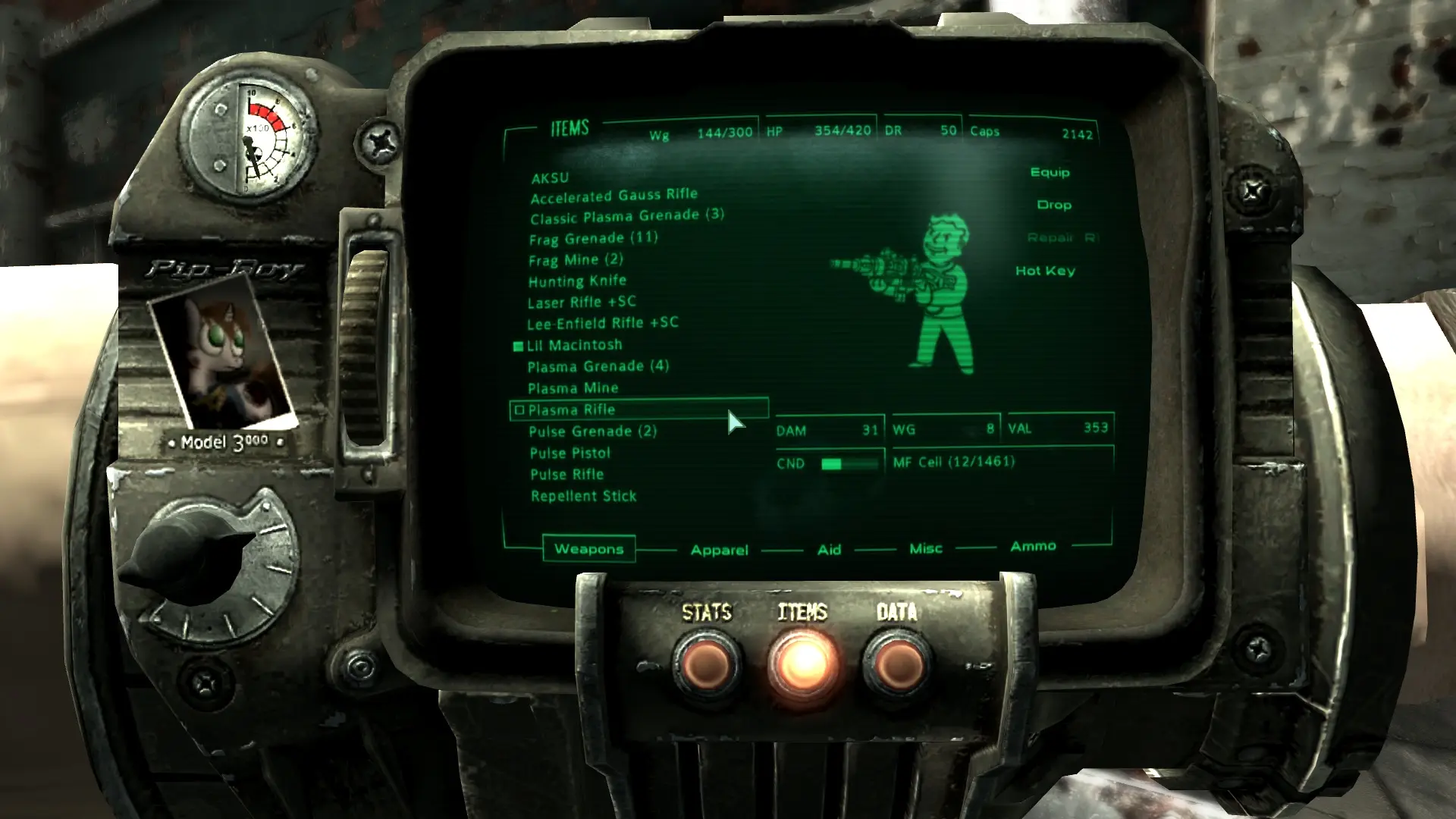
And a Fallout Pip Boy for reference: https://staticdelivery.nexusmods.com/mods/120/images/16096-1...
http://world.honda.com/history/challenge/1981navigationsyste...
The story of how TomTom and not Garmin ended up owning the data originally digitized at Etak is interesting. At the time, there were only two digital map companies: Tele Atlas (from which TomTom got their map data) and Navteq (from which Garmin got their map data).
From Wikipedia [1]:
"On July 23, 2007, a €2 billion offer for the company by navigation system maker TomTom was accepted by the Tele Atlas board. This was then trumped by a €2.3 billion offer from United States-based rival Garmin on October 31, 2007 initiating a bidding war for Tele Atlas. TomTom responded by upping their bid to €2.9 billion, an offer which was again approved by the board of Tele Atlas. Garmin had been expected to counterbid once again: with Tele Atlas' main global rival Navteq subject to a takeover bid from Nokia, the company had stated that it did not wish both companies to fall into the hands of rivals. However, after striking a content agreement with Navteq through the year 2015, Garmin withdrew its takeover offer, clearing the way for TomTom. On December 4, 2007, TomTom shareholders approved the takeover. The European Commissioner for Competition cleared the takeover in May 2008, and it closed in June."
TomTom (where I worked at the time) was shocked and dismayed that Garmin outbid them by €300 million on Tele Atlas, because while it made a lot of sense for TomTom to buy their own map data supplier, it would have been prohibitively complex and expensive for Garmin, who used Navteq data, to switch map data sources and retool their entire map data digestion, distribution and error correction pipelines.
TomTom was so determined to buy Tele Atlas and keep it out of Garmin's hands, that they raised their bid by €900 million.
In the meantime, Garmin renegotiated their deal with Navteq, so they didn't have to pay as much for the data, and didn't have to switch map suppliers.
The stunt that Garmin pulled of was, in my opinion, an ingenious head-fake that cost TomTom an enormous amount of money, almost a billion euros, and at the same time saved Garmin a whole lot of money by enabling them to renegotiate a better deal with Navteq, who was faced with losing their major customer if they didn't lower their prices.
He's won the Jules Verne trophy as navigator, fastest round the world (48 days). He's won the Volvo. PacCup with Nolan Bushnell. Rolex Yachtsman of the year (his wife Sally has won twice). He did the NFL line effects, same for NASCAR and NHL. He did the Americas Cup effects. He did Sailmail. Multiple patents.
And he's an incredibly nice guy. Dennis Connor is the best American yachtsman, but Honey ain't far behind.
Picture driving a snow plow in the California sierras in whiteout conditions. On one side of you is a steep cliff with no guard rails (not that guard rails would - the snow is higher than the rails).
So, they embedded magnets in the road that had data in them (the way they were organized):
> Two primary technologies are being used in the ASP: detecting the plow's position relative to the center of the lane, to assist the operator in steering; and detecting obstacles, for collision warning. PATH's magnetic marker guidance system provides guidance information. This system was developed for automated vehicle guidance and control applications. A single magnetometer array comprised of seven magnetic sensors was installed at the front of the snowplow. Signal processing of the magnetometers provides lateral position measurement relative to the center of the lane, longitudinal position relative to mileposts, and yaw angle estimate. Binary coding of the magnetic markers when installed (north pole up vs. south pole up) also provides information about roadway characteristics, e.g. the direction and radius of the curves. The obstacle detection system uses a commercially available Eaton-Vorad radar, incorporating a digital interface developed by AHMCT in conjunction with Eaton Vorad.
Ah yes, the Polynesian stick charts:
If anyone has any up to date information or papers on this approach, I'd be very interested.
(It seems to be also known as a quantum compass)
I truly believe he is as much a visionary as Steve Jobs ever was, the difference being that Jobs had the patience to wait for technology to catch up to his vision, whereas Bushnell did his level best to invent it.